
Livraison le jour même ou le lendemain

Qualité garantie

Débloquez vos offres de bienvenue: Livraison GRATUITE | Jusqu'à -80 % | 30 jours d'essai gratuits à JoyPlus
Téléchargez l'application
A dead battery on a cold morning, a flat tyre far from any service station... these are the nightmares every driver dreads. The jump starter with an air compressor has emerged as the all-in-one solution for handling these unexpected problems. The issue? The market is saturated with marketing promises that often lead to disappointing purchases. To help you cut through the noise, we've broken down the pitfalls to avoid and the real performance criteria to look for before you buy.
On the surface, all models look alike. In reality, their performance varies dramatically. Here are the three key issues to understand so you don't regret your investment.
To choose a truly reliable device, you need to read between the lines of the spec sheets and focus on a few key data points.
The peak current, expressed in amps (A), is the number one criterion. It must be suitable for your vehicle's engine size and type.
The reliability of your jump starter depends entirely on its internal battery. Its technology determines its lifespan and, most importantly, its ability to remain operational.
For an electric tyre inflator that won't test your patience, two values matter:
We have analysed several models based on their suitability for different user profiles, focusing on the performance and reliability criteria mentioned above.
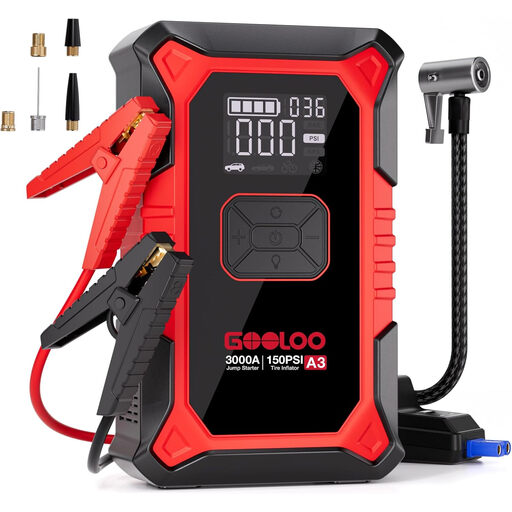
Why it's a great choice: Perfect for drivers of saloons, SUVs, and motorbikes who want a versatile, reliable, and simple device. It offers an excellent balance between ample starting power for most engines (up to 9.0L petrol / 6.5L diesel) and an efficient compressor for both daily use and emergencies.
Its compressor, with an airflow rate of 35 L/min, avoids the "anemic inflator" trap. According to GOOLOO, it can inflate a Tesla Model 3 tyre from 30 to 36 PSI in just one minute. That's tangible, impressive performance.
Its digital screen and 5 preset inflation modes make it incredibly intuitive, even for a novice. The auto-stop function, which prevents any risk of over-inflation, is a real bonus.
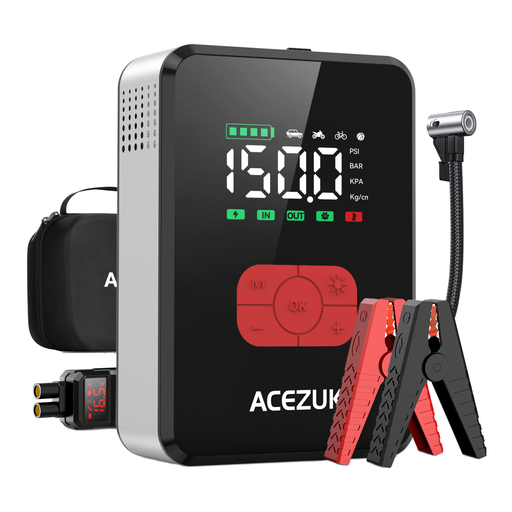
Why it's a great choice: Built for professionals and owners of motorhomes, vans, or trucks. Its colossal 7000 A power is calibrated to revive the largest diesel engines (up to 12L), where conventional jump starters give up.
It doesn't bluff on power. Its 7000 A is real and suited for the most demanding engines, sidestepping the marketing numbers trap. The smart clamps with an integrated screen are a true safety feature for tricky starts.
Its raw power and compatibility with all 12V engines, including 12L diesels. The remote screen on the clamps, which displays real-time information, is a decisive advantage for professional use.

Why it's a great choice: For anyone who wants a "set it and forget it" solution based on future-proof technology. This device is designed to stay in the car all year round without any maintenance, offering absolute peace of mind.
It completely demolishes the "phantom drain" trap. Thanks to its sodium-ion battery, its self-discharge is almost zero (~1% per month). According to GOKKCL, it can hold a charge for 5 years on standby after a full charge. No more need for preventative recharging!
Its incredible thermal stability (from -40°C to +80°C) and intrinsically safe chemistry (no risk of thermal runaway) make it the champion of safety for permanent storage in a vehicle, from extreme cold to scorching heat.
Discover our full selection of jump starters that meet our performance criteria and European safety standards.
It all depends on the engine size and fuel type. For a small petrol city car, 1500?A is enough. For a large diesel SUV, aim for at least 3000?A. Our advice: always go for a little more power than you think you need, especially if you live in a region with harsh winters.
It all depends on its technology. A standard lithium-ion model needs to be recharged every 3 to 6 months. Next-generation devices with sodium-ion batteries can hold their charge for several years, making them infinitely more reliable for unexpected emergencies.
Yes, as long as you choose a suitable model. It's crucial to check the operating temperature range specified by the manufacturer. A quality device should withstand temperatures from -20°C to +60°C without issue. Models with high thermal stability are the safest: they won't get damaged or lose performance, even if left in a car in direct sunlight or extreme cold.