
Livraison le jour même ou le lendemain

Qualité garantie

Débloquez vos offres de bienvenue: Livraison GRATUITE | Jusqu'à -80 % | 30 jours d'essai gratuits à JoyPlus
Téléchargez l'application
By the Joybuy Team, Product ExpertsPublished: August 27, 2026
A dead battery. It's every driver's nightmare. That ominous little click, the deafening silence of the engine… and just like that, your day is ruined. Faced with this predicament, the jump starter emerges as a lifesaver: a small device capable of getting you back on the road in minutes. The problem is, the market is flooded with models making tempting promises that often fall short.
To avoid ending up with a useless gadget when you need it most, here's how to sidestep the most common marketing traps.
The Peak Amps Mirage: Many manufacturers advertise an impressive figure: Peak Amps. This value only corresponds to an ultra-brief burst of energy, lasting a fraction of a second. The only number that truly matters is the starting current (or Cranking Amps), which measures the real, continuous power the booster can deliver to start your engine, especially in cold weather. High peak amperage with a weak starting current means you won't be able to restart your car, especially if it's a diesel.
Hidden Engine Incompatibility: A small, entry-level jump starter might do the job for a petrol city car. But it will completely struggle with an SUV, a van, and let alone any diesel vehicle. Diesel engines, with their high compression ratio, require far more 'punch' to get started. Choosing an underpowered model is a surefire way to get stranded.
Rapid Self-Discharge: What good is a jump starter in your glove box if it's dead the day you need it? Some models, especially those with low-end lithium-ion batteries, can lose a significant amount of their charge in just 2 or 3 months. Therefore, low self-discharge isn't an option—it's an essential reliability criterion.
To make the right choice, forget the marketing jargon and focus on these few technical specifications that make all the difference.
Forget peak amperage. The only thing to check is the compatibility stated by the manufacturer: for what engine size (in litres) and fuel type (petrol/diesel) is the booster designed?
Expressed in milliamp-hours (mAh), the capacity determines the number of starts possible on a single charge, as well as its usefulness as a power bank for your other devices.
The battery technology has a direct impact on the safety and longevity of your jump starter.
We have scoured the market to find the models that stand out from the crowd, based on the performance and reliability criteria we've just discussed.
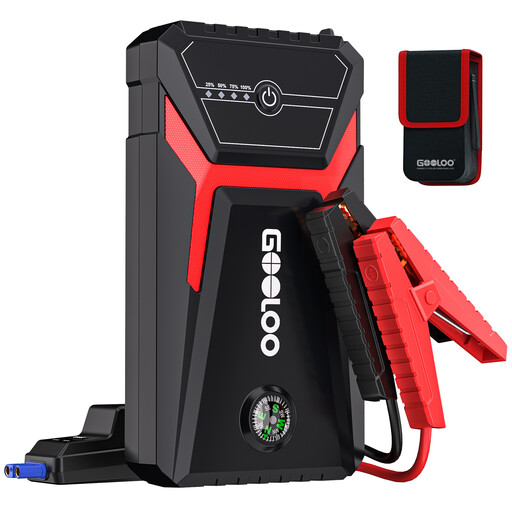
The profile: Perfect for drivers of mid-size petrol cars (up to 6.0L) or small diesels (up to 4.0L). It's the reliable and affordable backup solution for most cars, without paying for power you don't need.
This model doesn't try to impress with excessive peak amperage. It offers balanced and clearly calibrated power for common vehicles, avoiding the incompatibility trap for standard use.
Compact and lightweight, it's easy to store anywhere. Its 10 levels of protection and robust clamps make it a reassuring choice for a first-time buyer.

The profile: Built for owners of SUVs, vans, motorhomes, and large diesel engines up to 10.0L. Its raw power guarantees an effective start even in extreme cold, where smaller models throw in the towel.
It directly addresses the incompatibility trap. With its 4000A peak and stated compatibility with 10.0L diesels, there's no risk of it being underpowered for the most demanding vehicles.
The "BOOST" function allows you to force a start even on a completely dead battery. Its 100% metal clamps are built to last and ensure perfect conductivity.
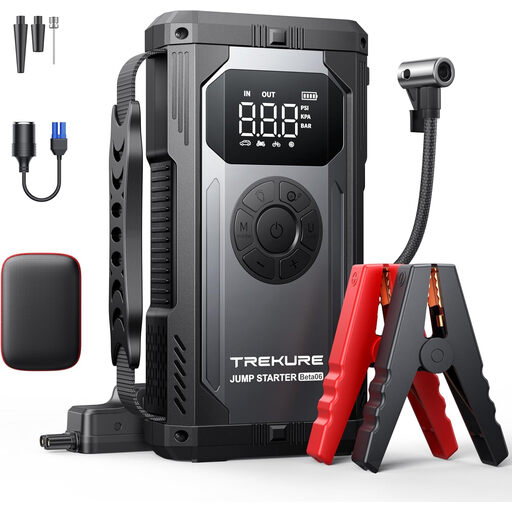
The profile: For those who want one tool to do it all. Besides being a powerful jump starter (compatible with all petrol and diesel engines up to 10.0L), it includes an air compressor to check tyre pressure. The ultimate road trip companion.
It avoids the trap of incomplete equipment. Instead of buying a jump starter AND a compressor, this 2-in-1 model brilliantly combines both functions, with an LCD screen for precise pressure control.
The compressor with automatic shut-off at the desired pressure is a real convenience. Its large 23800 mAh battery ensures excellent autonomy for both starting and inflating.

The profile: For those who want to buy a jump starter and forget it in their car without worrying about recharging it every three months. Its sodium-ion technology ensures exceptional stability and lifespan. It will always be ready when you need it.
It shatters the self-discharge trap. According to the manufacturer, a single charge holds for up to 5 years on standby, compared to 2-3 months for a lithium model. Designed for extreme temperatures (-40°C to 80°C), it can stay in the car all year round without issue.
Sodium-ion technology offers enhanced safety (no risk of fire) and a record-breaking lifespan (up to 6000 cycles). It's a very long-term investment.
Discover our full, up-to-date selection of jump starters that meet our demanding selection criteria and European safety standards.
It all depends on its technology. A standard lithium-ion model should be recharged every 2 to 3 months to remain operational. The new sodium-ion batteries, like those in the GOKKCL GK01, have such low self-discharge that they can last several years without a recharge, according to the manufacturer's data.
This is a crucial question. Always check the operating temperature range indicated by the manufacturer. In a car's cabin that gets overheated in summer, a lithium-ion battery can be damaged or even pose a risk. Conversely, winter frost can cripple its performance. Only models designed for extreme temperatures (e.g., -20°C to +60°C, and even wider for sodium-ion) can be left in a vehicle all year round.
It's very simple, but you must follow these steps to the letter to avoid any risk: