
Livraison le jour même ou le lendemain

Qualité garantie

Débloquez vos offres de bienvenue: Livraison GRATUITE | Jusqu'à -80 % | 30 jours d'essai gratuits à JoyPlus
Téléchargez l'application
A dead battery: it's every driver's nightmare, especially on a freezing morning or in the middle of nowhere. Add a flat tyre to the mix, and you're in for a real headache. Faced with these unexpected events, the jump starter with air compressor stands out as the all-in-one solution. But be warned, not all models are created equal.
Many devices boast peak performance claims that don't hold up in the real world. To help you cut through the noise and invest in a model that won't let you down, we've broken down the common pitfalls to avoid and the criteria that truly matter.
To ensure you invest in a reliable device and have peace of mind on the road, focus on these three fundamental criteria.
Peak Amps represent the maximum burst of power the jump starter can deliver in an instant. It's an important marketing number, but the ability to maintain a stable cranking current is even more crucial.
The integrated electric tyre inflator is not just a gimmick: it must be effective. Check two key specs:
Much more than a simple jump starter, this tool is a true survival toolkit for your car.
Rather than an endless list, we have selected models for every type of user to help you find the one that perfectly matches your needs.
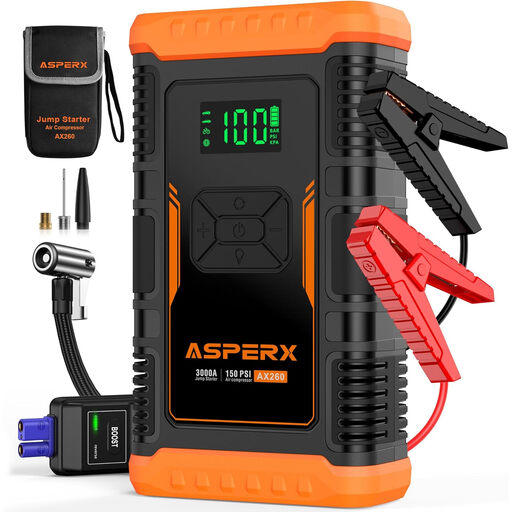
Why we chose it: Perfect for drivers of common vehicles (petrol up to 10.0L, diesel up to 8.0L) who want a reliable and compact emergency tool. It offers the ideal balance of starting power, compressor efficiency, and portability.
Its 150 PSI compressor with preset and auto-stop functions is genuinely effective, a far cry from the anemic gadgets on the market. Its 10 levels of protection ensure worry-free use.
Intelligent cordless compressor (LCD screen, 35 L/min flow rate). Lightweight and multifunctional design: jump-starting, inflation, power bank, lighting.
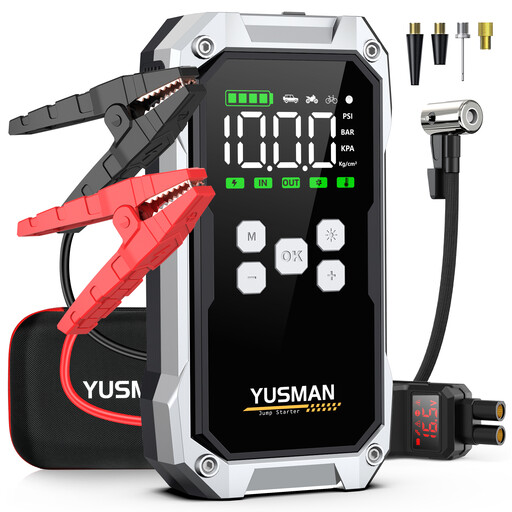
Why we chose it: Built for owners of large vehicles (SUVs, trucks, boats) with diesel engines up to 10.0L. Its colossal peak power and high-capacity battery (21,800 mAh) make it a heavyweight ally for intensive use and extreme climates.
With 5,000A peak power, it doesn't bluff on its specs. It delivers the raw power needed to revive the most stubborn engines where less robust models would throw in the towel.
Very high starting power (5,000A). Smart clamps with comprehensive protections and audible alerts. Operational from -40°C to 60°C.
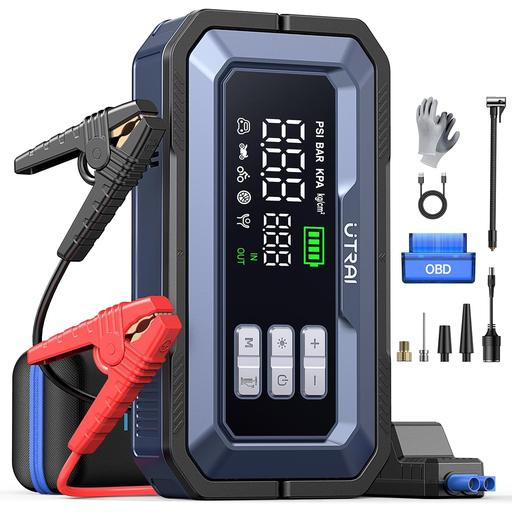
Why we chose it: This is much more than a simple jump starter. It's the ultimate tool for adventurers, DIY enthusiasts, or anyone who wants a do-it-all solution. It combines a monster 7,000A of power, a compressor, a 2,000-lumen work light, a 160W DC output, and even an OBD2 fault code reader.
It goes far beyond conventional devices by integrating truly practical features, like a powerful, adjustable work light and a DC output to power a cooler, pump, or other 12V tools.
Extreme power (7,000A) for diesel engines up to 14L. 2,000-lumen LED work light. 160W DC output (cigarette lighter type). OBD2 fault code reader included.
We have compiled a comprehensive and up-to-date list of products that meet our demanding selection criteria and current safety regulations.
A diesel engine's compression ratio is higher, so it requires more power to start, especially in cold weather. For a city car or compact diesel (up to 2.0L), a 2,000A jump starter may be sufficient. For an SUV or van (2.0L to 5.0L), it's safer to choose a model with at least 3,000A. For very large engines (over 5.0L), look for 4,000A and above to ensure a quick start, regardless of the conditions.
Charging time varies from 3 to 8 hours depending on the battery capacity and the charger's power. More importantly: self-discharge. Good lithium-polymer battery models can hold their charge for 6 to 12 months. However, we recommend checking and topping up the charge every 3 to 4 months to ensure it's ready to go when you need it most.
Yes, provided you choose a model with sufficient maximum pressure. A compressor capable of reaching 150 PSI (10 BAR) is perfectly capable of inflating an SUV tyre to its recommended pressure (usually between 2.2 and 2.8 BAR). The inflation time will then depend on the air flow rate (L/min). A model with a flow rate of 30 L/min or more will reinflate a standard-sized tyre in just a few minutes.