
Livraison le jour même ou le lendemain

Qualité garantie

Débloquez vos offres de bienvenue: Livraison GRATUITE | Jusqu'à -80 % | 30 jours d'essai gratuits à JoyPlus
Téléchargez l'application
A dead battery early in the morning, a flat tyre far from any service station... it's every driver's nightmare. Instead of relying on a recovery service or help from another driver, the solution might be to equip yourself with an all-in-one device: the jump starter with air compressor. This clever tool combines the power of an emergency starter with the convenience of an electric tyre inflator, ensuring welcome peace of mind on the road.
But with an overwhelming number of options on the market, it's not easy to find your way. Our guide is here to break down the key criteria and present a selection of the best models available today. The goal? To help you make the right choice, without getting bogged down in technical jargon.
Before diving into our selection, let's review the key points to check to find the device that will perfectly meet your needs.
Peak current, measured in amps (A), is THE number one criterion. It determines whether the booster has enough power to start your engine. Naturally, a small petrol engine won't have the same needs as a large diesel one.
The internal battery's capacity, in milliampere-hours (mAh), determines the device's runtime. A higher capacity will allow you to perform multiple jump starts or recharge your portable devices several times. Most of these devices also double as a car power bank.
For the compressor, check the maximum pressure (in PSI) and the air flow rate (L/min). A pressure of 150 PSI is standard and capable of inflating most passenger vehicle tyres. A high air flow rate, in turn, will speed up inflation.
A good multifunction power station must be both practical and safe. Ensure the device includes essential protections: against short circuits, reverse polarity, overcharging, and overheating. An LCD screen that clearly displays the charge level and tyre pressure is a real bonus. USB ports for charging smartphones and tablets, along with an LED light with an SOS mode, complete the perfect driver's Swiss Army knife toolkit.
Here are three models that caught our eye for their features and versatility.
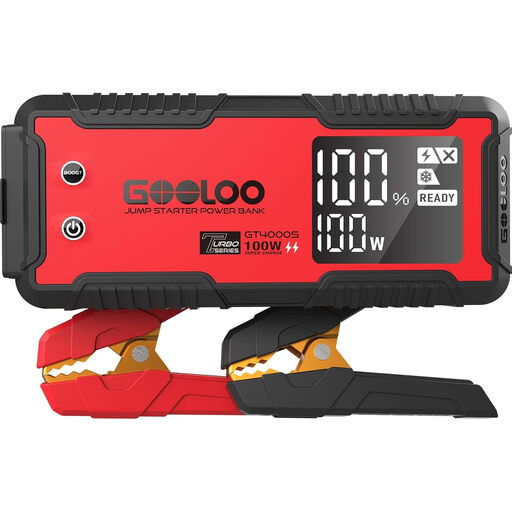
Why it stands out: Its main advantage? Its 100W two-way fast charging. According to the manufacturer, the device can be fully recharged in just 1.2 hours, and a 5-minute charge is enough for an emergency jump start.
Key features:
Who is it for? Drivers looking for a very powerful portable car starter who place a high value on recharging speed. Ideal for owners of large vehicles (SUVs, trucks, boats) who want a device that's ready in a flash.
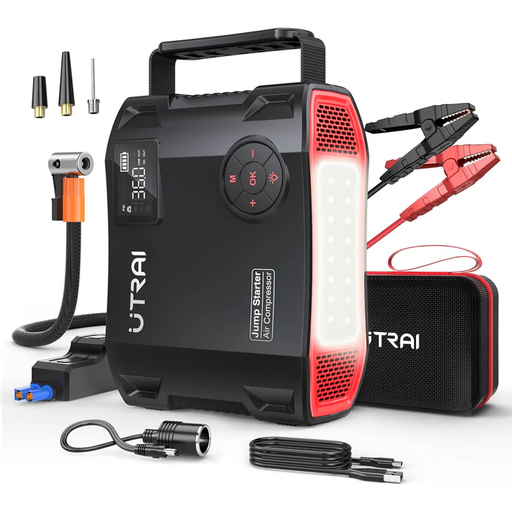
Why it stands out: For its combination of an impressive 6000A peak current and a high-performance integrated air compressor, all in a compact housing.
Key features:
Who is it for? For owners of very large vehicles (motorhomes, heavy-duty vans, agricultural machinery) who need maximum starting power. It's also an excellent choice for adventurers looking for a complete multifunction power station for camping or long road trips.
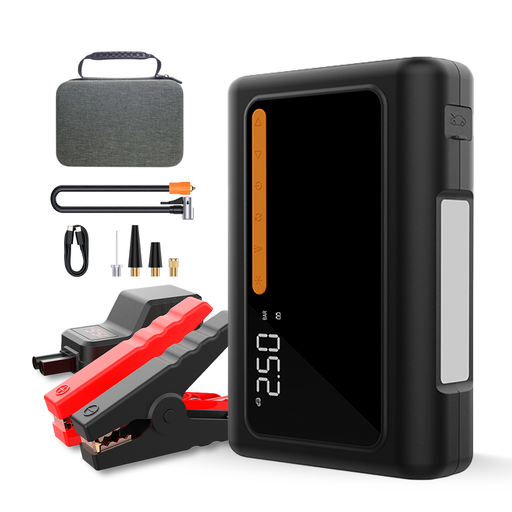
Why it stands out: For its sodium-ion battery technology. Unlike lithium batteries, it offers a much wider operating temperature range, a longer lifespan, and enhanced safety.
Key features:
Who is it for? For the driver who prioritises safety, durability, and reliability above all else. Ideal for those living in regions with extreme climates (very hot or very cold) who want a device they can leave in the boot with complete peace of mind.
Our selection focuses on all-in-one models that combine jump-starting and inflation. If you have more specific needs, such as a professional 12v battery charger without a compressor or other types of starters, there is a much wider range available.
? Discover our full range of commercial jump starters.
Diesel engines require a higher starting current due to their higher compression ratio. For a diesel jump starter, aim for a minimum peak current of 2000A. For larger engines (over 3.0L), a model with 3000A or more, like the UTRAI JS5 or the GOOLOO GT4000S, will give you comfortable headroom, especially in winter.
It depends on the battery technology. Traditional lithium jump starters are sensitive to extreme temperatures. It's best to avoid leaving them in a car in direct sunlight during summer or in freezing weather during winter. Conversely, models with sodium-ion batteries, like the GOKKCL GK01, are specifically designed to withstand a wide temperature range (-40°C to 80°C), making them perfect candidates to be kept permanently in a vehicle.
No, a jump starter (or emergency starter) and a battery charger are two very different devices. The jump starter delivers an intense burst of current over a very short period to start the engine. It does not recharge the battery. In contrast, a 12v battery charger supplies a low current over several hours to restore a battery's charge. Once your car is started with the jump starter, the alternator takes over and recharges the battery as you drive.