
Livraison le jour même ou le lendemain

Qualité garantie

Débloquez vos offres de bienvenue: Livraison GRATUITE | Jusqu'à -80 % | 30 jours d'essai gratuits à JoyPlus
Téléchargez l'application
It's the worst-case scenario. You turn the key, hear dead silence, and the dashboard remains stubbornly dark. A dead battery is every driver's nightmare. Fortunately, a simple and incredibly effective solution exists to ensure you're never caught off guard again: the jump starter. This compact device has become the essential companion for getting back on the road in minutes, without needing to find another vehicle for a jump.
With an overwhelming number of options on the market, it can be hard to know where to start. As the Head of Product Recommendations at Joybuy, I've analyzed the market to help you make the right choice. This guide will introduce you to the most reliable and versatile options, so you can find the model that truly fits your car and your needs.
Before diving into our selection, here are the essential criteria to master so you don't make a mistake.
The peak amperage (A) is the most critical specification. It indicates the maximum power the jump starter can deliver to start your engine. A small petrol engine won't have the same requirements as a large diesel one.
Modern models go far beyond a simple jump start. A portable car battery charger can integrate several very useful tools:
A good jump starter must be safe, even for novices. Check for multiple safety features: spark-proof technology, reverse polarity protection, overload protection, overheat protection, and more. An LCD screen that clearly displays the charge level and operating status is also a major convenience.
Here are three models that stand out for their performance, versatility, and reliability.
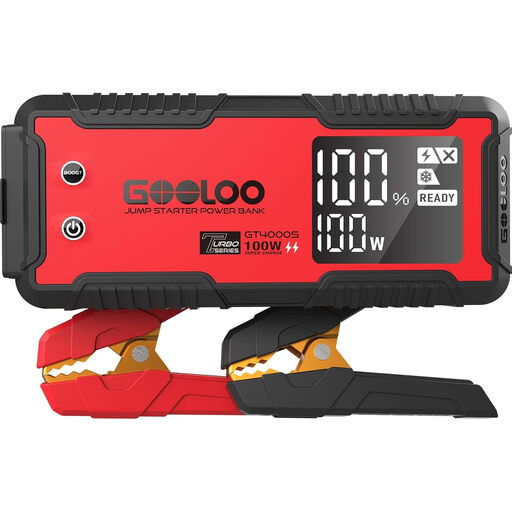
Why it stands out: Its secret weapon? 100W two-way fast-charging technology. According to GOOLOO, it fully recharges in just 1 hour and 12 minutes, and a 5-minute charge is enough for an emergency jump start. It can even charge a laptop as fast as its original charger via its USB-C port.
Key features:
Who is it for? Ideal for owners of large vehicles (SUVs, trucks, RVs, boats) and for those seeking a fast, powerful, and portable charging solution for all their electronic devices.
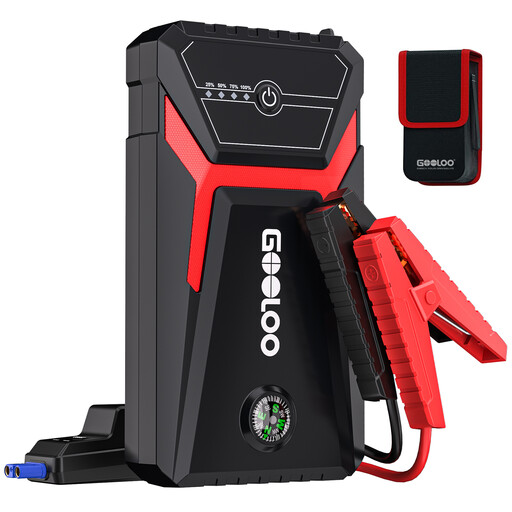
Why it stands out: The GE1500 strikes the ideal balance between power, portability, and price. It delivers enough punch for most passenger cars while remaining light and compact enough to slip into your glove box.
Key features:
Who is it for? Perfect for the driver of a city car, sedan, or small SUV. It's the reliable and affordable backup solution for everyday battery trouble.
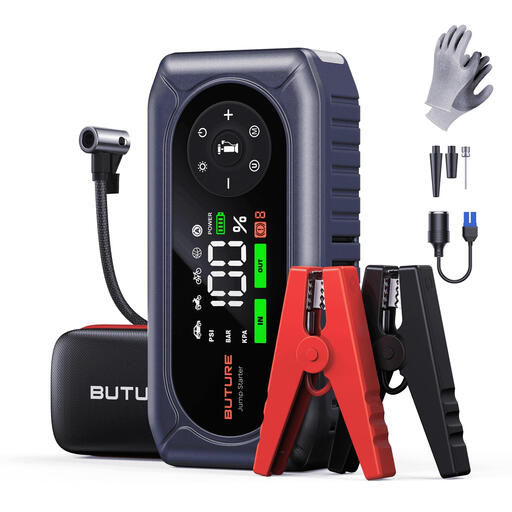
Why it stands out: This model goes far beyond being a simple jump starter; it's a true 5-in-1 emergency station. Its built-in 150 PSI digital air compressor makes it the motorist's Swiss Army knife.
Key features:
Who is it for? The user looking for an all-in-one solution to handle any roadside emergency. Ideal for long trips, camping, or simply for those who like to be prepared for any eventuality.
A good emergency kit isn't just about the battery. For optimal visibility in all conditions—whether for a nighttime repair or simply to upgrade your vehicle—quality lighting is essential.
Discover our range of accessories, including our selection of LED adapters, to complete your automotive safety kit.
Explore the LED Adapter category
Check your vehicle's documentation to find its engine displacement. As a general rule, 1500?A is sufficient for a standard petrol car. For an SUV or a diesel engine, aim for at least 2000?A. When in doubt, it's better to have more power than you need, so opt for a slightly more powerful model.
Yes, most models are designed to withstand extreme temperatures (e.g., from -20°C to 60°C). However, always check the manufacturer's technical specifications. To preserve its battery life, avoid leaving it in direct sunlight behind the windshield during the summer.
Even when not in use, a portable car battery charger will slowly lose its charge. Remember to recharge it every 3 to 6 months to ensure it's ready when you need it most. Most models have charge indicators to make this easy.