
Livraison le jour même ou le lendemain

Qualité garantie

Débloquez vos offres de bienvenue: Livraison GRATUITE | Jusqu'à -80 % | 30 jours d'essai gratuits à JoyPlus
Téléchargez l'application
Boosting your vitamin intake with fresh fruits and vegetables is a great goal. To achieve it, nothing beats a delicious homemade juice that's as simple to prepare as it is to enjoy. But with the overwhelming number of models available, buying a juice machine can quickly become a headache. Should you opt for an ultra-fast centrifugal juicer or choose a slow juicer to get the maximum amount of nutrients?
Our mission is to help you make sense of it all. This guide is designed to break down the key features, give you the tools to make the right choice, and introduce you to the best models currently on the market. The goal: to find the juicer that perfectly fits your needs and your budget.
Before you dive in, it's crucial to understand what truly sets one model apart from another. Here are the two fundamental criteria to consider to ensure you make the right choice.
This is THE big question: the extraction technology.
The choice therefore depends on your priorities: speed and price for a centrifugal juicer, or nutritional quality and yield for a slow juicer.
To ensure your machine doesn't end up collecting dust in a cupboard, it must be a pleasure to use every day.
We've selected three models that excel in their category, whether you're a fan of a simple morning orange juice or more complex vegetable blends.
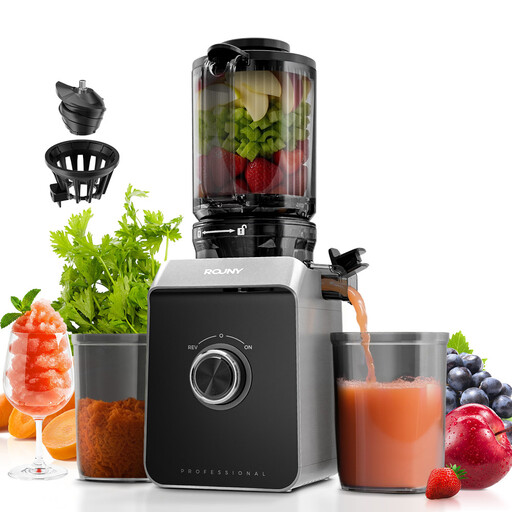
Why it stands out: This slow juicer is all about simplicity. Its huge 130 mm chute can take whole apples, a real daily time-saver. But its main advantage is its filter-free technology, which makes cleanup incredibly fast: a simple rinse under running water is all it takes.
Pros:
Who is it for? Ideal for families and anyone who wants the best nutritional value without sacrificing convenience. It's the perfect appliance for daily use thanks to its ultra-simple maintenance.
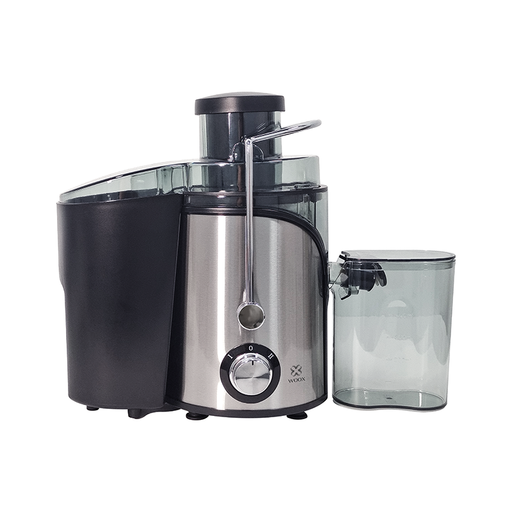
Why it stands out: The WOOX centrifugal juicer is all about speed and efficiency. With its 600W motor and 7.6 cm chute, it prepares a juice in just a few seconds. Its stainless steel design and BPA-free materials are a mark of reliability.
Pros:
Who is it for? Perfect for those in a hurry in the morning and for anyone looking to get started with homemade juices using a simple, fast, and effective machine, without the budget for a cold press model.
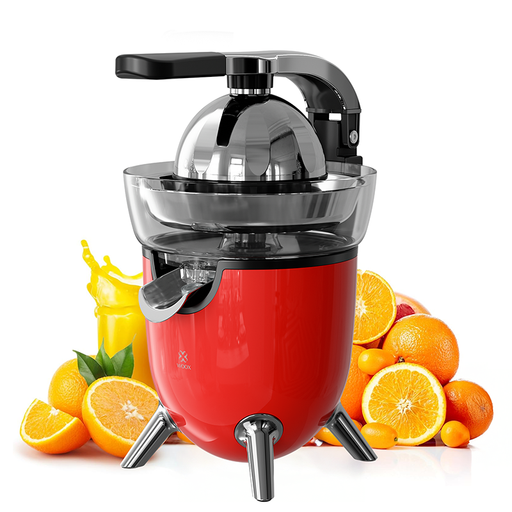
Why it stands out: A high-performance specialist. This electric citrus press is optimised to extract every last drop of juice from oranges, lemons, or grapefruits. Its 100W motor and ergonomic lever arm make the process completely effortless.
Pros:
Who is it for? For die-hard fans of fresh citrus juice who want a dedicated, robust, and much more efficient machine than a manual model for their morning ritual.
Didn't find your dream model in our selection? Don't worry, every kitchen and every routine is different. To explore a wider range of appliances, from the simplest to the most advanced, take a look at our full catalogue.
? Discover Our Full Range of Juicers
As a general rule, a centrifugal juicer is much louder. Its very high rotation speed (several thousand RPM) generates a noise level comparable to a blender. In contrast, a slow juicer (often under 100 RPM) is much quieter. This is a decisive factor if you plan to make juice early in the morning without waking up the whole house.
Most models can handle a wide range of produce, from soft items (tomatoes, citrus) to hard ones (carrots, beets). However, there are a few exceptions: fruits that are too soft or starchy, like bananas and avocados, won't produce juice and risk clogging the machine. Also, remember to always remove large pits (from peaches, apricots, cherries). Note that slow juicers are often better at handling very fibrous vegetables (celery, kale) or leafy greens. In any case, a quick look at the user manual is always a good idea.
The number one tip: clean it right away! Don't wait for the pulp and fibres to dry, which makes the task much harder. Most machines can be disassembled in a snap. A simple rinse of the parts under warm water is usually enough. Use the small brush provided to properly dislodge residue from the sieve, which is the trickiest part. To make your life easier, opt for an easy-to-clean juicer: look for models with few components, a "filter-free" design, or dishwasher-safe parts.