People preparing several Italian dishes
If you’re serving pasta, risotto, vegetables or a sauce on the same evening, look for a stock cube whose recommended uses suit your recipes, then check the amount you’ll need before cooking.


If you're making several dishes, such as pasta, risotto and vegetables, start with a vegetable stock cube whose recommended uses suit your menu. A Mediterranean herb recipe is a better choice if that’s the specific flavour you’re after. Then check the recommended amount, salt content, ingredients and allergens on the pack you choose: ‘reduced salt’ and ‘salt-free’ don’t mean the same thing.
If you’re serving pasta, risotto, vegetables or a sauce on the same evening, look for a stock cube whose recommended uses suit your recipes, then check the amount you’ll need before cooking.
If your menu already includes cheese, olives, cured meats or a ready-made sauce, compare the salt content per serving of reduced-salt and salt-free stock cubes.
Before serving guests with dietary restrictions, check the ingredients, allergens and any ‘may contain’ statements on the exact product. Another recipe from the same brand may have a different composition.
First, choose a flavour profile to suit your menu, then compare the salt content, ingredients and recommended amount with the dish you’re making.
| Criteria | What to check | Who is it for? |
|---|---|---|
| Suitability for your menu | Check which dishes are listed on the pack and whether Mediterranean herbs are included in the ingredients. | If I’m making several recipes, I want a flavour that won’t overpower the dish; around 31% of consumers say this is their main priority. |
| Managing salt | Know the difference between ‘reduced salt’ and ‘salt-free’, and compare the nutritional information for the stated serving size. | If cheese or olives are on the menu, I’d like to be able to adjust the seasoning; around 25% of consumers prioritise managing their salt intake. |
| Ingredients and allergens | Read the ingredients list, highlighted allergens and any ‘may contain’ statements on the exact pack. | If a guest needs to avoid certain ingredients, I need to know what’s in that particular stock cube; this is the top priority for around 25% of consumers. |
| Amount and storage | Compare the number of cubes, the volume of water recommended per cube and the storage instructions after opening. | I want to measure out enough stock for the meal and store any leftover cubes properly; around 19% of consumers prioritise this convenience. |
A reduction in salt doesn’t mean the cube contains none. For example, Knorr states that its Salt-Free Vegetable variety contains 0.02 g of salt per serving; this figure doesn’t apply to its other recipes.
Compare the ‘salt’ line in the nutritional information with the serving size it refers to, then taste your dish before adding any more seasoning.
Recipes may contain celery or carry different ‘may contain’ warnings. Saying that ingredients are plant-based doesn’t, by itself, answer questions about allergens.
For each guest concerned, check the ingredients list and any ‘may contain’ statements on the pack you’re using.
Storage instructions vary by product. Auchan advises transferring any leftover cubes from its vegetable-flavoured stock into an airtight container after opening.
Follow the instructions on your pack and keep the cubes away from heat and moisture.
The range includes a Mediterranean vegetable stock cube with herbes de Provence, recommended for pasta, rice and ratatouille.
Knorr offers a vegetable stock for pasta and risotto, as well as a Salt-Free Vegetable variety.
Carrefour offers dehydrated vegetable stock in a pack of 12 cubes of 10 g.
Auchan vegetable-flavoured stock comes in a pack of 12 cubes of 10 g, with suggested uses for pasta, rice and vegetables.
E.Leclerc offers Rustica dehydrated cooking stock in a pack of 12 cubes, weighing 120 g in total.
This selection features a reduced-salt vegetable stock cube, worth considering if you want to compare its added salt with that of a menu that’s already well seasoned. Its name doesn’t specify a particular use for pasta or risotto.
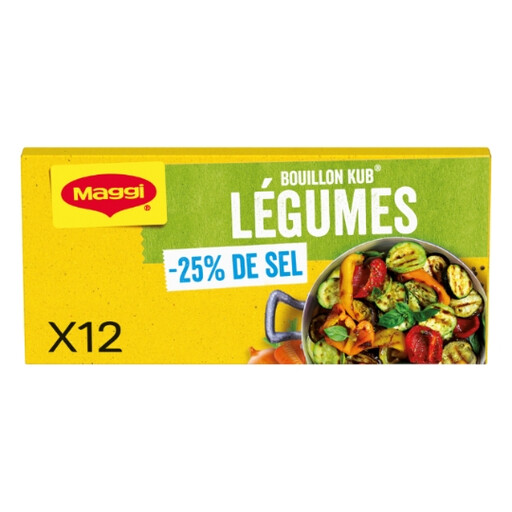 Image unavailable
If other ingredients in the meal already contain salt, compare the salt content per serving you’ll use before adding this cube to your dish.
The pack contains 120 g. ‘25% less salt’ doesn’t mean ‘salt-free’: check the recommended amount, ingredients and allergens on the packaging too.
Follow the recommended amount for the product you’re using rather than the instructions for another brand. Auchan’s product listings for its vegetable-flavoured stock and MAGGI Mediterranean vegetable stock recommend one cube per half-litre of water. For a sauce, check the instructions on your own pack and taste it before adding salt.
Follow the packaging instructions and keep the cubes away from heat and moisture. For its vegetable-flavoured stock, Auchan recommends putting any leftover cubes in an airtight container.
No. The word ‘vegetable’ doesn’t tell you everything about a product’s allergens, possible traces or other dietary characteristics. The DGCCRF advises that allergens must be highlighted in the ingredients list; check the details on the exact pack before cooking for anyone with an allergy or dietary restriction.