
Livraison le jour même ou le lendemain

Qualité garantie

Débloquez vos offres de bienvenue: Livraison GRATUITE | Jusqu'à -80 % | 30 jours d'essai gratuits à JoyPlus
Téléchargez l'application
Choosing the right induction pan can often feel like a puzzle. Between brand promises and the reality of daily use, it's easy to end up with a disappointing piece of cookware. As the head of product selection at Joybuy, my mission is to help you see things more clearly. Together, let's break down the pitfalls to avoid so you can make the right choice.
The main pitfall? A pan that loses its non-stick coating after just a few weeks. Another common disappointment is induction compatibility that looks good on paper but underperforms in reality. The result: the pan heats up slowly, unevenly, or makes an unpleasant noise. This can quickly turn a promising purchase into a daily frustration.
To avoid these letdowns, it's crucial to focus on a few technical details that make all the difference. Ignoring them means you risk regretting your purchase.
A pan that doesn't stick is the bare minimum. But be aware, not all coatings are created equal.
A pan can be "induction compatible" on paper but perform poorly if its base isn't optimised. The secret is the thermo-diffuser base. A thick, perfectly flat base with an integrated ferromagnetic disc ensures rapid heating and even heat distribution. This is essential for searing meat to perfection or making an omelette without overcooked spots. It's what makes a pan truly compatible with all hobs, including induction.
The size of your pan should obviously match your cooking habits.
To illustrate these criteria in practice, here are a few models that meet specific needs while avoiding the common pitfalls.
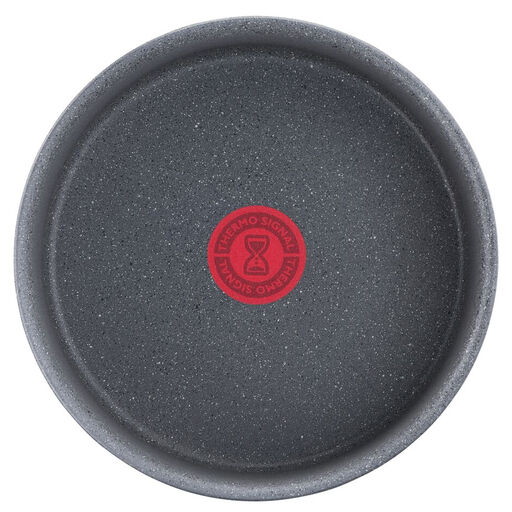
Why this model stands out: Perfect for small kitchens. The removable handle system allows you to move from the hob to the oven, then to the fridge, and stack everything for maximum space-saving storage.
Its Thermo-Fusion base ensures excellent performance on induction, while its mineral-reinforced Mineralia+ coating is built to last, combating premature wear and tear.
Versatility and space-saving thanks to the removable handle and stackable design. Made in France.
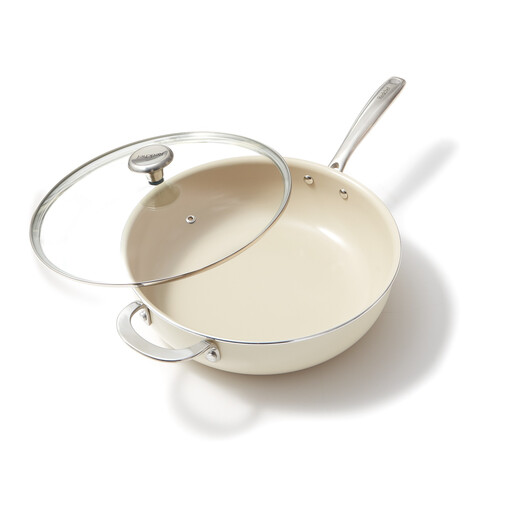
Why this model stands out: With its large 4.7-litre capacity and high sides, this sauté pan is the perfect partner for one-pot meals for the whole family, from vegetable woks to slow-cooked dishes.
Its die-cast aluminium body resists warping, and its induction base ensures even heating. The ceramic coating is clearly advertised as free of PFAS, PFOA, lead, and cadmium.
Large capacity, included tempered glass lid, and riveted handles that stay cool on the hob.
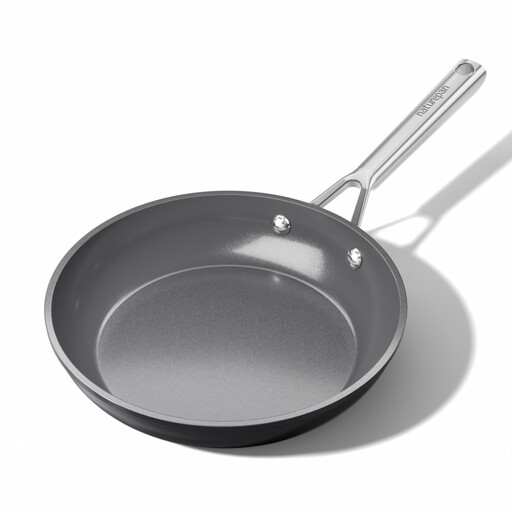
Why this model stands out: Its 24 cm diameter is ideal for meals for 2 to 3 people. Its ceramic coating promotes healthy cooking with very little oil, perfect for those who are health-conscious.
Its ceramic coating is reinforced with diamond and titanium particles, giving it superior durability compared to classic ceramics. Its optimised base prevents hot spots, a typical flaw in entry-level pans.
Durable and healthy coating (PTFE/PFOA/PFAS-free), and oven-safe up to 260 °C for maximum versatility.
We have curated a complete selection of products that meet our quality criteria and European safety standards.
The simplest trick is the magnet test: if a magnet sticks firmly to the bottom of the pan, it's compatible. Most manufacturers also add a coil-shaped symbol on the packaging or directly on the pan's base.
Its longevity depends on the quality of the coating and how it's cared for. To preserve it, avoid thermal shock (don't run it under cold water while it's still hot), use wooden or silicone utensils, and opt for hand washing with a soft sponge, even if the model is dishwasher-safe. A high-quality, well-maintained pan can retain its properties for several years.
The ceramic pan is often seen as a healthier option because it does not contain PTFE (the component in traditional coatings). It can withstand very high temperatures but may be more fragile and prone to chipping. On the other hand, a quality classic non-stick coating, guaranteed PFOA-free, remains a very high-performance and durable option, especially if it's reinforced with mineral particles. The final choice will depend on your priorities: durability or material composition.