Busy daily coffee drinker, alone or in a small household
If you want a quick coffee with minimal effort and no grind-size adjustments, compare the cost per serving, the capsule or pod format supported and the water-tank capacity.


Start by choosing the coffee system and deciding how much weekly maintenance you are prepared to take on. Capsules and pods minimise handling, while a portafilter or grinder lets you use ground coffee or beans. If you make several coffees a day, a grinder could be a good fit, provided its size and cleaning routine work for you.
If you want a quick coffee with minimal effort and no grind-size adjustments, compare the cost per serving, the capsule or pod format supported and the water-tank capacity.
Look at the cost of consumables, the capacity of the water tank, the grounds or capsule container and the cleaning time. A bean-to-cup machine may be worth considering if you are happy with its maintenance and footprint.
A portafilter machine may suit you if choosing the ground coffee and fine-tuning the settings matter more than immediate convenience, provided you are prepared to measure, tamp and clean it.
Start with the consumable format supported, then check the daily steps and maintenance required by the model you are considering.
| Priority | What to check | Your needs |
|---|---|---|
| Cost of consumables | Format supported by the machine; pack price and number of servings; price per kilogram and dose used for ground coffee or beans. | I want to avoid a machine that is affordable to buy becoming expensive to run with coffee prepared every day. UFC-Que Choisir states that a grinder can have a per-cup cost two to three times lower than a pod espresso machine, according to its guide to bean-to-cup machines. |
| Simplicity and speed | Preparation steps; whether measuring or tamping is required; whether you can make one or two cups; water-tank capacity. | In the morning, I prefer consistent coffee without having to adjust lots of settings. A pre-portioned serving reduces the effort, whereas a portafilter requires more input. |
| Maintenance | Parts that need emptying and rinsing; descaling procedure; approved products; access to the tank, container and brewing unit. | I am looking for a cleaning routine that is realistic for my schedule. The procedures and descaling frequency depend on the model and the hardness of the water. |
| Waste and compatibility | Capsule material; local recycling instructions; any collection point; exact reference for the pod or capsule system. | I want to choose my coffee format with the waste it generates in mind and avoid buying incompatible consumables. |
When you use a machine every day, the cost of capsules, pods, beans or ground coffee can have a greater impact over time than the price difference between two machines.
Divide the price of a pack by the number of capsules or pods, then compare the result with your weekly consumption. For beans and ground coffee, also compare the price per kilogram with the dose you actually use.
“Nespresso compatible” and “Senseo compatible” refer to different systems. You should never assume that a capsule or pod will work with another machine.
Note the exact model reference and check its manual or the manufacturer’s product information before ordering a large quantity.
A machine can become inconvenient if cleaning the containers, brewing unit or steam wand, as well as descaling, does not fit into your routine.
Before buying, consult the manual for the exact model and make a list of the parts that need emptying, rinsing, cleaning and descaling.
How capsules should be disposed of depends on their material, local recycling instructions and, for some brands, access to a collection point.
Check the capsule material, your local council’s instructions and the collection options available before making this a deciding factor.
Capsule system. Capsules marketed as Nespresso compatible are available from French retailers, although this does not establish compatibility with other capsule systems.
System of machines using soft pods, with Senseo-compatible references available from French retailers.
A brand with a presence in both the portafilter and automatic grinder-machine segments, with dedicated French maintenance documentation.
This selection brings together soft-pod machines and automatic grinder machines suited to making coffee regularly at home.
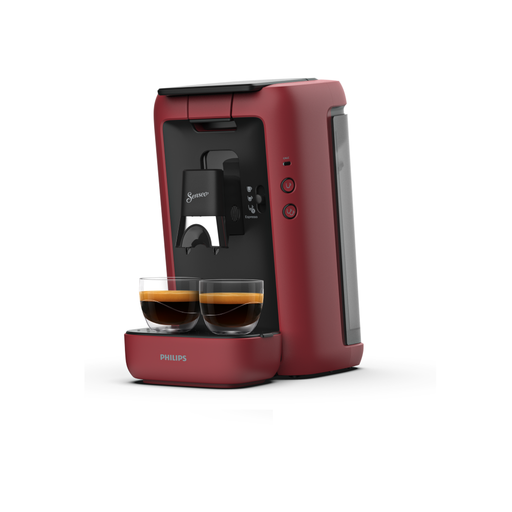 Image unavailable
For a small household wanting to prepare one or two cups quickly with SENSEO pods.
Advertised 1.2 L tank, two-cup preparation, Long, Intense and Espresso recipes, adjustable spout and descaling indicator. Check the exact pod compatibility before building up a supply.
 Image unavailable
Worth considering for a household that makes several coffees and wants to use beans for milk-based drinks.
Advertised 1.8 L tank, 275 g bean hopper, two-coffee preparation, 12 grind settings and LatteGo system. Advertised dimensions: 246 × 371 × 433 mm; check that you have enough worktop space.
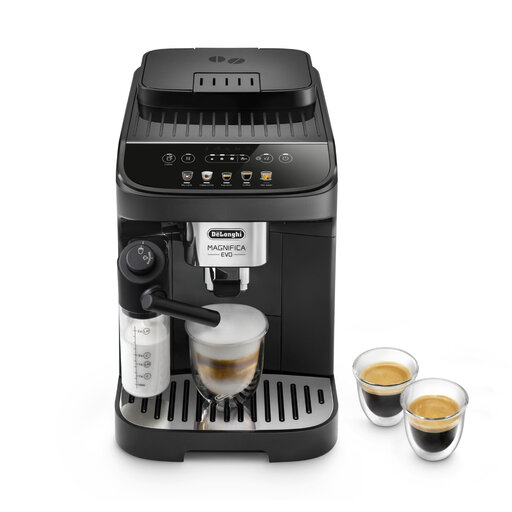 Image unavailable
This machine suits households looking for coffee and milk-based drinks at the touch of a button, with an integrated grinder.
Advertised 1.8 L tank, 250 g bean hopper, 13 grind levels, LatteCrema Hot and MyLatte. Advertised dimensions: 240 × 440 × 360 mm; cleaning and descaling cycles are still required.
 Image unavailable
For a household that prefers black coffee made from beans, with the option to froth milk manually.
Advertised 1.8 L tank, 250 g bean hopper, grinder with 13 settings, two-coffee preparation and access for pre-ground coffee. Advertised dimensions: 240 × 440 × 350 mm; the steam wand requires manual operation.
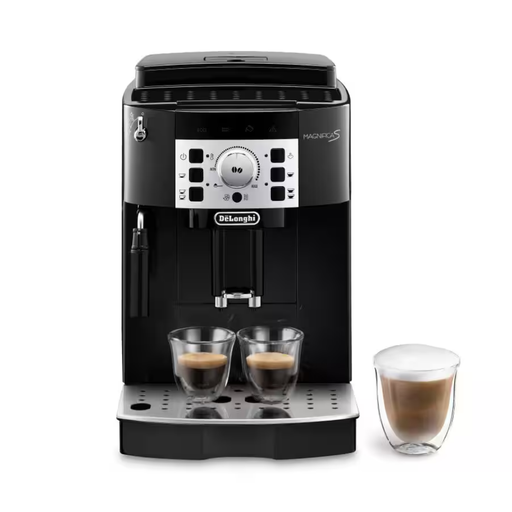 Image unavailable
Worth considering if you want to switch between coffee beans and ground coffee while regularly making several cups.
Advertised 1.8 L tank, adjustable grinder, two-cup preparation and a dedicated opening for pre-ground coffee. The steam wand must be cleaned after use.
No. Compatibility depends on the machine’s exact system. Products may be labelled “Nespresso compatible” or “Senseo compatible”, but this does not mean they work with other systems. Check the manual and the exact model reference before buying consumables in bulk.
The answer depends on the number of drinks, the coffee dose, consumables and maintenance. UFC-Que Choisir states that a bean grinder can have a per-cup cost two to three times lower than a pod espresso machine. Compare the price per serving for pre-portioned formats and the price per kilogram, together with the dose used, for beans or ground coffee.
Yes. The frequency depends on the water used and how often the machine is operated, not just on the coffee system. Philips recommends regular descaling for SENSEO machines, while De’Longhi explains that the frequency for a traditional machine varies, in particular, according to water hardness. Follow the manual for the model you buy.
ADEME states that aluminium or plastic capsules should be placed in the recycling bin, bag or container for paper and packaging. However, check the capsule material and your local council’s instructions, as some brands also provide collection points.
In France, the legal guarantee of conformity applies to new, second-hand and refurbished goods sold by a professional to a private individual, according to the Ministry of the Economy. It covers, among other things, a machine that does not match its description, is unsuitable for normal use or has a manufacturing defect. Keep the receipt, product description and manual.