
Livraison le jour même ou le lendemain

Qualité garantie

Débloquez vos offres de bienvenue: Livraison GRATUITE | Jusqu'à -80 % | 30 jours d'essai gratuits à JoyPlus
Téléchargez l'application
Driving at night or in bad weather with yellowish halogen headlights can quickly become a nightmare. Visibility is reduced, signs are harder to read, and your vehicle's appearance looks seriously dated. Upgrading to an H7 LED bulb is the solution more and more drivers are adopting to modernise their lighting, enhance their safety, and enjoy a whiter, crisper light.
With an overwhelming number of options on the market, it's hard to know where to start. This guide is here to shed light on the selection criteria that truly matter and introduce you to the best current options, without unnecessary technical jargon.
Before you dive in, here are the key points to check to find the perfect model for your vehicle and your needs.
A bulb's performance is measured in lumens (lm), which indicate its light output. A powerful H7 LED bulb will offer much better range and a wider beam than its halogen equivalent.
Colour temperature, expressed in kelvins (K), defines the hue of the light. A 6000K H7 bulb produces a pure white light, close to daylight, which dramatically improves contrast and the perception of details on the road. This is now the standard for a modern look and optimal visibility.
One of the major advantages of recent models is their simple installation. A plug-and-play H7 bulb is designed to be installed in place of the original halogen bulb, without any headlight modification or adapters. The process usually takes only about ten minutes.
However, be aware?: modern vehicles are equipped with an on-board diagnostic system (CAN bus) that monitors bulb function. Since LEDs consume much less power, the on-board computer may mistake this for a fault and display an error message. Choosing an error-free H7 bulb (or "CANbus ready") solves this problem on most vehicles thanks to a built-in resistor.
LEDs get hot! This heat must be effectively dissipated to ensure their longevity and stable performance. Systems vary?: some models use a fan (active cooling), while others rely on an aluminium heat sink (passive cooling). Good cooling guarantees a lifespan of tens of thousands of hours, far surpassing halogen bulbs. A quality H7 LED kit is therefore recognisable by its efficient heat dissipation system.
To guide you, we have scrutinised several models based on their technical specifications, ease of installation, and overall design.
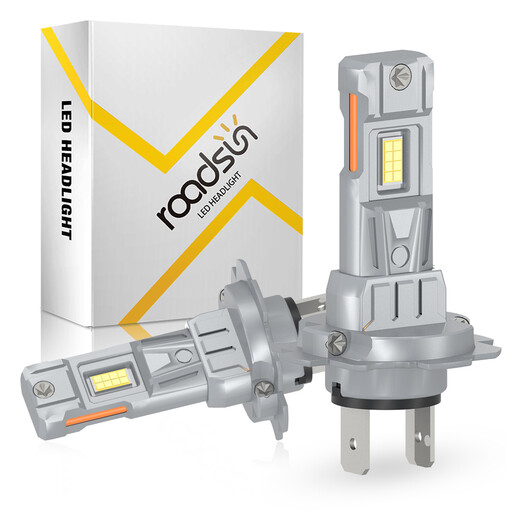
Why it stands out: This model shines with its 1:1 mini size design, which identically replicates the dimensions of a halogen H7 bulb. This feature ensures near-universal compatibility and a greatly simplified installation, as it requires no adapters or headlight modifications.
Advantages:
Who is it for? Ideal for drivers, even those new to mechanics, who are looking for a simple, fast, and hassle-free solution with the guarantee of maximum compatibility.
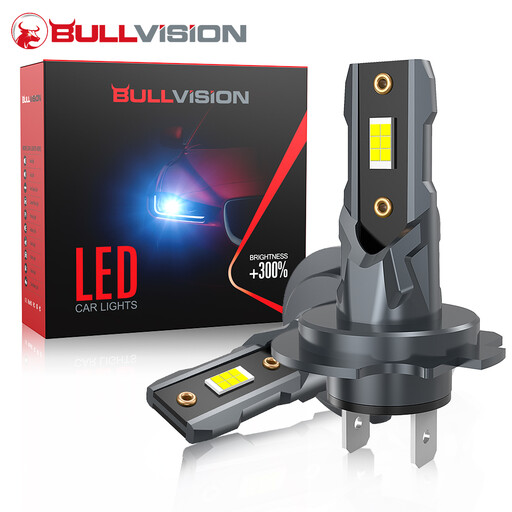
Why it stands out: The Bullvision model combines high brightness with active cooling. Its fan (10,000 RPM) ensures highly effective heat dissipation, guaranteeing a lifespan of up to 50,000 hours, according to the manufacturer. Its integrated smart driver makes it compatible with the CAN bus system of 99% of vehicles.
Advantages:
Who is it for? Perfect for high-mileage drivers who need a reliable and high-performance solution for the long haul, while benefiting from broad compatibility. Manufacturer's note: For some vehicles (Volkswagen, Mercedes-Benz, BMW), an additional CAN bus decoder may be necessary.
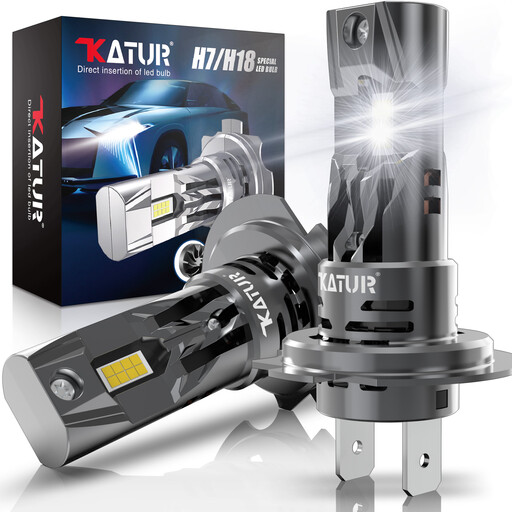
Why it stands out: KATUR brings out the big guns with impressive specifications: 100W and a claimed 30,000 lumens per pair. This model features a high-speed turbo fan (16,000 RPM) and an aviation-grade aluminium body for maximum heat dissipation. Its external driver is designed to optimise lifespan and prevent interference.
Advantages:
Who is it for? Aimed at demanding users seeking the highest brightness and a no-compromise cooling system for cutting-edge lighting.
The choice of an H7 LED bulb depends heavily on your vehicle model and personal preferences. If the products featured here don't check all your boxes, many other solutions are available. Our complete catalogue of car LED headlights is sure to have the perfect fit you're looking for.
Discover our full range of car LED headlights
European regulations require replacement bulbs to be type-approved (ECE certification). However, many aftermarket LED kits do not have this certification for use on public roads. In practice, their installation is often tolerated, provided the beam pattern is correctly adjusted to avoid dazzling other road users. It is wise to check the current legislation in your region and have your headlight alignment checked after installation.
Yes, by a significant margin. In terms of light output (lumens), an LED bulb is far more efficient than a halogen one, all while consuming significantly less power. A standard H7 halogen bulb typically maxes out at around 1,500 lumens, whereas an H7 LED headlight can easily exceed 6,000 lumens per bulb. The result is a radically improved night-time driving experience.
For most plug-and-play models, installation is a breeze: