
Livraison le jour même ou le lendemain

Qualité garantie

Débloquez vos offres de bienvenue: Livraison GRATUITE | Jusqu'à -80 % | 30 jours d'essai gratuits à JoyPlus
Téléchargez l'application
Driving at night with dull, yellow halogen headlights isn't just tiring—it's dangerous. Poor visibility, washed-out colours, and an outdated look... It's time for an upgrade. LED lighting is the ultimate modern solution to transform your night-time driving experience and give your car a fresh, contemporary look.
This guide is here to help you choose the perfect H7 LED bulb kit for your vehicle. We'll break down the technical specs so you can see things clearly, all without the confusing marketing jargon.
Before you dive in, let's review the key criteria that make all the difference in performance and compatibility.
A powerful H7 LED bulb is about more than just lumens. A flood of light is useless if it isn't properly directed. The beam pattern is therefore paramount: a good LED kit must perfectly replicate the beam of the original halogen bulb. The goal? To illuminate the road optimally without ever blinding oncoming drivers.
As for colour temperature (measured in Kelvin, or K), it defines the visual output. Aim for 6000K to 6500K to get that crisp, pure white light, highly sought after for its famous "xenon effect".
Modern cars are essentially computers on wheels, equipped with an onboard diagnostic (OBD) system that monitors everything. The problem? An LED bulb consumes far less power than a halogen one. The onboard computer, not detecting the usual power draw, assumes a bulb is burnt out and triggers a dashboard warning.
To avoid this minor inconvenience, the solution is simple: choose an error-free H7 bulb, also known as "CANbus Ready." It integrates a small circuit that tricks the computer by simulating the power consumption of a standard bulb. Clever!
This is a crucial point that should never be overlooked. To be legally used on public roads, an H7 LED kit must have the proper ECE approval (look for the ECE mark). However, a large number of kits available for sale are actually intended for track or "off-road" use only. Before purchasing and installing, it is your responsibility to verify that the product complies with local regulations. Do not take this matter lightly.
We've scoured the spec sheets to bring you models that stand out from the crowd, whether for their design, power, or ingenuity.
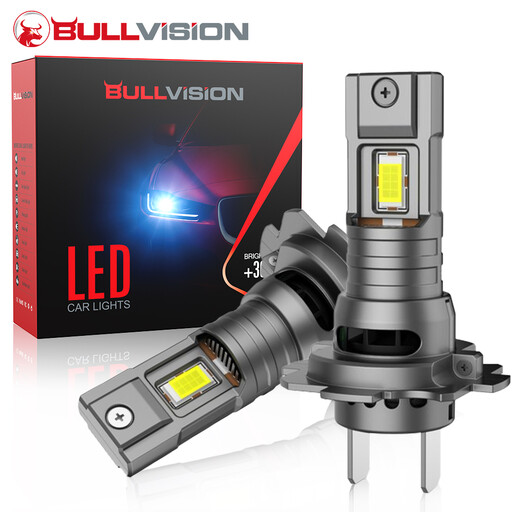
Key Feature: An impressively realistic "1:1 Mini Size" design. These bulbs are exactly the same size as a standard H7 halogen. The result: installation is child's play—truly "plug-and-play," with no adapters or headlight modifications required.
What We Love:
Who is it for? For those who want a fast and effective solution without the headache of compatibility issues or limited space in the headlight housing.
Manufacturer's note: On certain sensitive vehicles (especially Volkswagen, Mercedes-Benz, BMW), an external CANbus decoder may be necessary.
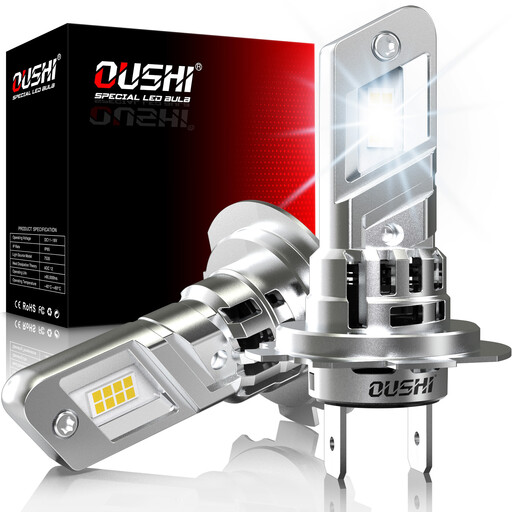
Key Feature: Raw power. These bulbs go all-in on extreme brightness and broad CANbus compatibility. The brand claims up to 600% more light than halogen, enough to turn night into day.
What We Love:
Who is it for? For owners of modern cars (especially European models) seeking maximum light output while minimizing the risk of OBD errors.
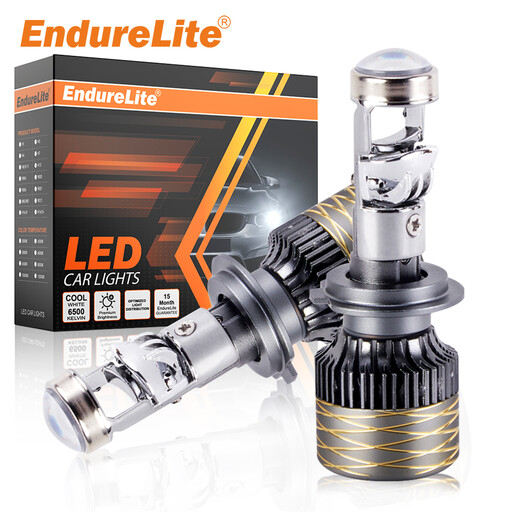
Key Feature: Intelligent beam pattern. This model incorporates a mini projector lens directly onto the bulb. This clever technology creates an ultra-sharp cut-off line, worthy of an OEM projector headlight. The light is perfectly focused on the road, with virtually no glare.
What We Love:
Who is it for? Ideal for owners of vehicles with reflector headlights (without original projectors) who want to achieve the precision and comfort of a sharp cut-off beam.
The H7 fitment is very common, but dozens of others exist (H1, H4, H11...). If your vehicle uses a different format, such as H2, it's crucial to choose the corresponding model for a perfect installation.
Feel free to explore our catalogue to find the right bulb for you.
? Discover our category of H2 bulbs and other formats
Yes, in the vast majority of cases. The only key consideration is the electronics. For cars made after 2000, always opt for an error-free (CANbus Ready) model to prevent a warning light from appearing on your dashboard. On a few notoriously finicky models (often German), an external CANbus decoder may be necessary as a last resort.
Not at all. Most modern kits are "plug-and-play." The process is as simple as changing a halogen bulb: unplug the old one, and clip in the new one. The 1:1 size models are the easiest, as their identical dimensions guarantee an installation without any need for adapters.
This is the most important point. To be street legal, an LED conversion kit must have the proper European approval (look for the ECE mark on the product). Be aware that many models sold online are intended for track or off-road use only. It is your responsibility to verify this before installation to comply with local traffic regulations.