
Livraison le jour même ou le lendemain

Qualité garantie

Débloquez vos offres de bienvenue: Livraison GRATUITE | Jusqu'à -80 % | 30 jours d'essai gratuits à JoyPlus
Téléchargez l'application
A geometry ruler is not just for drawing straight lines. Depending on your needs, it can also be used to measure a length, check a right angle, transfer a 45° or 60° angle, or even create technical markings on wood or metal.
The right choice therefore depends less on the tool’s appearance than on several very practical details. A school ruler that is too flexible may become warped in a bag, graduations that are difficult to read can lead to inaccurate measurements, and an incomplete set may force you to buy a set square or protractor separately.
A thin, lightweight ruler is easy to carry, but some plastics can become scratched, bend or warp when exposed to heat. For everyday use at secondary school or in the workshop, check the material and the stated level of resistance. Transparent plastic is ideal for everyday exercises, while anodised aluminium or stainless steel is better suited to intensive use.
A graduated ruler may show centimetres, millimetres or inches. If the numbers are too small, have too little contrast or are printed on only one side, reading them quickly becomes uncomfortable. For pupils, thick, well-spaced graduations make learning easier. In technical drawing, consistent markings and tool stability are the top priorities.
A 30 cm ruler is useful for exercise books, A4 sheets and schoolwork, but it cannot replace a set square for checking a right angle. Similarly, a 180° protractor is suitable for geometry but less practical for guiding a cut. Before choosing, identify the main purpose: measuring, drawing, checking an angle or combining several functions in a single tool.
Transparent plastic allows you to see the document beneath the ruler and makes it easier to align a point or line. It is perfectly suitable for school and office use, provided you avoid high temperatures and prolonged bending.
Anodised aluminium is more resistant to corrosion and flexing than most thin plastics. However, its edges may require a little extra care when handling. For DIY projects, an aluminium ruler or metal set square provides greater stability. It does not, however, replace a professionally calibrated instrument when a measurement tolerance is specified.
In a well-packed school bag, a set made from a material advertised as impact-resistant can reduce the risk of breakage. Even so, avoid deliberately bending the instruments and store them flat whenever possible.
The 30 cm ruler remains the most versatile format for pupils and office tasks. A 20 cm ruler fits more easily into a small pencil case, while a 30 cm model covers more formats.
Also check for graduations in millimetres and centimetres. Imperial units may be useful for certain plans, instructions or DIY projects, but they are not essential for every user in France.
A set square at 45° or 60° is used to draw and check the most common angles. A protractor in a semicircular design allows you to measure angles up to 180°. Some DIY instruments combine a ruler, set square, protractor and various marking guides.
For woodworking, carpentry or fitting work, consider the useful length, the clarity of the markings, whether it has a cutting guide and whether it can check 90° or 45° angles. These features matter more than simply describing a product as “multifunctional”.

Why this choice suits this profile: Its standard size is suitable for exercise books, sheets of paper and early geometry exercises. Its light weight makes it easy to carry every day.
The transparent design makes alignment easier, while the two measurement systems mean you are not restricted to a single unit.
30 cm length, centimetre and inch graduations, transparent design.
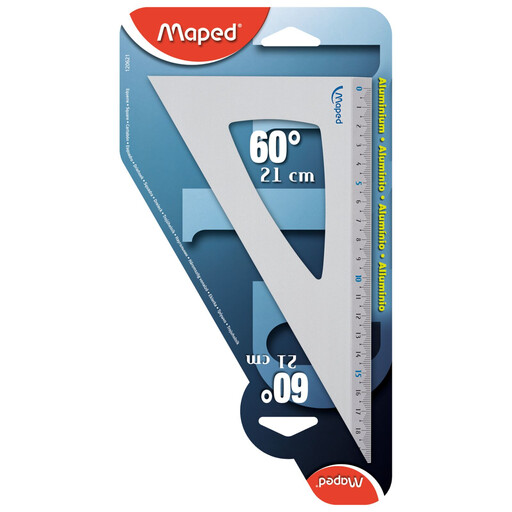
Why this choice suits this profile: This anodised aluminium set square is designed for users who want a durable instrument for lessons, technical drawing or regular marking work.
The metal construction reduces the risk of a school ruler becoming warped because it is too flexible. The protected ends also reduce direct contact with the edges.
Anodised aluminium, 60° angle, 21 cm length, easy-to-read graduations.
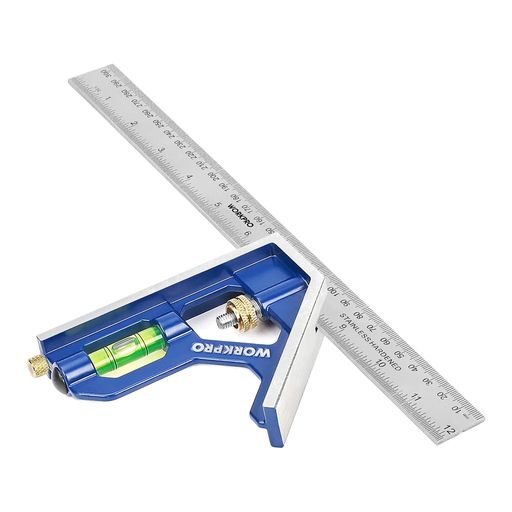
Why this choice suits this profile: Its 300 mm format and adjustable head are suitable for carpenters, DIY enthusiasts, engineers and anyone who regularly carries out measuring and marking tasks.
This is more than just a ruler: the adjustable locking mechanism keeps the chosen position secure, while the tool combines several measuring and marking functions.
300 mm stainless steel ruler, zinc alloy head, spirit level, marking point, metric and imperial graduations.
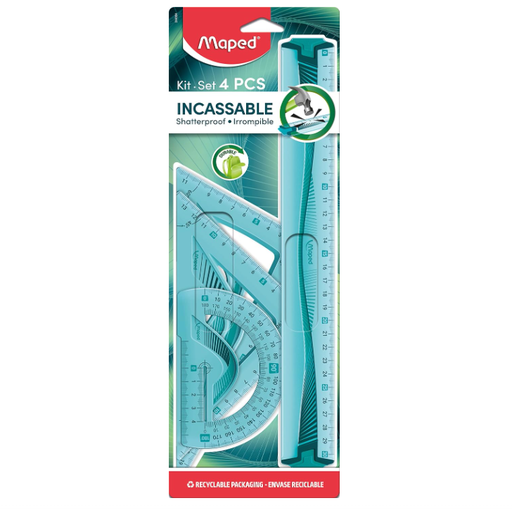
Why this choice suits this profile: This set brings together the instruments commonly used in maths and geometry lessons at secondary school, so you do not need to buy them separately.
The stated contents include a ruler, two set squares and a protractor. The UV-printed graduations are designed to remain visible over repeated use.
Advertised impact-resistant material, 30 cm ruler, 45° and 60° set squares, 180° protractor.
We have put together a complete, real-time updated selection of products that meet these strict criteria, as well as European safety regulations.
Wipe the tool with a soft, slightly damp cloth, then dry it before storing it. Avoid abrasive products on aluminium and transparent plastic. Do not leave a ruler or protractor exposed to intense heat, such as in a car: the material could warp.
Service life depends on how often the tool is used, storage conditions and the pressure applied while drawing. A sufficiently large pencil case or rigid compartment can help prevent scratches and bending. Children under 3 must not use these instruments, which may have sharp corners or small parts.
A 20 cm ruler is easy to carry in a small pencil case. The 30 cm format is better suited to exercise books, A4 sheets, drawings and exercises requiring longer lines. For technical use, a length of 300 mm offers a wider measuring range.
A geometry set is practical if the pupil needs a ruler, set square and protractor. It helps prevent items being forgotten and makes storage easier. Buying separately may be preferable if you are looking for a particular material, such as aluminium, or a set square better suited to DIY projects.
It can be suitable for school use, but its edges must be handled carefully. For a young child, choose a model with protected ends or a durable plastic ruler. In all cases, make sure it is stored appropriately.