
Livraison le jour même ou le lendemain

Qualité garantie

Débloquez vos offres de bienvenue: Livraison GRATUITE | Jusqu'à -80 % | 30 jours d'essai gratuits à JoyPlus
Téléchargez l'application
Juggling a mountain of cables and adapters for every device is a real headache. Between the underpowered smartphone charger, the bulky laptop power brick, and the various adapters for your tablet or smartwatch, your power strip is often on the verge of collapse. Fortunately, GaN charger technology is here to bring order to this chaos.
More compact, faster, and more energy-efficient, these next-generation chargers promise to consolidate all your charging needs into a single, high-performance device. In this guide, we'll break down the advantages of this technology and present a selection of models suited for different uses to help you find the right one for you.
Before you jump on the first model you see, let's review a few technical criteria that will ensure optimal compatibility and performance with your devices.
This is the crucial factor: power, expressed in watts (W), determines charging speed. A modern smartphone will benefit from a 20W charger or more, while a laptop charger will typically require between 45W and 100W.
Check the maximum power your devices can accept. A charger that's more powerful than necessary won't damage your equipment; it will automatically adapt thanks to protocols like Power Delivery (PD). This standard, a key part of fast USB-C charging, establishes a dialogue between the charger and the device to deliver just the right amount of power, safely.
A multi-port charger is the ideal solution for powering several devices simultaneously. You'll typically find an assortment of ports:
Note: On a multi-port charger, the total power is shared among the active ports. For example, a 65W model might allocate 45W to a laptop via one USB-C port and the remaining 20W to a smartphone on a second port.
Behind the acronym GaN is gallium nitride, a semiconductor material that is replacing traditional silicon. For you, the benefits of a GaN power adapter are clear:
We've selected a few gems for you, chosen for their performance, form factor, and versatility.
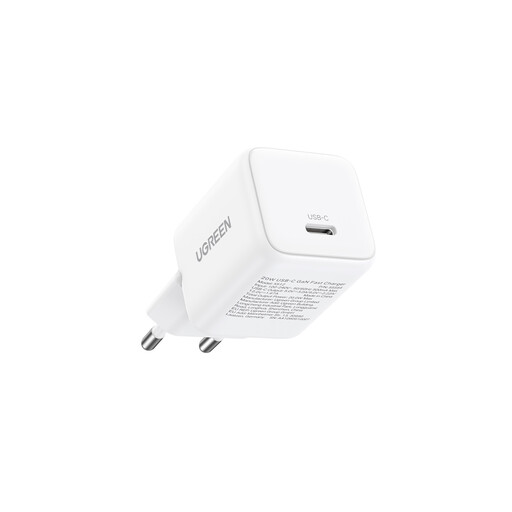
Why It Stands Out
Simplicity in the service of efficiency. This charger does one thing, but it does it perfectly: deliver a fast, efficient charge in an ultra-compact form factor. With its 20W of power and PD 3.0 compatibility, it's perfect for modern smartphones and tablets.
Advantages
Who Is It For? The ideal companion for those who want to replace their original charger (often missing from the box!) with a smaller, faster model for the office or on the go.
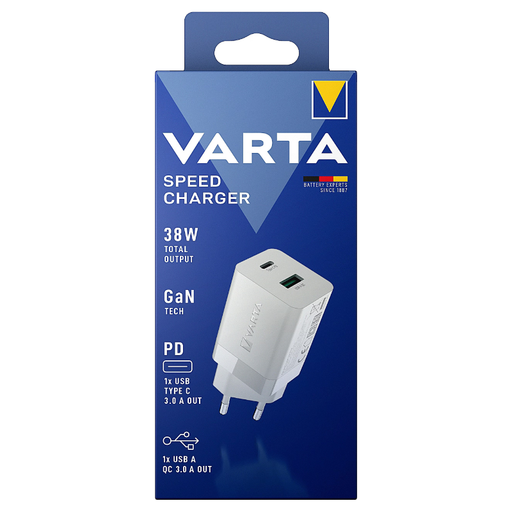
Why It Stands Out
The VARTA Speed Charger 38W strikes the perfect balance between power and versatility. It features two ports to power two devices simultaneously, with intelligent power distribution. GaN technology allows it to remain compact despite its dual-port design.
Advantages
Who Is It For? For those who never leave home without their smartphone and a second device (earbuds, watch...), whether at home, in the office, or while travelling.
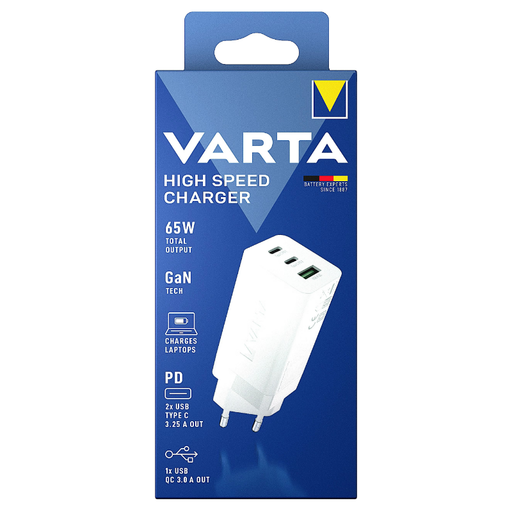
Why It Stands Out
With its 65W and three ports, this model is a true all-in-one charging station. Powerful enough to handle most USB-C compatible laptops, it can simultaneously charge a phone and a tablet. The ultimate solution for saying goodbye to the collection of power bricks cluttering your bag.
Advantages
Who Is It For? For professionals on the go, students, or anyone who juggles a laptop, smartphone, and other gadgets daily. It simplifies your life and frees up space on your power strip (and in your backpack).
Do the models presented not quite meet your needs? There is a wide variety of chargers available to suit more specific requirements.
? Explore our full range of US chargers to discover more models.
1. What exactly is a GaN charger? A GaN charger uses gallium nitride, a semiconductor that is more efficient than silicon. The result: chargers that are more compact, generate less heat, and waste less energy, all while delivering high charging power.
2. Does fast charging damage the battery? No, as long as you use a certified and compatible charger. Technologies like USB Power Delivery (PD) allow the charger to communicate with the device to adjust the power, optimise the speed, and prevent overheating. The charging speed also gradually decreases as it approaches 100% to preserve battery health.