
Livraison le jour même ou le lendemain

Qualité garantie

Débloquez vos offres de bienvenue: Livraison GRATUITE | Jusqu'à -80 % | 30 jours d'essai gratuits à JoyPlus
Téléchargez l'application
A bag overflowing with chargers: one for your laptop, another for your phone, a third for your tablet... Does this sound familiar? For digital nomads and frequent travellers, optimising bag space is a constant struggle. Fortunately, one technology has changed the game: the GaN charger. Smaller, more powerful, and more efficient, it promises to replace all your old power bricks with a single, ultra-compact solution.
With the market now flooded with options, it can be tough to know where to start. This guide is here to cut through the noise, help you understand the key criteria, and introduce our selection of the best models available today, whether you need to power a MacBook, an iPhone, or multiple devices at once.
Before you take the plunge, here are the key points to consider to make the right choice—one that's perfectly suited to your devices and your lifestyle.
Power, measured in watts (W), is crucial: it determines charging speed and device compatibility. A modern USB-C fast charger relies on the Power Delivery (PD) standard to intelligently modulate the power output.
Always check the maximum power your devices can handle to ensure perfect compatibility.
One of the biggest advantages of a GaN charger is its ability to feature multiple ports. This is the core principle of a multi-port charger.
A good travel charger ideally combines several USB-C ports with at least one USB-A port. This configuration offers maximum versatility and allows you to charge your MacBook and iPhone simultaneously.
GaN (gallium nitride) technology enables the creation of smaller components that generate less heat. The result? A compact charger that slips into any pocket or bag. Some models take it a step further with foldable prongs or integrated cables—details that make all the difference when you're on the move.
After reviewing dozens of models, here are three chargers that particularly caught our eye, each catering to a specific user profile.
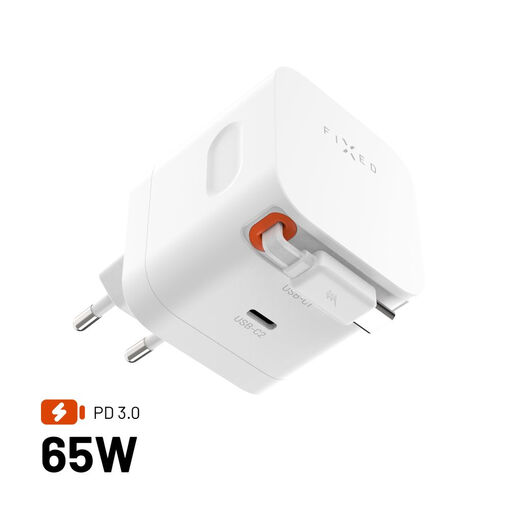
Why it stands out
This model tackles one of the traveller's worst nightmares: a tangled mess of cables. Its 64 cm USB-C cable, both integrated and retractable, is a solution as simple as it is ingenious. You pull it out to use it, and it automatically retracts once charging is complete.
Pros
Who is it for?
The digital nomad or frequent traveller looking for an ultra-practical, all-in-one solution and who is tired of tangled cables. It's the ultimate choice for simplicity and efficiency.
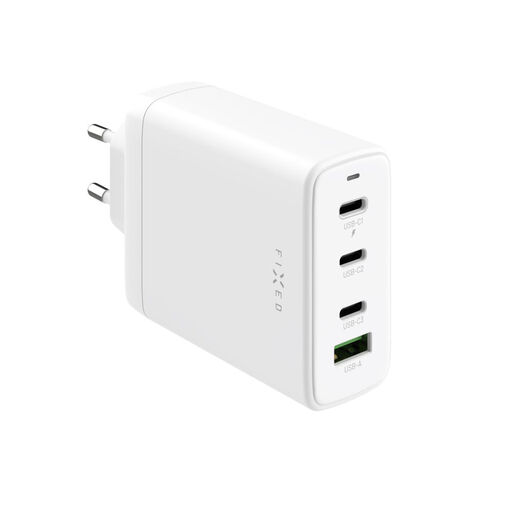
Why it stands out
With its colossal 120W of power and four ports, this model is a true pocket-sized charging station. It can simultaneously power a high-performance laptop, a tablet, a smartphone, and another accessory, all without breaking a sweat.
Pros
Who is it for?
The power user (developer, creative professional, etc.) who juggles a complete ecosystem of devices (powerful laptop, tablet, smartphone). It's also the ideal charger for a family on holiday, capable of centralising everyone's charging needs on a single outlet.
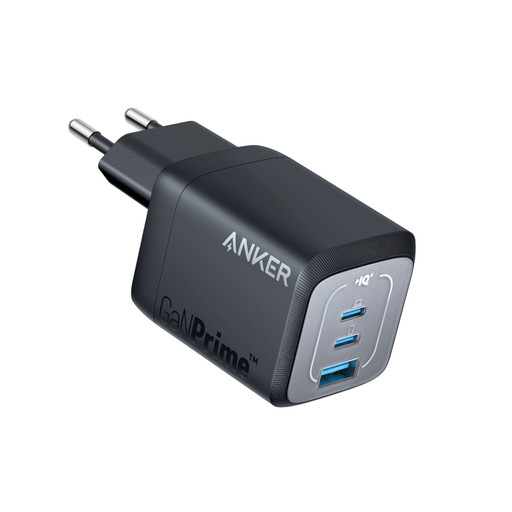
Why it stands out
Anker needs no introduction—it's the benchmark brand in the world of charging accessories. This Prime 67W model strikes the perfect balance between power, versatility, and extreme compactness, thanks in particular to its foldable prongs.
Pros
Who is it for?
The user for whom portability is the number one criterion, but who doesn't want to compromise on power or versatility. It's the ideal travel companion for those who travel light and prefer to rely on a reputable brand.
Our selection highlights solutions tailored to specific needs, but the market is flooded with options. If you're looking for different power outputs, other port configurations, or alternative designs, feel free to explore our complete collection of USB Charger Adapters.
GaN, or gallium nitride, is a next-generation semiconductor material that is replacing the silicon found in older chargers. Its main advantage? It conducts electricity much more efficiently and therefore generates less heat. This allows for more tightly packed components, ultimately resulting in chargers that are much smaller and lighter for the same power output, while also being safer.
Absolutely not. Modern chargers, especially those compatible with Power Delivery (PD), are "smart." The charger and your device (smartphone, tablet, etc.) communicate constantly so that the charger only delivers the exact amount of power requested by the device. Therefore, a 100W charger will never supply more power than your phone can safely handle (e.g., 25W).
Yes, and this is a crucial point. To take full advantage of your GaN charger's power, especially above 60W, you must use a USB-C cable that is certified to handle that wattage. For example, for a 100W charger, you will need a cable rated for "100W." Using an unsuitable cable isn't dangerous, but it will drastically limit (or "throttle") the charging speed.