
Livraison le jour même ou le lendemain

Qualité garantie

Débloquez vos offres de bienvenue: Livraison GRATUITE | Jusqu'à -80 % | 30 jours d'essai gratuits à JoyPlus
Téléchargez l'application
Fender benders, hit-and-runs, vandalism… In these situations, irrefutable video evidence is a game-changer. But the dash cam market is a jungle of technical jargon?: 4K, HDR, STARVIS 2, ADAS... It's easy to get lost.
My role as Head of Product Recommendations at Joybuy is to cut through the noise for you. This guide is designed to decode the features that truly matter and present a curated selection of front and rear 4K dash cams that blend security with performance—all without the marketing fluff.
Before diving into our top picks, let's review the essential criteria that make all the difference. Here are the key points to consider to guide your choice.
While 4K (3840x2160p) resolution has become the standard for capturing the finest details (especially license plates), it doesn't tell the whole story. The true heart of the camera is its image sensor. The latest models equipped with a Sony STARVIS 2 sensor are a game-changer, offering far superior light sensitivity and dynamic range (the ability to handle high-contrast scenes).
Add HDR (High Dynamic Range) technology, which balances overexposed and underexposed areas of the image, and you get night vision worthy of the name. This is an indispensable asset for identifying a vehicle or person when light is scarce.
A dual-lens dash cam doesn't just protect you on the road. Its mission continues even when the engine is off, thanks to parking mode. There are three main types?:
For ultimate peace of mind, the holy grail is a 4G dash cam. Once connected to the car's battery via a dedicated hardwire kit, it sends real-time alerts to your smartphone in case of an incident and even lets you view the live video feed remotely.
Beyond video capture, certain features can be decisive?:
We have selected three models that stand out from the crowd, each with its own strengths to meet specific needs.
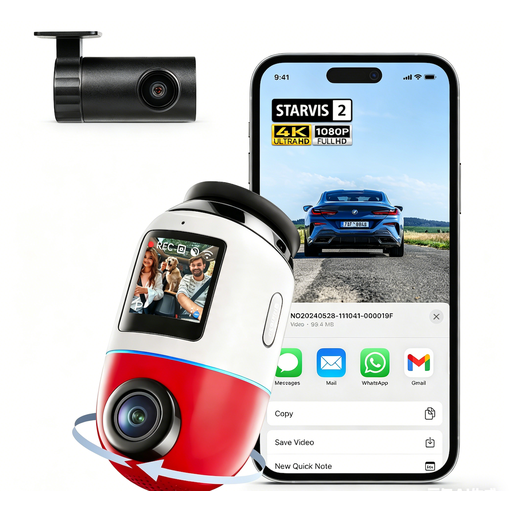
Why it stands out?: This is the market's first 360° dash cam featuring a motorized rotating head. Its main advantage? It pans around the vehicle's environment to eliminate blind spots. This new version takes performance to the next level with true 4K resolution at 60 frames per second (FPS), perfect for freezing fast-moving scenes with impeccable smoothness and clarity. The combination of a front Sony STARVIS 2 IMX678 sensor and a 1080p HDR rear camera ensures comprehensive, high-end protection.
Key Features?:
Who is it for?? For tech enthusiasts and car lovers who demand the absolute best in surveillance, without compromising on coverage or image quality. Its exclusive Red & White design also adds a touch of style to the car's interior.
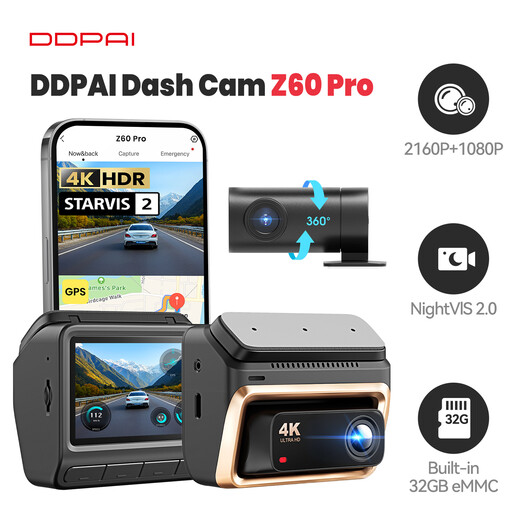
Why it stands out?: The DDPAI Z60 Pro focuses on reliability and image quality. It achieves this with a pair of Sony sensors: a STARVIS 2 IMX678 at the front and an IMX662 at the rear, both with HDR support for maximum detail, even in backlit conditions. But its real standout feature is the D?save 2.0 dual-storage system. It combines 32GB of internal eMMC memory with a microSD card slot. If the external card fails, recording instantly switches to the internal memory—a fail-safe security measure to ensure you never lose an important clip.
Key Features?:
Who is it for?? For pragmatic drivers who place data security and redundancy at the top of their priority list. A sensible choice for road professionals (ride-share drivers, sales reps, etc.) for whom losing a recording is simply not an option.
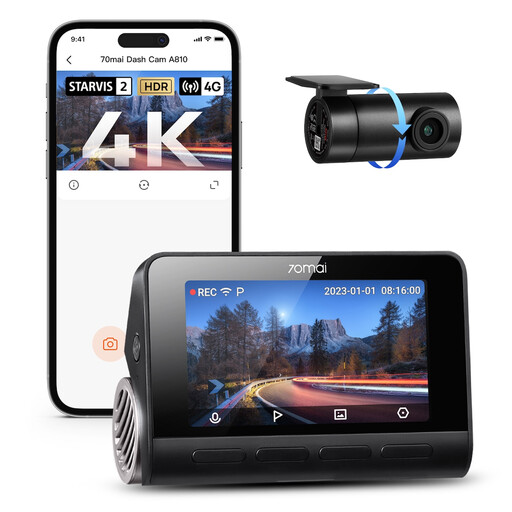
Why it stands out?: A true bestseller, the 70mai A810-2 is a proven performer, praised for its reliability and impeccable image quality. It relies on a pair of Sony STARVIS 2 sensors (IMX678 front, IMX662 rear) for 4K UHD video at the front and 1080p at the rear. But what truly sets it apart is its dual-channel HDR recording, which applies this advanced image processing to both cameras simultaneously. Combined with the proprietary 70mai Night Owl Vision technology, the results at night are stunning, with the ability to read details even when facing dazzling headlights.
Key Features?:
Who is it for?? For the driver seeking a complete, reliable, and high-performance solution that gets straight to the point. It's the ultimate Swiss Army knife, equally at home on daily commutes and long holiday road trips.
Our selection highlights a few flagship models, but the world of dash cams is much broader. If these three options don't check all the boxes on your list, whether in terms of features or budget, know that many other configurations are available.
To discover a wider range of products with different resolutions and features, take a look at our complete category.
Discover All Our Front and Rear 4K Dash Cams
Absolutely. 4K resolution offers four times the pixel density of Full HD (1080p). In practice, this means you can zoom into the footage without it turning into a pixelated mess. It's an essential advantage for reading a license plate from a distance or identifying crucial details at an accident scene.
That's an excellent question. To operate with the engine off, the dash cam must be continuously connected to the battery via a hardwire kit, which is often sold separately. Rest assured, these kits include low-voltage protection: they constantly monitor the battery's voltage and will automatically cut power to the camera if it drops below a critical threshold. This ensures there's always enough power left to start your car without any issues.
Installing the front camera is usually a breeze: you just stick it to the windshield and plug it into the cigarette lighter. For the rear camera and the hardwire kit (for parking mode), the process is more technical. It involves neatly running cables along the car's interior trim and connecting to the fuse box. If DIY isn't your cup of tea, it's best to have it installed by a professional for a clean and secure setup.