One person in a studio flat
You want to keep the appliance footprint to a minimum while retaining enough capacity for your shopping. Que Choisir suggests 100 to 150 litres of usable capacity for one person.


Measure the space and door opening before choosing, then match the capacity to your shopping habits and frozen-food needs. Que Choisir suggests 100 to 150 litres of usable capacity for one person: a table-top fridge takes up less space, while a model with a separate freezer compartment is better suited to regularly storing frozen food.
You want to keep the appliance footprint to a minimum while retaining enough capacity for your shopping. Que Choisir suggests 100 to 150 litres of usable capacity for one person.
A compact appliance may be suitable for occasional use; choose whether you need a freezer compartment based on the food you keep there. Que Choisir and the European Commission recommend checking the capacities of the compartments separately.
Compare the freezer compartment capacity, not just the total capacity. According to Que Choisir, a basic freezer compartment is not enough when you eat a lot of frozen food.
Best for: very limited space and mainly buying small quantities of fresh food.
Keep in mind: the capacity may be below the 100 to 150 litres of usable capacity suggested for one person, and freezer space is often unavailable or limited.
Best for: when space is limited but you would like to keep a few frozen items or ice cubes occasionally.
Keep in mind: freezer capacity must be checked separately; Que Choisir points out that a basic freezer compartment is not suitable for storing large quantities of frozen food.
Best for: shopping for several days at a time or regularly storing frozen food.
Keep in mind: the extra storage usually comes with a taller or bulkier appliance than a table-top fridge.
When comparing similarly sized models, the European energy label shows, among other things, annual energy consumption, compartment capacities and airborne noise emissions.
| Priority | What to check | Your needs |
|---|---|---|
| Space and usable capacity | Measure the width, depth, height, ventilation clearances and door opening. Then compare the fresh-food capacity in litres. | I want the fridge to fit in a small kitchen without having to shop too often. Que Choisir suggests 100 to 150 litres of usable capacity for one person. |
| Noise | Compare the dB(A) figures and noise class on the label for appliances of a similar size. If your bed is nearby, also check detailed tests or reviews covering vibrations and sound character. | In an open-plan room, I want to minimise disruption from an appliance that runs continuously. Que Choisir reminds us that decibels alone are not enough to predict perceived comfort. |
| Energy consumption | Read the kWh per year alongside the energy class, comparing appliances with similar capacities and designs. The label’s QR code may provide access to model information in EPREL. | I want to compare annual energy use rather than relying solely on the energy class letter. |
| Freezing | Check whether there is a freezer compartment and how much capacity it offers. Distinguish between a small freezer compartment for occasional use and a separate compartment suitable for regular storage. | I need to know whether a few ice cubes and occasional storage will be enough, or whether my frozen food requires a proper freezer compartment. |
A very small appliance can become impractical if its usable capacity does not match your shopping routine. Que Choisir puts the guideline for one person at between 100 and 150 litres of usable capacity.
Measure the space, then compare the usable capacity with the amount of food you store over several days; do not judge capacity by height alone.
An integrated compartment can be useful in a pinch, but it may not provide enough capacity for regularly storing frozen food. Que Choisir says that a basic freezer compartment is insufficient when consumption is high.
Make a list of the frozen food you usually keep and check the freezer compartment capacity in litres before choosing a single-door model.
Two appliances displaying the same figure may sound different depending on their vibrations, frequency or tone. Que Choisir highlights the subjective nature of how noise is perceived.
Use the dB(A) figure and noise class as an initial filter, then look for detailed tests or reviews if the fridge will be close to your bed or living area.
Refrigeration appliances contain components that must be handled through a specialist recycling route.
When replacing your appliance, hand the old one to the retailer or delivery driver, or take it to the designated area for electrical and electronic equipment at a recycling centre. ADEME also says that repair may be considered when the fault can be fixed.
Joybuy options for equipping a studio flat, small home or second home, with sizes ranging from mini fridges to small fridge freezers.
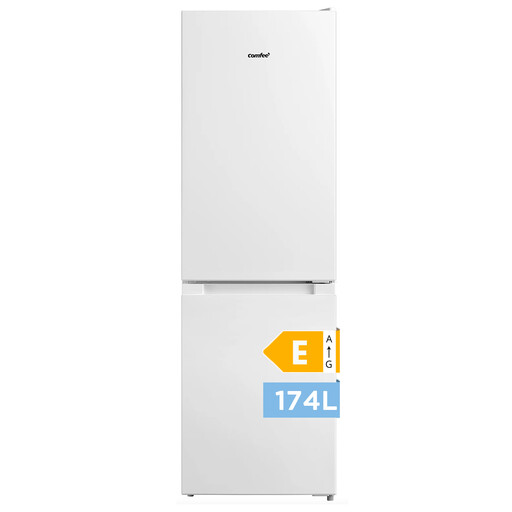 Image unavailable
Worth considering for shopping for several days and regularly storing frozen food in a narrow kitchen.
115 L fridge capacity and 59 L separate freezer capacity; width 50 cm, depth 55 cm, height 150 cm, Low Frost, 4-star compartment, stated noise level of 39 dB and reversible door.
Check the height, ventilation clearances, door opening and energy label before buying.
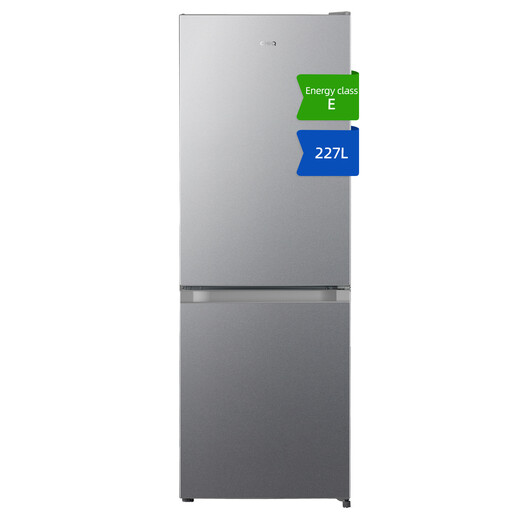 Image unavailable
For one person who cooks and freezes food regularly, provided the space can accommodate a higher-capacity appliance.
153 L fridge capacity and 74 L separate freezer capacity; width 54 cm, Low Frost, 4-star freezer, reversible door and adjustable feet.
Its 227 L capacity may be excessive when minimising the footprint is the priority; check the height, clearances and energy label.
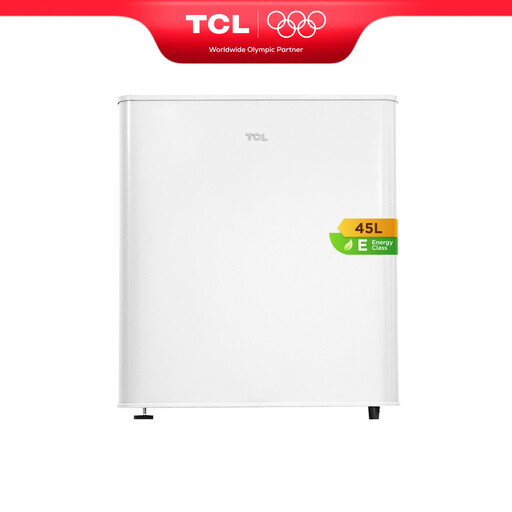 Image unavailable
Suitable for a worktop or very limited space for drinks and small amounts of fresh food.
42 L fridge capacity, stated 3 L freezer zone, dimensions 449 × 485 × 512 mm, adjustable glass shelf and adjustable feet.
The fresh-food capacity is below the 100 to 150 L guideline for one person; also check the conditions and actual temperature of the freezer zone.
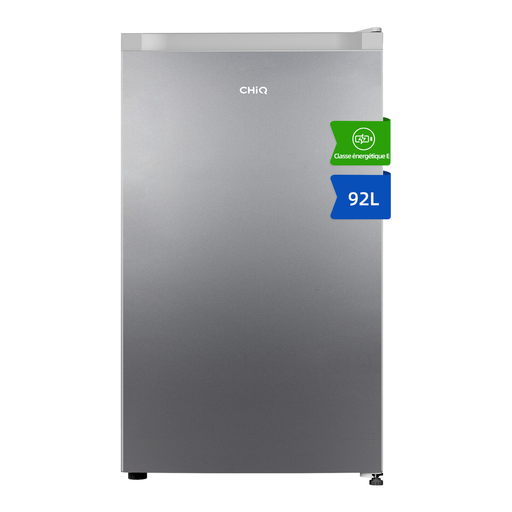 Image unavailable
An option for a small kitchen when width and floor space are the main considerations.
92 L fridge capacity, width 47 cm, stated footprint of 0.22 m², adjustable shelves, salad drawer and reversible door.
Check the capacity and conditions of the freezer section, as well as the noise level, annual consumption and full dimensions.
 Image unavailable
Worth considering for fresh food in a small kitchen or second home without a regular need for freezing.
82 L, stated noise level of 40 dB, 84 kWh/year, energy class E, LED lighting, adjustable shelves and salad drawer.
This model has no freezer compartment; measure the width, depth, height and ventilation clearances before installation.
Que Choisir suggests 100 to 150 litres of usable capacity for one person. A smaller capacity may work if you shop frequently and store little, while a small fridge freezer is better suited to keeping food for several days or storing frozen items.
Yes, provided you compare appliances of a similar type and capacity. For household refrigeration appliances, the label shows the A to G class, annual consumption in kWh, compartment capacities and airborne noise emissions, among other details; the European Commission says that the QR code provides access to additional information in EPREL.
No. A level below 40 dB(A) is a useful initial benchmark, but Que Choisir points out that disruption also depends on vibrations, frequency and the tone of the noise. If the appliance is close to your bed or living area, supplement the label information with detailed tests or reviews.
When you regularly eat large quantities of frozen food, a basic integrated freezer compartment is not enough according to Que Choisir. In that case, choose a small fridge freezer and check the freezer capacity separately from the fridge capacity.
ADEME says that you can hand it to the retailer or delivery driver when replacing it, or take it to a recycling centre with an area for electrical and electronic equipment. Repair, donation or reuse may also be considered if the appliance is still in working condition.