Living alone with a very restricted kitchenette
A table-top or under-counter model should be your first option to consider if the appliance needs to fit under a worktop or in a small recess. Measure the space before choosing the capacity.


For one person, a useful capacity of around 100 to 150 L is a good starting point according to Que Choisir; the format then depends on the space you have measured and how much room you need for frozen food. A table-top fridge suits very small kitchens and frequent shopping, while a compact fridge freezer is more suitable if you regularly store frozen food. Also compare installation dimensions, compartment capacities, noise levels and the energy label.
A table-top or under-counter model should be your first option to consider if the appliance needs to fit under a worktop or in a small recess. Measure the space before choosing the capacity.
Que Choisir recommends an average useful capacity of 100 to 150 L for one person. Then check the interior layout for fresh food, drinks and ready meals.
A proper freezer compartment is more practical than a small freezer box if you regularly keep frozen food. A compact or combined model may be suitable as long as its dimensions are compatible with your home.
Start by measuring the space, then choose the balance between fresh and frozen storage before comparing noise levels and energy consumption.
| Priority | What to check | Your needs |
|---|---|---|
| Useful capacity | Compare the fresh-food and freezer capacities separately. For one person, Que Choisir gives a useful capacity guideline of 100 to 150 L. | I want enough room for my usual shopping without choosing an appliance that is too bulky for my studio flat. If I buy a lot of frozen food, its compartment must be large enough regardless of the total capacity. |
| Overall dimensions | Measure the height, width and depth, as well as the ventilation clearances specified in the instructions. Also check the door-opening direction and the installation type. | My fridge must fit through the access route to my home and be installed without blocking a door, piece of furniture or the passage through the kitchenette. |
| Noise | Compare sound emissions in dB(A) between models of a similar size. Que Choisir uses below 40 dBA as a guideline for the quietest appliances. | When the fridge is close to the bed, desk or living area, I want to minimise noise disturbance without assuming that one figure guarantees silence. |
| Energy label | Read the A to G energy class alongside annual consumption in kWh/year, compartment capacities and noise level. Compare appliances with similar capacities and formats. | I want to assess the stated energy consumption while keeping an appliance suited to my space and shopping habits. |
Two appliances with the same total capacity can divide the space very differently between fresh and frozen food. A small freezer box does not necessarily replace a proper freezer compartment for regular shopping.
Record your fresh and frozen storage needs separately, then check the capacity of each compartment, the four-star rating and the freezing capacity where these matter to you.
The depth, height, door opening and ventilation can prevent installation or make everyday use impractical in a kitchenette.
Measure the space, the delivery route and the possible door-opening side. Also check the clearances required in the instructions for the exact model.
The figure on the label is useful for comparison, but it does not describe every intermittent noise or how they are perceived depending on the location. Que Choisir highlights this limitation.
For a living space, shortlist models below 40 dBA, then consult any available independent tests and make sure the appliance is level in accordance with its instructions.
The energy class alone tells you nothing about the capacity, noise or stated annual consumption of the model. Appliances of very different sizes are not directly interchangeable.
Compare the class with kWh/year, compartment capacities and noise, preferably between appliances of the same format and a similar capacity.
Worth considering for under-counter and table-top fridges designed for small spaces.
Worth considering for a small under-counter or built-in fridge in a compact kitchen, as well as for some small fridge freezers.
Worth considering for table-top formats and fridge freezers when you need more freezer space.
Joybuy options covering compact fridge freezers, combined models and small formats for a studio flat, depending on your shopping routine and need for frozen food.
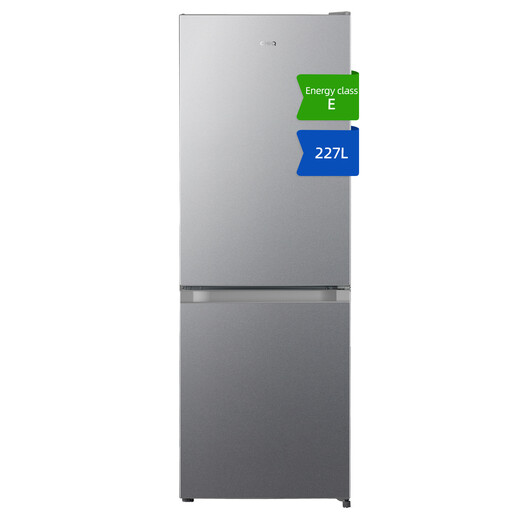 Image unavailable
Consider it if you want to keep fresh and frozen shopping clearly separated in a narrow kitchen.
153 L fridge capacity, 74 L freezer capacity, stated width of 54 cm, four-star freezer rating, 39 dB, reversible door and E energy rating.
Check the total height, ventilation clearances and delivery route before installation.
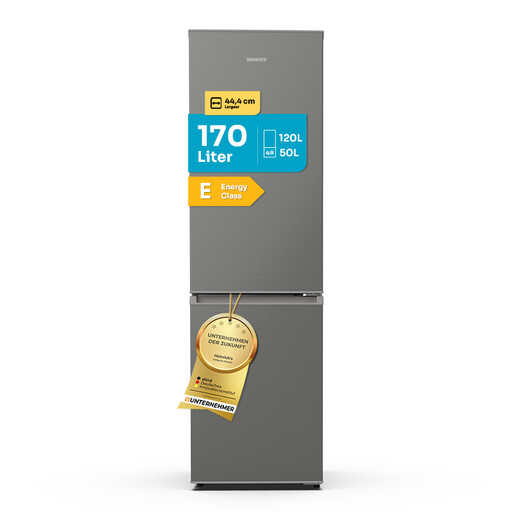 Image unavailable
This format is suitable if you are looking for fresh-food capacity close to the guideline for one person, with a separate freezer.
120 L fridge capacity, 50 L freezer capacity, three freezer drawers, four-star rating, stated noise level of 40 dB and E energy rating.
Check the overall dimensions, door-opening direction, ventilation and access route to your home. The stated noise level does not guarantee that there will be no disturbance in a living space.
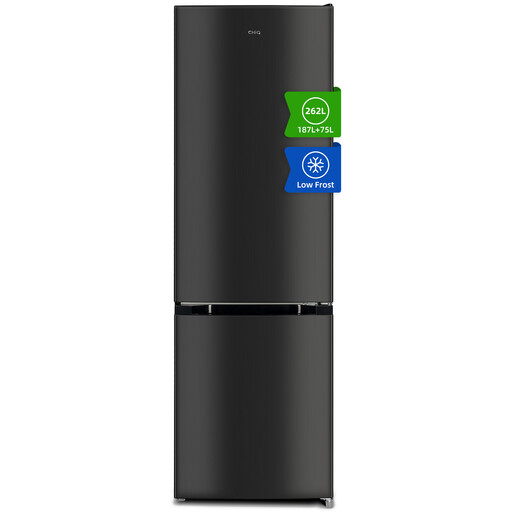 Image unavailable
Best suited to studio flats that can accommodate a tall appliance and to people who need more freezer storage.
187 L fridge capacity, 75 L freezer capacity, 54 cm width, 176 cm height, stated noise level of 39 dB, 215 kWh/year, four-star freezer rating and reversible door.
Its 262 L capacity may exceed the needs of people who do smaller shops; also check the ventilation clearances and delivery route.
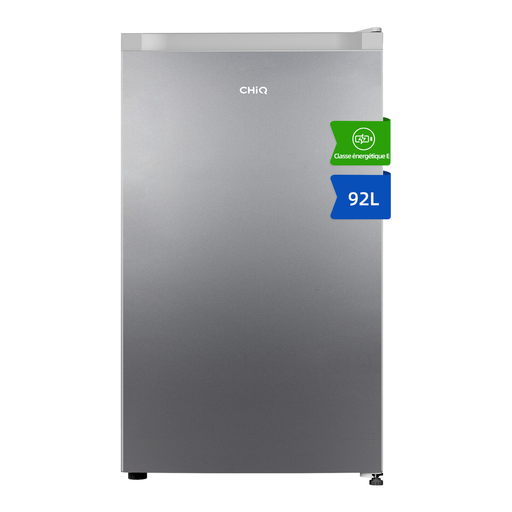 Image unavailable
Consider this model when width is your priority and you do smaller, more frequent shops.
Stated total capacity of 92 L, 47 cm width, reversible door, adjustable feet, adjustable shelves and E energy rating.
This capacity is below Que Choisir’s 100 to 150 L guideline for one person. Check the freezer capacity and rating if you keep frozen food.
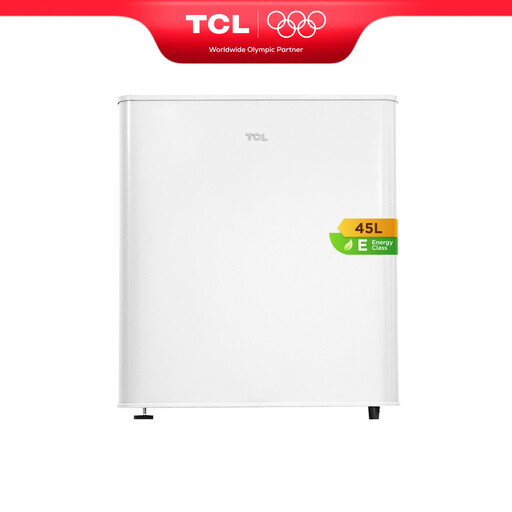 Image unavailable
This small format is designed for a very limited space and for drinks, snacks or frequent top-up shops.
Stated dimensions of 449 × 485 × 512 mm, 42 L fridge capacity, 3 L freezer box, stated noise level of 40 dB, E energy rating, adjustable feet and glass shelf.
With 45 L in total, it is not suitable for a standard week’s shopping or regular frozen food. The freezer box should not be treated as a four-star freezer without checking.
Use 100 to 150 L of useful capacity as a starting point for one person, according to Que Choisir. Then adjust this according to how often you shop, your drinks, ready meals and the space needed for vegetables; if you often buy frozen food, check the freezer capacity separately.
Compare the sound level in dB(A) shown on the label. Que Choisir uses below 40 dBA as a guideline for the quietest models, but this figure is only a shortlisting criterion: installation and the way the appliance operates also affect the disturbance you experience.
At a minimum, compare the A to G energy class, annual consumption in kWh/year, the capacities of the fresh and frozen compartments, as well as the noise level in dB(A) and its noise class. ADEME presents this label as a tool for comparing appliances within the European energy labelling framework.
Do not assume so from the product name. Check the compartment capacity on the product page or in EPREL, along with any four-star rating and the freezing capacity; these details may differ from the appliance’s total capacity.
Anses recommends a temperature between 0 °C and 4 °C at the coldest point in the fridge. Monitor the actual temperature, particularly when the appliance is very full, opened frequently or installed in a warm room.