Housemates who shop separately
Plan shelves, drawers or areas that everyone can identify, along with a labelling rule for personal food. The BUT Blog and Flatzen point out that capacity alone will not resolve disputes over shared storage.


Start by checking the delivery route, available space, door opening and clearances specified in the instructions. Then compare fridge and freezer capacities separately, based on your shared shopping habits. A fridge-freezer can work well when space is limited, while a multi-door model or separate freezer requires a suitable kitchen and a genuinely regular need for additional storage, as highlighted by guides from Que Choisir and Samsung France.
Plan shelves, drawers or areas that everyone can identify, along with a labelling rule for personal food. The BUT Blog and Flatzen point out that capacity alone will not resolve disputes over shared storage.
Compare the space allocated to fresh food with the freezer capacity, then consider how often you shop. Anses recommends storing food between 0 and +4 °C in the coldest part.
First check the delivery route, available space, door swing and the clearances specified for the model. A wider appliance can be difficult to deliver or use in a narrow kitchen.
Consider it: for keeping fresh and frozen food in one appliance when the available width or delivery route is limited.
Check: the net capacity of each compartment and the shelves you can actually use, as total capacity does not guarantee a fair split.
Consider it: if you shop less often, keep substantial supplies and have a kitchen large enough for the appliance.
Keep in mind: Que Choisir states that a large model can be close to 1 m wide and 75 to 80 cm deep. Also compare the energy label, annual consumption and noise level.
Consider it: only if frozen food consistently takes up a significant amount of space and a second, ventilated location is available.
Plan for: each appliance to be installed, powered, maintained and shared according to its own requirements.
| Priority | What to check | Your needs |
|---|---|---|
| Usable capacity that can be divided | Compare the net capacities of the fridge and freezer separately. Check the number, surface area and position of shelves, drawers and door racks. | I want everyone to be able to store their food without taking over an entire area. Accessible, clearly identifiable compartments matter just as much as the advertised capacity. |
| Balance between fresh and frozen food | Compare freezer capacity with your frozen food, prepared meals and bulk purchases. Check the climate class specified by the manufacturer. | My shopping may consist mainly of fresh food, or the opposite may be true, with lots of frozen items. The right format depends on this actual split, not just on the number of housemates. |
| Kitchen compatibility | Measure the appliance, the space required with the doors open, the delivery route and the alcove. Check the opening direction and the ventilation clearances specified in the instructions. | I need to be able to deliver, install and open the appliance without blocking the walkway or neighbouring furniture. |
| Hygiene and maintenance | Set and check the temperature in the coldest part; Anses recommends 0 to +4 °C. Avoid overloading the shelves and plan to use sealed containers. | A shared fridge should be easy to clean and organise. Allocated areas and labels for personal food help prevent mix-ups. |
The number of occupants alone does not tell you how many meals are prepared, how much of the shopping is shared or how much frozen food is stored. Que Choisir’s capacity guidelines are a useful starting point, but they should be adapted to how your household actually uses the appliance.
For one or two weeks, note your fresh, frozen and shared purchases, then compare the net capacities and storage areas of each compartment.
Que Choisir states that an American-style or multi-door model may require around 1 m of width and 75 to 80 cm of depth, compared with around 70 cm wide for a standard model.
Measure the corridor, lift, corners, installation space and door swing before choosing the exact model.
Door opening and the clearances around the appliance are part of the installation requirements. The measurements to follow depend on the model.
Read the instructions or installation sheet, check whether the doors can be reversed and make sure no furniture obstructs them.
An appliance that is too full restricts the circulation of cold air. Anses recommends a temperature between 0 and +4 °C in the coldest part and highlights the importance of arranging food so that the temperature remains even.
Leave space between food items, keep opened products in sealed containers, label personal food and clean the inside regularly.
Joybuy options for organising shared food storage, including fridge-freezers, multi-door and side-by-side models to compare according to the available space and the balance between fresh and frozen food.
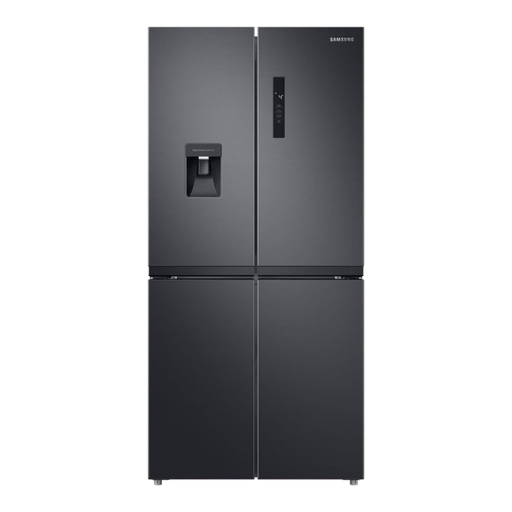 Image unavailable
For large shared shops and personal food: 329 L of fridge capacity and 159 L of freezer capacity, with 3 shelves, 5 door racks, 2 fresh-food drawers and several freezer areas. Listed dimensions: 83.3 × 179.3 × 74 cm; check the delivery route, door opening and ventilation clearances before buying.
 Image unavailable
A fridge-freezer designed for a narrow kitchen, with 187 L of fridge capacity, 75 L of freezer capacity, 4 shelves including 3 adjustable ones, 3 door racks and 3 drawers. It measures 1760 × 540 × 550 mm and has a reversible door; the Low Frost compartment requires manual defrosting approximately once or twice a year.
 Image unavailable
An integrated option with 186 L of fridge capacity and 62 L of freezer capacity, 5 glass shelves, a salad drawer and 3 freezer drawers. This sliding-door model requires a compatible housing unit: check the niche dimensions and installation requirements before choosing it.
 Image unavailable
For a house share that stores plenty of fresh and frozen food: 333 L of fridge capacity and 192 L of freezer capacity. No Frost and Multi-Airflow functions are listed; however, check the dimensions, clearances, door swing and interior layout before installation.
 Image unavailable
A large-capacity fridge listed at 444 L, with Total No Frost, LED lighting, temperature control and rapid cooling. Before choosing this side-by-side format, check the split between fresh and frozen capacity, the dimensions, the doors and the available storage areas.
Use capacity as a starting point rather than a fixed rule. Que Choisir suggests an average of 100 to 150 L for one person, followed by an additional 50 L per person. Adapt this guide to your shopping, prepared meals, frozen food and the food you genuinely share, comparing the compartments separately.
Measure the delivery route, installation space, room needed to open the doors and the clearances specified in the model’s instructions. Samsung France points out that installation distances can vary depending on the appliance.
Assign identifiable shelves, drawers or areas to each person and decide what is shared before shopping. The BUT Blog and Flatzen recommend a clear system and labelling for food that is not shared, so choose an interior whose storage areas remain accessible.
Anses recommends a temperature between 0 and +4 °C in the coldest part. Avoid overloading the appliance so that cold air can circulate, and clean the areas used by everyone regularly.
Yes. ADEME states that large household appliances must display an energy label in shops and online. Compare the class, annual consumption, noise level and usable capacity of the exact model rather than focusing on just one specification.