Households that buy frozen food every week
If your basket regularly includes vegetables, ice cream or frozen meals, look at the space allocated to the freezer separately from the fridge capacity.


If your weekly shop regularly includes frozen food, start by comparing fridge freezers, which have a separate freezer compartment. A multi-door model may suit larger shops if your kitchen has room for it; a single-door or table-top model is better if space is very limited, although it offers less room for frozen food. In every case, check the capacity of both compartments and the installation requirements for the specific model.
If your basket regularly includes vegetables, ice cream or frozen meals, look at the space allocated to the freezer separately from the fridge capacity.
You want enough room for your groceries without exceeding the dimensions allowed by the available space, doorways or planned installation type.
If the appliance is near a living area, its noise level is also worth considering. ADEME points out that a fridge runs continuously, so compare the annual energy consumption of the models you’re considering too.
Start by considering how much space your fresh and frozen food actually takes up, then factor in the room available in your kitchen.
Consider this if: you want to store several days’ worth of shopping with a separate freezer, without immediately opting for a particularly wide appliance.
Bear in mind: freezer capacity varies by model and installation type, even among fridge freezers.
Consider this if: storing larger quantities of fresh and frozen food is a priority and your kitchen can accommodate a wider appliance.
Bear in mind: it needs more space. ADEME points out that a larger size and extra features can also increase energy consumption.
Consider this if: you mainly store fresh food and only buy frozen food occasionally.
Bear in mind: the small compartment can quickly prove limiting if you regularly buy frozen food, as Que Choisir’s guide explains.
Consider this if: the space available — for example, in a studio flat or beneath a worktop — determines which size you can choose.
Bear in mind: the smaller capacity gives you less room for both fresh food and frozen food.
| What to consider | What to check | Who this matters to |
|---|---|---|
| Space for frozen food | Compare the freezer capacity in litres separately from the fridge capacity, then look at the shape of the drawers. | If I buy frozen food every week, I don’t want to find that a large total capacity hides a small freezer. Around 36% of consumers would prioritise space for frozen food. |
| Size and installation | Measure the height, width and depth; check that the doors can open fully and look at any installation or housing requirements. | In a narrow or fitted kitchen, I need to be able to install the appliance and open its doors without obstruction. This would be the priority for around 29% of consumers. |
| Space for fresh food | Compare the fridge capacity and the layout of the shelves and drawers with your usual shop. | My weekly shop also includes drinks and fresh food: I want to store everything without sacrificing all the freezer space. Around 21% of consumers would prioritise this balance. |
| Energy use, noise and maintenance | Compare the annual energy consumption, noise level in dB(A) and cooling system of the specific models. | With my living area nearby, noise matters every day, as does the energy use of an appliance that’s always running. Around 14% of consumers would put these aspects first. |
This figure doesn’t tell you how much room there is for frozen food. A small freezer compartment can become restrictive if your weekly shop includes frozen products.
Compare the fridge and freezer capacities in litres separately, then check whether the drawers suit the food you usually buy.
The depth, height and door clearance can prevent installation or make the appliance difficult to use. Size is particularly important with a multi-door model.
Measure the space and the delivery route, then check the manual for clearance requirements and, for a built-in model, the housing dimensions.
ADEME points out that fridges and freezers run continuously, and that a larger size and extra features can increase their energy consumption.
Compare the annual energy use of models with capacities that meet your needs, rather than relying on the list of features alone.
Anses advises against overfilling the fridge so that cold air can circulate. Choosing a capacity that’s too small makes this harder.
Allow enough room to store food without packing it in, and check the temperature at the coldest point.
The range includes freestanding and built-in fridge freezers. Check the installation type before comparing capacities.
The range includes multi-door models, worth considering if you’re looking for several compartments and have enough space.
Haier’s range includes single-door, double-door, fridge-freezer and side-by-side models, giving you several formats to consider.
These fridge freezers and multi-door models let you compare options for storing several days’ worth of shopping, including frozen food. The stated total capacity doesn’t replace checking the capacity of each compartment and the space needed for installation.
 Image unavailable
Worth considering if you’re looking for a multi-door fridge freezer for regular shops that include frozen food, provided there’s enough room for it in your kitchen.
Four doors, Total No Frost and energy rating E. Check the capacity of each compartment, the delivery route and the installation clearances.
 Image unavailable
This fridge freezer is worth comparing if you want to keep fresh food separate from frozen food without choosing a multi-door model.
Three doors, Total No Frost, energy rating E, Wi-Fi and My Zone. Check how the capacity is divided, the delivery route dimensions and the ventilation clearances.
 Image unavailable
Consider this if your weekly shop calls for a larger model and you have room for a multi-door fridge freezer.
Energy rating E. Before choosing, compare the fridge and freezer capacities, and check the delivery route and the clearances needed for installation.
 Image unavailable
This fridge freezer with a bottom freezer may suit shops that include both fresh and frozen food, once you’ve checked how much space each compartment offers.
Energy rating E. If the appliance will be near a living area, compare its noise level too, and check the clearance required for installation.
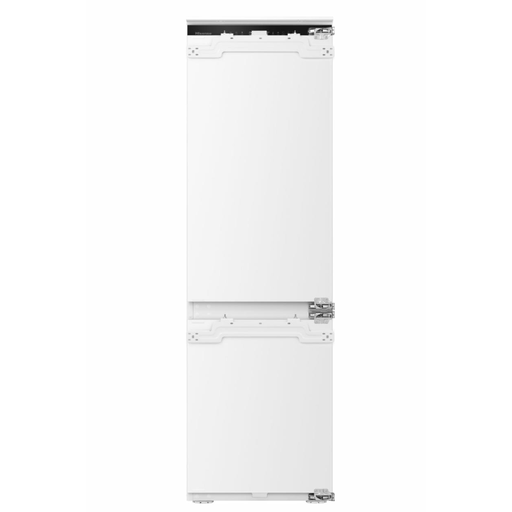 Image unavailable
Worth considering if your kitchen is designed for a built-in appliance and you need compartments for both fresh and frozen food.
No Frost, energy rating C and an Inverter compressor. Before buying, compare the capacity of each compartment with your shopping needs, and check the housing, door fixing and required clearances.
Anses recommends keeping the temperature between 0 °C and 4 °C at the coldest point. Check it especially if the appliance is very full or its door is opened frequently. This is about how you use the fridge, rather than the size you choose.
No. First, prioritise capacities and dimensions that suit your shopping needs and kitchen. On models with No Frost, you don’t need to defrost the freezer manually; a LowFrost system reduces ice build-up but doesn’t prevent it completely.
It lets you compare their annual energy consumption, among other things. The DGCCRF confirms that household fridges are among the appliances covered by energy labelling in France. Compare this figure with the capacity and features of each model, rather than judging its energy consumption by the rating alone.
Before placing your order, confirm access to your home, delivery, any installation service and the arrangements for removing your old appliance with the seller. The French Ministry for Ecological Transition describes a ‘one-for-one’ take-back service when you buy an appliance of the same type. If you buy from a business in France, the legal guarantee of conformity applies regardless of any services offered by the seller, as the French Ministry of the Economy points out.