What to look for
Start by working out how much extra capacity you need and where the appliance will go. Then compare the internal layout, energy consumption and installation requirements of the specific model.
| Priority |
What to check |
Your needs |
| Usable capacity and format |
Compare the usable litre capacity with the shortage of space you have identified. Check whether it is an upright model with drawers or a chest freezer with an open compartment, as well as the dimensions, door or lid clearance and delivery route. |
I want to store groceries, prepared meals or bulky products without installing an overly large appliance. A chest freezer is ideal for large volumes; an upright model makes it easier to separate food for everyday use. |
| Energy consumption and label |
Since March 2021, the European energy label has used a scale from A to G. Compare kWh/year, storage capacity and noise levels between appliances with similar capacities and formats. |
I am looking for an appliance suited to my storage needs without relying solely on an old A+, A++ or A+++ rating. The European Commission states that the label also shows annual consumption and capacity. |
| Installation room and power cuts |
Check the climate class and permitted ambient temperatures for the exact reference. Also compare the stated storage time in hours and, where necessary, whether the appliance has a high-temperature alarm. |
My freezer needs to work in the kitchen, utility room, cellar or planned garage. ADEME recommends checking the suggested ambient temperature for the room where the appliance will be installed. |
| Storage and maintenance |
Look at the drawers, baskets, adjustable compartments and space allocated to large items. Check whether the model uses a No Frost system or requires manual defrosting. |
I want to find food easily and choose a maintenance routine that suits my habits. For a manually defrosted appliance, UFC-Que Choisir recommends defrosting when the frost reaches 3 mm, as it increases energy consumption. |
Options available on Joybuy
This Joybuy selection brings together chest freezers for increasing household storage, along with an upright model for households that prefer drawer-based organisation.
 Image unavailable
AUCMA 291 L convertible chest freezer
For bulk shopping, large batches of prepared food and bulky products in a 291 L compartment.
Energy class E, 226 kWh/year, five-level digital control, LED lighting, removable basket and defrost drain. Stated dimensions: 1100 × 597 × 872 mm; allow 10 cm of clearance for ventilation. Check the climate class, ambient temperature range and storage time before installing it in a garage, cellar or utility room.
Joybuy
 Image unavailable
Heinrich’s 161 L No Frost upright freezer
For organising portions and food by category, thanks to three drawers and two shelves.
Energy class C, No Frost system, Fast Freeze function, LED display, alarm and reversible door. The model is designed for freestanding installation and is not built in; allow sufficient ventilation and check the dimensions, annual consumption, climate class and storage time before buying.
Joybuy
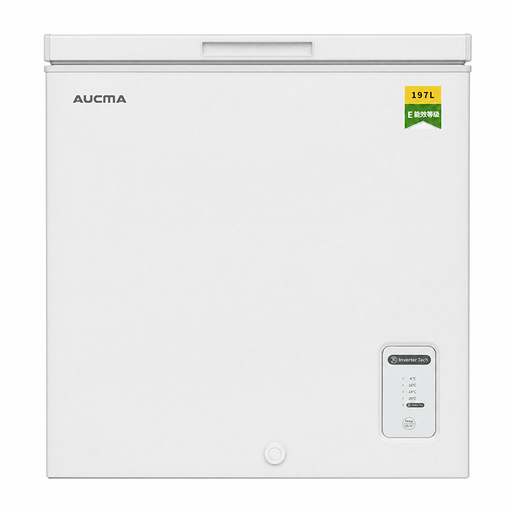 Image unavailable
AUCMA 197 L convertible chest freezer
For adding significant storage capacity without moving up to a very large chest freezer.
Capacity of 197 L, energy class E, 197 kWh/year, five-level digital control, removable basket, defrost drain and adjustable feet. Stated dimensions: 816 × 554 × 848 mm. You can select refrigerator or freezer mode; check the permitted ambient temperatures and storage time for installation in an additional room.
Joybuy
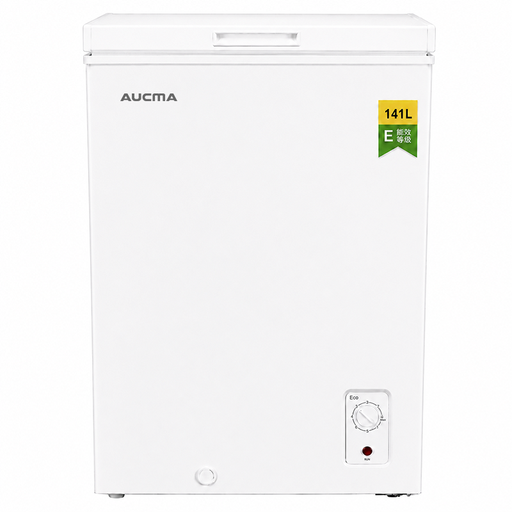 Image unavailable
AUCMA 141 L convertible chest freezer
For extra mid-sized storage in a home where every centimetre counts.
Capacity of 141 L, energy class E, 179 kWh/year, seven-level mechanical thermostat, removable basket and defrost drain. Stated dimensions: 632 × 554 × 848 mm. Storage is based around a compartment with a basket rather than detailed drawer organisation; check the climate class and storage time before installing it outside the kitchen.
Joybuy
 Image unavailable
CHiQ JR99DWE 99 L chest freezer
For a small storage boost in a restricted space rather than for large bulk purchases.
Capacity of 99 L, four-star freezing, freezing capacity of 4,5 kg/24 h, mechanical thermostat, removable metal basket, sliding lid and energy class E. Stated dimensions: 54,5 × 47,6 × 83,5 cm; allow 10 cm of clearance. Manual defrosting is required when frost exceeds 5 mm according to the product description.
Joybuy
Frequently asked questions
How can I tell whether a freezer can be placed in a garage or cellar?
Check the climate class and, above all, the ambient temperature range stated in the technical specification or instructions for the exact model. Do not assume that a chest freezer is suitable for an unheated room: this varies by reference. For example, Beko states that the HSM14540 has a minimum operating temperature of −15 °C and climate class SN-T.
What should I check on a freezer’s energy label?
For the relevant domestic appliances sold in the European Union, the label uses an A to G scale and shows annual kWh consumption, the volume of frozen compartments and noise level, among other details. Compare this data only between appliances suited to the same format and capacity requirements; EPREL can provide additional model information via its QR code.
Is storage time during a power cut important?
Yes. It indicates how long food remains frozen during a power failure or outage. UFC-Que Choisir’s test protocol measures the time taken to rise from −17 °C to −9 °C without a power supply; therefore, compare the stated or tested figures for the models you are considering, especially for an appliance located in an additional room.
Does a No Frost model eliminate all maintenance?
No. A No Frost system reduces or eliminates the need for defrosting, depending on the model, but you should still follow the instructions, keep the ventilation clear and clean the appliance. For manually defrosted models, UFC-Que Choisir recommends taking action as soon as frost reaches 3 mm, as it increases energy consumption.


