
Livraison le jour même ou le lendemain

Qualité garantie

Débloquez vos offres de bienvenue: Livraison GRATUITE | Jusqu'à -80 % | 30 jours d'essai gratuits à JoyPlus
Téléchargez l'application
A good food storage container can revolutionise your kitchen routine, help you waste less, and preserve the freshness of your meals. The problem? The market is saturated with products whose marketing promises are often disappointing. As a product expert for Joybuy, my mission is to guide you through this jungle of options to find reliable solutions that fit your daily life, without falling into the common traps.
Before you start shopping, it's crucial to know the setbacks that can turn a good purchase into a regret after just a few weeks of use.
To make an informed choice, focus on these key points that make all the difference in terms of durability and practicality.
The choice of material directly impacts the use, durability, and maintenance of your containers.
A good locking system is the secret to successful food preservation. The most reliable models combine two elements:
For maximum versatility, especially if you're a fan of meal prep (preparing meals in advance), keep an eye on the icons:
Rather than an endless list, we've selected products that meet specific needs, based on our criteria for quality and practicality.

Why we love it: Perfect for family meal prep, this large glass dish lets you cook, store, transport, and reheat. Its generous capacity is ideal for gratins, lasagnas, or saucy dishes prepared for several days.
Its borosilicate glass body won't stain or retain any odours, even when faced with a stubborn tomato sauce or a spicy dish. The airtight lid with a steam vent prevents splatters in the microwave.
Its total versatility: it goes in the oven (without the lid), microwave, freezer, and dishwasher. A true all-in-one that radically simplifies meal preparation.
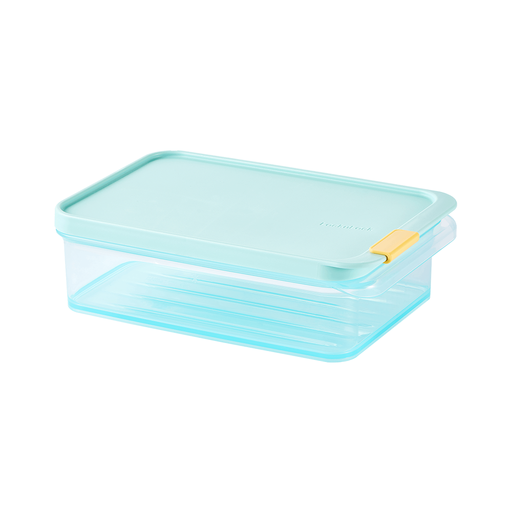
Why we love it: Specially designed for freezing, this container is the queen of optimisation thanks to its modular and perfectly stackable design. Ideal for those who love to batch-freeze soups, sauces, or individual portions.
Its material is specially designed to withstand very low temperatures without cracking. Its stackable design, with a recessed lid to hold the base of another container, ends freezer chaos and maximises every square inch.
Space optimisation thanks to its modular stacking system. A clever bonus: the label clips, which make it easy to track contents and freezing dates.
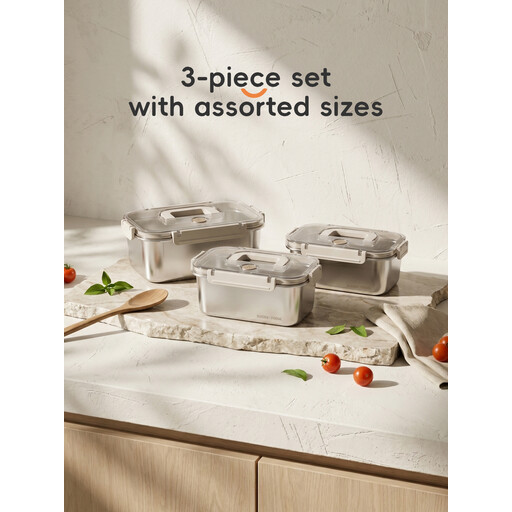
Why we love it: This set of 304 stainless steel containers is the healthy and virtually indestructible solution for storing leftovers, packing lunches, or organising the fridge. Stainless steel is unbreakable, lightweight, and perfectly hygienic.
Unlike plastic, stainless steel is completely inert: no more stains, lingering odours, or warping. It's a long-term investment that will remain pristine year after year.
A healthy, corrosion-resistant, and ultra-easy-to-clean material. The set of three sizes offers great flexibility to adapt to all your needs.
Discover our complete selection of products that meet our strict selection criteria and current safety standards.
How can I prevent tomato sauce stains on my plastic containers? Here's a pro tip: before pouring in your sauce, wipe the inside of the container with a paper towel lightly coated in vegetable oil. The oil creates a protective barrier that prevents pigments from setting into the plastic.
Can all glass containers go in the oven? No, be careful! Only containers made of borosilicate glass are designed to withstand thermal shock and can go from the refrigerator to the oven (after allowing time to adjust to room temperature). Always check the manufacturer's instructions. And of course, the plastic lid should never go in the oven.
The silicone seal on my container is mouldy, what should I do? If the seal is removable, take it out and let it soak for an hour in a mixture of hot water and white vinegar. Then, scrub it with a small brush (a dedicated toothbrush works well), rinse thoroughly, and let it air-dry completely before putting it back. If the seal is not removable, it's unfortunately almost impossible to salvage... This is a decisive factor to consider when buying.