
Same-day & Next-day Delivery

Quality Guaranteed

Unlock Your Welcome Offers: FREE Delivery | Up to 80% OFF | Free 30-day JoyPlus trial
Download the APP
Whether for taking lunch to the office, prepping meals for the week (the famous "meal prep"), or simply storing dinner leftovers, the food storage container is a kitchen essential. But with an overwhelming number of options, it's hard to know what to choose and avoid buyer's remorse. A leaking lid, stained plastic, cracked glass… these are all disappointments that can easily be avoided.
As the Head of Product Selections at Joybuy, I'm here to help you see things more clearly. Let's forget the marketing jargon and focus on what really matters day-to-day: practicality and durability. This guide breaks down the pitfalls to avoid and points you towards the most suitable models for your needs.
The market is flooded with products making tempting promises. Unfortunately, some of the advertised features hide flaws that only become apparent with use. Here are the three most common pitfalls.
To avoid these traps, you just need to check a few key parameters before buying.
Each material has its own advantages and disadvantages, suited for different uses.
A leak-proof seal relies on two pillars: the locking mechanism and the gasket. Systems with clips on all four sides are often the most effective, as they distribute pressure evenly. As for the gasket, it should be made of high-quality, flexible silicone and, most importantly, be removable for a deep clean to prevent mould growth.
Always check the manufacturer's icons or instructions:
Also, consider the stackability of the containers: a detail that makes all the difference in optimising space in your cupboards and fridge.
Rather than an impersonal list, we've matched user profiles with products that meet their specific needs.
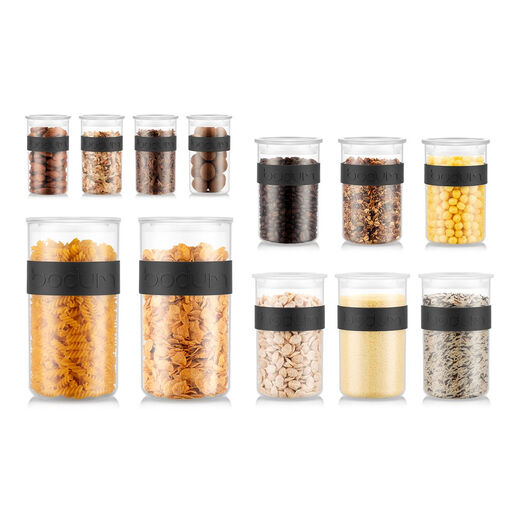
Why we recommend it: For anyone who preps their meals for the week, this comprehensive set is the all-in-one solution. The four sizes allow you to compartmentalise everything (main dish, side, sauce, snack), and their stackable design optimises storage down to the last inch.
This food storage container set ends the headache of mismatched containers. The BPA-free plastic is perfect for fridge storage and transport, while the airtight system guarantees food freshness.
A 12-piece set with 4 ultra-versatile sizes (from 0.25 L to 2 L) for impeccable and consistent organisation of your meal preps.

Why we recommend it: Perfect for family meals. Its large capacity allows you to bake a casserole, store it in the fridge, and then reheat it directly in the microwave. The true all-in-one dish.
It avoids the trap of misleading versatility. The borosilicate glass body is a true oven-safe storage dish, and its lid includes a steam vent for safe, splatter-free reheating in the microwave.
Its large 2.3 L capacity and clever lid with a steam vent, designed for the full cycle: cook, store, reheat.

Why we recommend it: For those who pack their lunch every day and won't compromise on durability and hygiene. Stainless steel is robust, lightweight, and resists both stains and odours, making it the perfect lunch box for heavy use.
This stainless steel storage container tackles the problem of stubborn plastic stains and odours head-on. The 316 stainless steel offers enhanced corrosion resistance and guarantees impeccable flavour neutrality.
An ultra-durable and hygienic material (316 stainless steel), lightweight for transport, and available in a practical set of three sizes (600 ml, 1100 ml, 2200 ml).
Discover our full selection of products that meet our quality criteria and current safety standards.
To maintain the effectiveness of your leak-proof food container, the best practice is to remove the silicone gasket from the lid before each wash. Clean it by hand with warm water and a little soap. Make sure the gasket and its groove are completely dry before putting it back in place. This will prevent mould from forming and extend its lifespan.
It's best to avoid extreme thermal shock. Even a highly resistant borosilicate glass dish can be weakened by moving abruptly from hot (out of the oven) to cold (freezer). The best practice? Let the dish cool to room temperature for a few minutes before placing it in the refrigerator or freezer.
BPA (Bisphenol A) is a chemical compound used in the manufacturing of certain plastics. Some studies suggest it can leach into food and may pose health risks. Choosing a BPA-free food container is therefore a precautionary measure, ensuring the container is made from a plastic considered safer for food contact.