
Livraison le jour même ou le lendemain

Qualité garantie

Débloquez vos offres de bienvenue: Livraison GRATUITE | Jusqu'à -80 % | 30 jours d'essai gratuits à JoyPlus
Téléchargez l'application
Smudged lines, skipping ink, a tired hand after just a few paragraphs… Finding the perfect pen might seem trivial. Yet, for students, professionals, or journaling enthusiasts who fill pages daily, every detail matters. A quality fine-point black gel pen isn't a luxury; it's an essential tool for clear notes, neat work, and a genuine pleasure in writing.
This guide breaks down the essential criteria and presents our selection of the best models, whether you're in the middle of a lecture or organising your planner.
Before diving into our top picks, let's review a few key criteria to help you make an informed choice.
The term "fine point" generally refers to a diameter between 0.38 mm and 0.5 mm. A 0.5 mm black ink pen offers an excellent balance between precision and smoothness, ideal for those with small handwriting or who need to fill in forms and planners with limited space. A finer tip allows for clean, controlled lines, which is essential for an effective note-taking pen.
The key advantage of gel ink is its consistency. It's thicker than the ink in a classic ballpoint, ensuring more intense colours and a much smoother glide. The only drawback? Drying time, which can vary from one model to another. To avoid smudges, opt for a no-smear pen with quick-drying ink. This is a crucial feature for left-handers or anyone annotating documents on the fly. Smooth, uninterrupted writing is the hallmark of a quality mechanism.
For a student pen or an office pen used for hours on end, comfort is paramount. Look at the grip area: is it made of rubber, silicone, or textured for a better hold? The shape of the pen's barrel (cylindrical, triangular) and its weight also affect hand fatigue. A well-balanced pen fades into the background, letting you focus on what's important: your ideas.
We've selected a few gems, each tailored for a specific use.

Why it stands out: This pen successfully combines the smoothness of gel with the magic of erasable, heat-sensitive ink. Mistakes happen, and being able to correct them cleanly—without cross-outs or correction fluid—is a decisive advantage.
Highlights:
Who is it for? Ideal for students, fans of planners and bullet journals, and anyone who likes to revise their work without leaving a trace. This gel pen set is a cost-effective and practical solution.
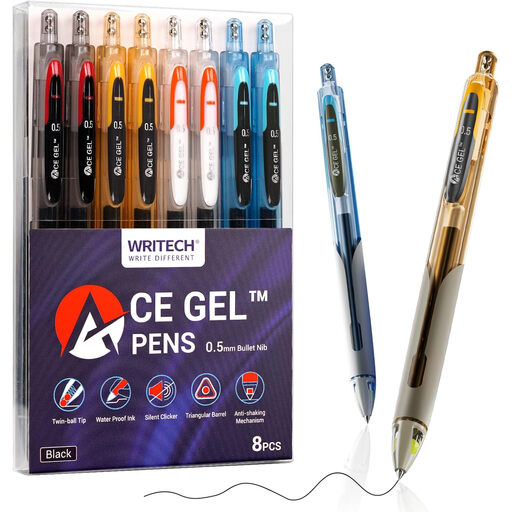
Why it stands out: The WRITECH pen focuses entirely on the writing experience with two thoughtful innovations: a silent click mechanism and comfort-focused ergonomics.
Highlights:
Who is it for? The perfect companion for professionals in open-plan offices, students in libraries, and anyone sensitive to noise who is looking for a high-performance, discreet office pen.
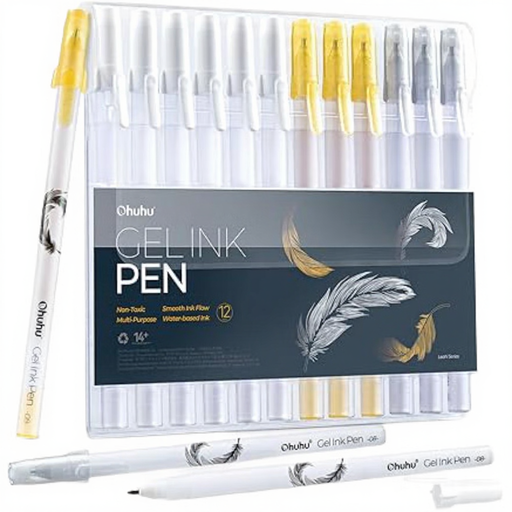
Why it stands out: It's impossible to talk about gel pens without a nod to creative uses. This Ohuhu set isn't a black pen, but a collection of white, gold, and silver gel pens specially designed to stand out on dark surfaces.
Highlights:
Who is it for? Artists, creatives, and craft enthusiasts looking to add bright and metallic touches to their work on dark or unique papers.
Our selection focuses on specific uses, but the world of gel pens is vast. If you are particularly interested in options for dark paper or wish to explore other models, feel free to browse our dedicated category for Gel Pens for Black Paper.
1. How can I prevent gel pen ink from smearing? The main factor is the ink's drying time. Opt for pens labelled as "quick-drying". Paper quality also plays a role: a more absorbent, less glossy paper will limit smudging. Finally, for left-handers, using a very fine tip (0.5 mm or smaller) deposits less ink and reduces the risk of smearing.
2. What is the difference between a 0.5 mm and a 0.7 mm point? A 0.5 mm point produces a fine, precise line, ideal for small handwriting, detailed diagrams, or notes in the margins. A 0.7 mm point offers a bolder line and an often more pronounced gliding sensation, which can be more comfortable for faster, larger writing, but it also lays down more ink.
3. Can a black gel pen be used on all types of paper? Yes, gel ink is very versatile. It works well on most office and notebook papers. However, on very glossy or coated paper (like photo paper or certain magazines), the ink will take longer to dry and is likely to smear. For best results, standard uncoated paper is recommended.