
Livraison le jour même ou le lendemain

Qualité garantie

Débloquez vos offres de bienvenue: Livraison GRATUITE | Jusqu'à -80 % | 30 jours d'essai gratuits à JoyPlus
Téléchargez l'application
By the Joybuy Product Recommendation Officer, July 21, 2026
A cable that charges at a snail's pace, frays after a few months, or is just too short to be practical: we've all been there. With the USB-C port now ubiquitous on our devices—from the iPhone 15 and MacBook to the Nintendo Switch—finding the right fast-charging USB-C cable has become a real challenge.
Faced with a jungle of options, it's hard to know where to start. Power, length, durability... what are the criteria that truly matter? This guide breaks down the essential technical specs and presents a selection of cables tailored for specific needs: office work, gaming, or intensive on-the-go use.
Before you buy, it's crucial to understand a few concepts that separate a basic cable from a high-performance model built to last.
Charging speed doesn't just depend on your charger; the cable plays an equally vital role. Power, measured in watts (W), indicates the amount of energy the cable can transfer. To take advantage of fast charging, your cable must be compatible with the Power Delivery (PD) protocol.
The outer jacket is your best defence against daily wear and tear. Where basic plastic cables eventually crack near the connectors, a braided cable made of nylon offers far superior resistance to twisting, repeated bending, and abrasion. These models are tested to withstand thousands of bends, making them the smart choice for mobile or heavy use.
The standard 1-metre length is often just not enough. A 2m USB-C cable provides welcome freedom of movement, allowing you to use your device comfortably even when you're far from an outlet.
For certain uses, the connector's ergonomics make all the difference. A 90-degree angled cable proves to be a particularly smart design for gaming on a smartphone or portable console. It ensures a better grip without the cable getting in the way and reduces strain on the device's port, thereby extending its lifespan.
Here are three models that stand out for their performance and design, tailored to very specific uses.
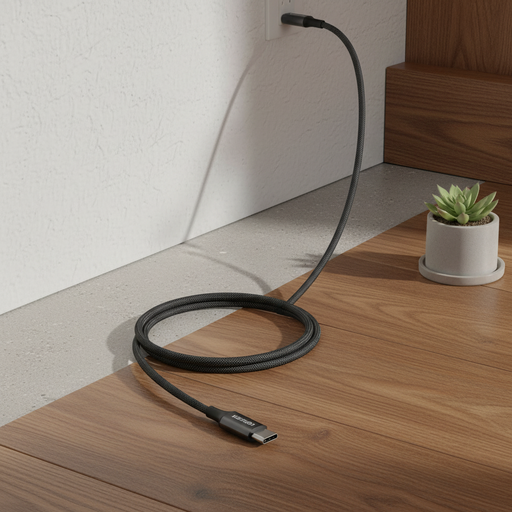
Why it stands out: Its ability to deliver up to 100W makes it compatible with the most demanding devices. It features an E-Marker chip that communicates with the charger and device to ensure safe and optimised power delivery.
Advantages:
Who is it for? For owners of MacBook Pros, laptops with USB-C Power Delivery, and anyone who wants a single cable capable of charging all their devices, from the smallest to the most powerful.
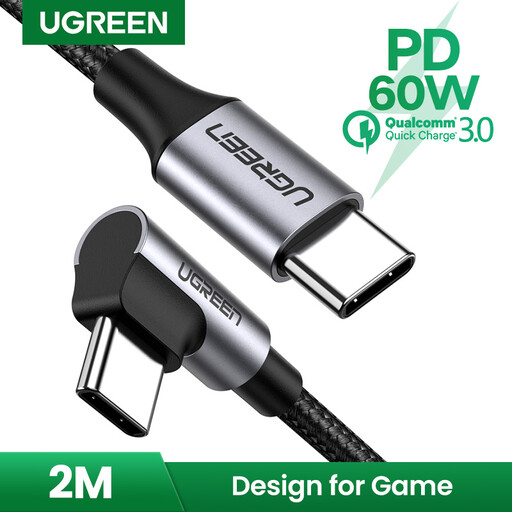
Why it stands out: Its smart design, featuring a 90-degree angled connector, was engineered for comfort. No more cable getting in the way when holding your phone horizontally to play games or watch videos.
Advantages:
Who is it for? The ideal choice for mobile or Nintendo Switch gamers, as well as for those who often use their tablet or smartphone while it's charging. It's also very practical in a car, where space is often limited.
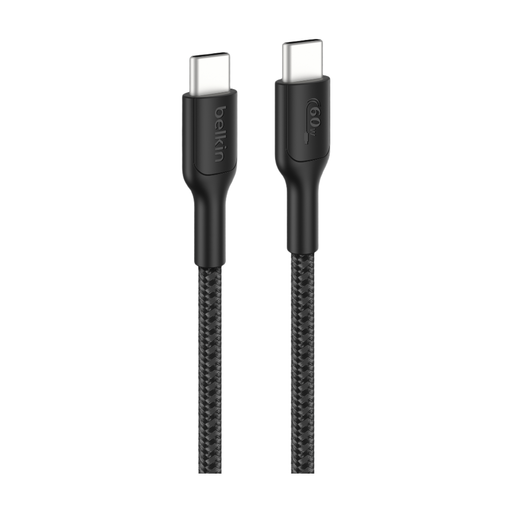
Why it stands out: This cable strikes the perfect balance between power, durability, and practicality. Being USB-IF certified, it guarantees rock-solid compatibility and safety with a myriad of devices.
Advantages:
Who is it for? For anyone looking for an ultra-reliable and versatile USB-C to USB-C cable for daily use. It's perfect for an iPhone 15, a Samsung Galaxy, an iPad, or a MacBook Air, and remains an excellent option for casual gaming.
Our selection focuses on common needs, but the world of accessories is nearly infinite. If you're looking for a different length, another colour, or specific features, a myriad of other solutions are available.
To explore a wider range, feel free to browse our complete category of cables and connectors.
Discover all our USB to mobile cables and connectors
It all depends on your most power-hungry device. For a smartphone or tablet, 30W to 60W is more than enough. For a laptop, aim for a 60W or 100W cable to ensure you reach your machine's maximum charging speed. Rest assured, using a cable that's more powerful than necessary will never damage your device; the charge adjusts automatically.
In theory, a very long cable can cause a tiny loss of power. In practice, over common lengths (1m, 2m, or even 3m), the difference is completely unnoticeable in everyday use. High-quality cables are designed to compensate for this loss and maintain a stable charge.
No. A cable can have USB-C connectors but be limited in power and not support the Power Delivery (PD) protocol. For fast charging worthy of the name, it's crucial to check that the cable explicitly mentions PD compatibility and the maximum power it supports (e.g., 60W or 100W).