
Livraison le jour même ou le lendemain

Qualité garantie

Débloquez vos offres de bienvenue: Livraison GRATUITE | Jusqu'à -80 % | 30 jours d'essai gratuits à JoyPlus
Téléchargez l'application
A fan can quickly improve air circulation, but not all models are suited to the same uses. Between a device marketed as quiet, a rechargeable fan whose battery life varies significantly, and a high-velocity model designed for the workshop, the differences are far from trivial.
Three common pitfalls crop up time and again when buying:
In a bedroom or living room, a pedestal fan or an oscillating model can circulate air over a relatively wide area. Check the adjustable height, the oscillation range, and the stability of the base: a device that wobbles or tips over at the slightest movement quickly becomes annoying in daily use.
A desk fan is more suitable for someone sitting in front of a screen. Its compact size makes it easy to store, but its coverage is limited. For on-the-go use, a portable fan or a neck fan will be more practical. A battery of 1,800 to 5,000 mAh can provide several hours of operation, but the stated battery life always depends on the speed used.
The bladeless fan reduces direct access to moving parts and is often easier to clean. However, don't stop at its design: compare its different modes, its airflow, and its noise level.
In a home with a wood-burning stove, a stove fan, also known as a heat-powered fan, uses the heat from the surface to help distribute warm air more effectively. It doesn't replace a heating system or mandatory ventilation: it's an accessory designed to improve heat distribution.
If you're sensitive to noise, look for a specification sheet that states a noise level in dB, ideally for a given speed. A DC motor can offer more gradual adjustment and controlled energy consumption, but the comparison is only meaningful if the data is clearly stated.
Horizontal oscillation and vertical tilt determine the actual area covered. A smart fan can also offer scheduling, control via an app, or automatic adjustment to the room temperature. These features are useful if you have a need for them; they won't make up for poor positioning or insufficient airflow.
In a workshop, basement, or space that's still damp after cleaning, a high-velocity fan must be easy to direct and able to withstand heavy use. However, check its usage conditions: a standard electrical appliance must never be placed on a wet surface.
For a rechargeable fan, check:
In the UK, as with any electrical appliance, consult the manual, use the supplied or recommended charger, and unplug the device before cleaning. A lithium-ion battery must not be dismantled, exposed to fire, or left in a car in direct sunlight. For a ceiling fan, installation must be carried out on a suitable support, in accordance with the manufacturer's instructions.
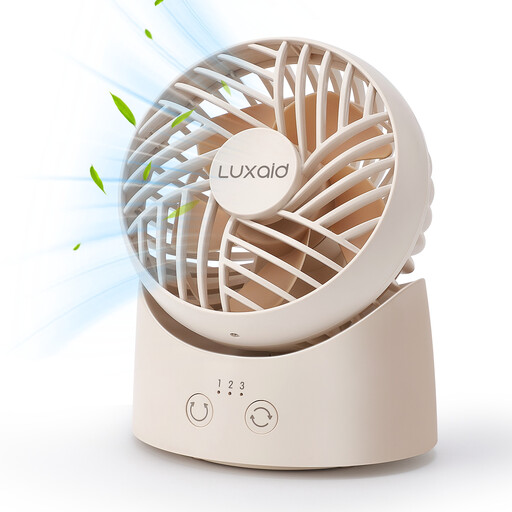
Why this choice suits this profile: Its compact size fits easily on a desk, bedside table, or in a small room. It offers three speeds, 60° oscillation, and USB-C charging.
The actual stated capacity is 1,800 mAh, despite a different indication on the packaging. This precision allows you to better put the stated battery life into perspective, which can reach up to 8 hours depending on usage.
Portable size, 60° oscillation, USB-C charging, and a programmable timer of up to 8 hours.
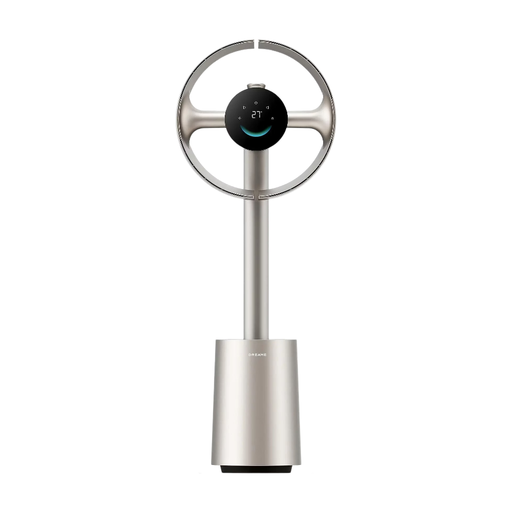
Why this choice suits this profile: This bladeless fan is aimed at users who want extensive coverage, automated settings, and remote control in a living space.
The spec sheet details the available modes, horizontal oscillation up to 180°, vertical oscillation up to 90°, and a power of 55 W. Concrete information to judge the true reach of the advertised features.
Wi-Fi app, voice control, washable main filter, and a claimed air distribution of up to 270°.
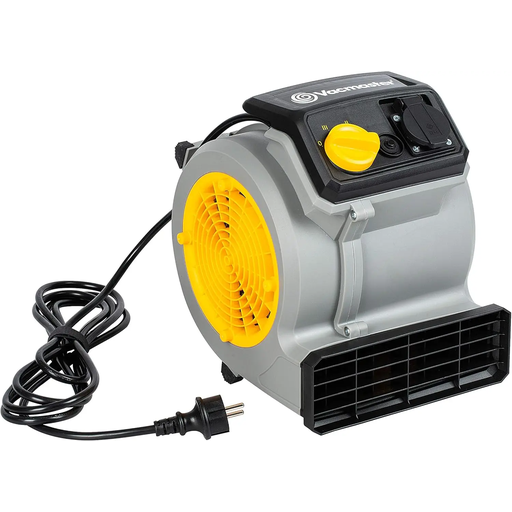
Why this choice suits this profile: Its floor-standing design, adjustable direction, and claimed airflow of 245 l/s make it suitable for a workshop, basement, gym, or drying project.
The 124 W power is clearly distinguished from the stated airflow. Its three speeds and various tilt positions allow you to adapt the airflow for both cooling and targeted ventilation.
Three speeds, tilt up to 45°, and the ability to connect up to 12 units, depending on the planned electrical configuration.
We've put together a comprehensive, real-time updated list of products that meet these demanding selection criteria, while also complying with European safety regulations.
It all depends on its power and how long you use it. A 35 W model running for 5 hours consumes approximately 0.175 kWh, not accounting for any variations related to the mode selected. To estimate the cost, multiply the power in kilowatts by the number of hours of use, then by the rate shown on your bill.
Place it on a stable surface and avoid pointing it directly at a person from close range for long periods. Positioned near an open window, it can help circulate air when the outside temperature drops. Oscillation is particularly useful for distributing the airflow in an occupied room.
It depends on the quality of the motor, how often it's used, how well it's maintained, and the storage conditions. Dust the grilles and blades regularly, never block the air intakes, and unplug the device before any maintenance. On a rechargeable model, the battery life may decrease over charge cycles: follow the manufacturer's recommendations to preserve the battery.