If you’re concerned about caffeine close to bedtime, start with a decaffeinated espresso, then check that the format is suitable for your machine: decaffeinated doesn’t necessarily mean caffeine-free. A half-caff still contains some regular coffee; if evening caffeine isn’t your main concern, choose your espresso for its flavour instead, and don’t mistake the stated strength for a measure of caffeine.
Who is this choice for ?
People keeping an eye on their caffeine intake in the evening
If you have an espresso after dinner and want to limit your caffeine intake, start by looking at decaffeinated options and their labelling. Anses notes that caffeine can disrupt sleep, so it’s worth paying closer attention to the caffeine content of a specific product than to its flavour description alone.
Those looking for a middle ground between regular and decaffeinated coffee
A half-caff might suit you if you’re happy to have some regular coffee. Carte Noire describes one of its options as half regular coffee and half decaffeinated coffee, but those proportions don’t tell you how much caffeine is in the cup.
People with a capsule or coffee pod machine
Your machine’s system determines which formats you can compare. Lavazza, for example, distinguishes between A Modo Mio and capsules compatible with Nespresso® Original; illy distinguishes between Iperespresso, capsules compatible with Nespresso® Original and E.S.E. pods.
What should you look at first ?
For an espresso after dinner, first decide how important caffeine is to you, then compare the flavours available in formats compatible with your machine.
Decaffeinated espresso
Worth considering : if you want to limit caffeine while still enjoying an espresso in the evening.
Keep in mind : check the caffeine content stated for the option you choose. For the relevant ground and whole-bean decaffeinated espressos, illy states a maximum caffeine content of 0.1 %.
Half-caff espresso
Worth considering : if you’re happy to have some regular coffee in your evening drink.
Keep in mind : Carte Noire’s 50/50 blend description doesn’t tell you how much caffeine is in a cup.
Regular espresso
Worth considering : if taste is your main consideration and you’re not looking to reduce the caffeine in your drink.
Keep in mind : a milder-tasting coffee isn’t necessarily lower in caffeine. Anses states that caffeine can delay falling asleep and reduce the duration or quality of sleep.
| Criteria |
What to check |
Who is it for ? |
| Caffeine |
Whether it’s labelled decaffeinated or half-caff and, where stated for that product, its caffeine content. |
If I drink my espresso close to bedtime, I want to limit caffeine rather than rely on a mild strength rating; around 42 % of consumers put reducing caffeine at the top of their list. |
| Flavour |
The stated flavour notes and blend ingredients, comparing strength within the same range. |
After dinner, I mainly want to enjoy the espresso profile I like, even if I switch blends; flavour remains the priority for around 33 % of consumers. |
| Format |
The exact system accepted by your machine and the compatibility information on the packaging. |
If I already have a machine at home, I need to be able to make my chosen coffee without switching systems; this compatibility comes first for around 25 % of consumers. |
Mistakes to avoid
-
Mistaking strength for an indication of caffeine content
Strength describes the flavour profile of a range, not the amount of caffeine in your cup. This distinction matters if you’re drinking coffee close to bedtime: Anses states that caffeine can disrupt sleep.
First choose between decaffeinated, half-caff and regular coffee, then use the flavour notes to narrow down your options.
-
Confusing capsule systems
A Modo Mio, Nespresso® Original, Dolce Gusto and Iperespresso are different systems; E.S.E. pods are another format altogether.
Check which system your machine uses, then look for the compatibility information on the coffee’s product page and packaging.
-
Assuming half-caff means half the caffeine per cup
Carte Noire describes its half-caff option as a blend of 50 % regular coffee and 50 % decaffeinated coffee. This describes the blend, not how much caffeine is extracted into each cup.
If reducing caffeine is your main concern, look instead at the information for a specific decaffeinated product.
-
Assuming a compostable pod can go in your home compost
Carte Noire states that its Espresso N°8 soft pods shouldn’t be put in a home compost bin, the garden or the countryside.
Check the manufacturer’s instructions and your local waste-sorting rules before choosing a format based on how it should be disposed of.
Brands to know when comparing formats
Lavazza
A range to explore if you’re looking for espresso in a format that suits your machine.
- Lavazza offers, among other options, A Modo Mio capsules, capsules compatible with Nespresso® Original and E.S.E. pods.
- These formats work with different systems, so check each product’s compatibility before comparing flavours.
illy
An option to explore when comparing ground or whole-bean decaffeinated espresso, capsules and pods for your machine.
- For the relevant ground and whole-bean decaffeinated espressos, illy states a caffeine content of no more than 0.1 %.
- This information doesn’t automatically apply to other products. Iperespresso capsules and capsules compatible with Nespresso® Original aren’t interchangeable.
Carte Noire
Options to compare if you’re choosing between decaffeinated and half-caff espresso.
- Carte Noire describes its Décaféiné N°5 as a 100 % Arabica blend and its half-caff option as an equal-parts blend of regular and decaffeinated coffee.
- These descriptions apply to specific products; the half-caff blend information alone doesn’t tell you the caffeine content per cup.
Carrefour Extra
A supermarket own-brand to consider if you use ground or whole-bean coffee.
- Carrefour describes a ground decaffeinated option made with decaffeinated Arabica coffee, as well as a whole-bean espresso option.
- Don’t confuse the whole-bean option with the ground decaffeinated one; check the name on the pack you choose.
Plantation (Marque Repère / E.Leclerc)
A supermarket own-brand to look at if you’re after decaffeinated coffee in capsules or pods.
- E.Leclerc lists, among other options, decaffeinated aluminium capsules, soft pods and capsules compatible with Dolce Gusto.
- Check that each format works with your machine, and confirm which product is available in your store.
Auchan
Another supermarket own-brand offering decaffeinated coffee in several formats.
- Auchan offers, among other options, ground or whole-bean decaffeinated coffee and decaffeinated capsules for different systems.
- An espresso marked as decaffeinated and compatible with Dolce Gusto won’t work with a Nespresso® Original machine just because it’s decaffeinated.
Decaffeinated espressos available on Joybuy
These three options let you look for an evening decaffeinated espresso to suit your capsule system: Dolce Gusto, A Modo Mio or the format specified for Carte Noire N°5. Check the exact compatibility before choosing.
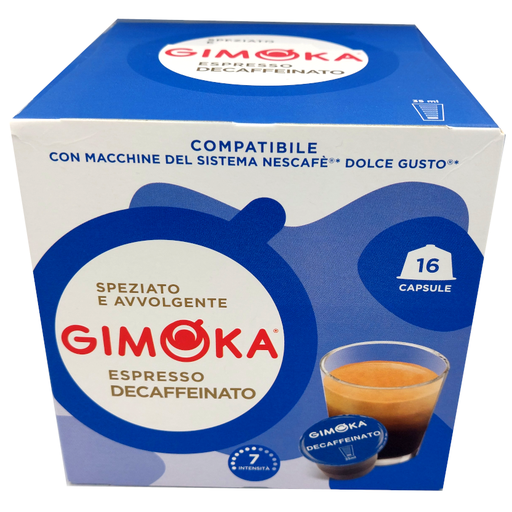 Image unavailable
GIMOKA Espresso Decaffeinated, capsules compatible with Dolce Gusto, 16 capsules, 112 g
For an evening decaffeinated espresso if your machine takes Dolce Gusto capsules.
The pack contains 16 capsules, weighing 112 g. Check the labelling for this product if you need a specific figure for its caffeine content.
View on Joybuy
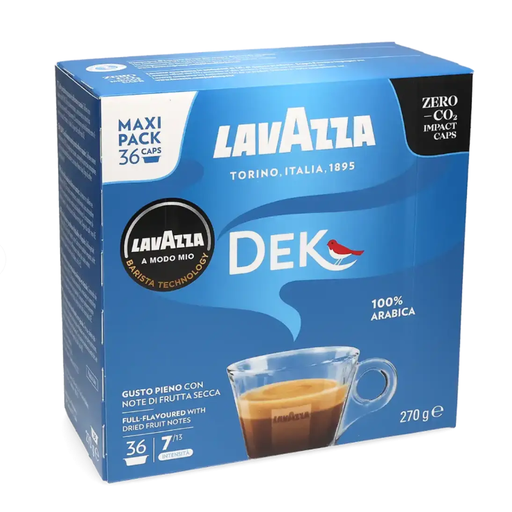 Image unavailable
Lavazza A Modo Mio Decaf, 36 capsules
A decaffeinated option for the evening if you use the A Modo Mio system specified for these capsules.
The box contains 36 capsules. Check the packaging for caffeine information specific to this product.
View on Joybuy
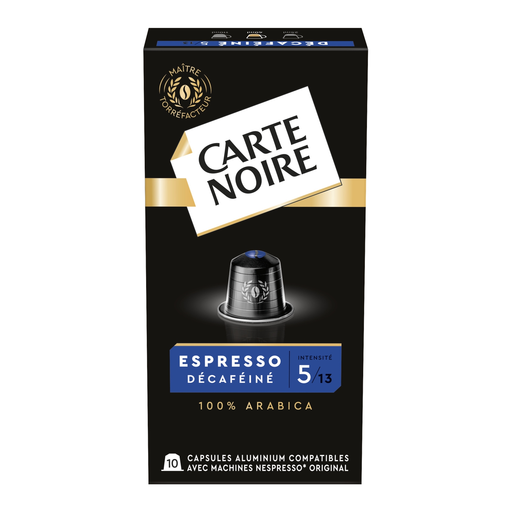 Image unavailable
Carte Noire Espresso Decaffeinated N°5, 10 aluminium capsules
For a decaffeinated evening espresso, provided your machine accepts the capsule format specified for this product.
The box contains 10 aluminium capsules. Carte Noire describes its Espresso Décaféiné N°5 as a 100 % Arabica blend; check the labelling for any information about its caffeine content.
View on Joybuy
Frequently asked questions
Is decaffeinated espresso completely caffeine-free ?
No, you shouldn’t assume it contains no caffeine at all. For the relevant ground and whole-bean decaffeinated espressos, illy states a caffeine content of no more than 0.1 %; check the information for the specific product you’re considering.
Does a lower strength mean less caffeine ?
No. Stated strength describes the flavour profile and doesn’t measure caffeine. If caffeine is your main concern for an evening drink, look for the decaffeinated or half-caff label and check the information for the specific product.
How can I check whether a capsule will work with my machine ?
Find the exact name of your machine’s system and look for the same compatibility information on the packaging. For example, Lavazza distinguishes A Modo Mio from capsules compatible with Nespresso® Original, while illy distinguishes Iperespresso from its capsules compatible with Nespresso® Original.
Can a pod labelled compostable go in my compost bin ?
Not necessarily: Carte Noire states that its Espresso N°8 soft pods shouldn’t be put in a home compost bin or the garden. Follow the instructions for the product you’ve bought and your local waste collection guidance.


