You've made the switch to electric. But a crucial question quickly arises: how do you charge your car at home? Between the endless charging times from a household outlet and the unpredictable availability of public stations, a dedicated home solution is often the key to a successful transition. In a booming market, it can be difficult to know where to start.
Our editorial team's mission is to provide you with clear, objective information to help you make an informed choice. This guide aims to break down the essential features of an EV charging station and present our selection of the most compelling models for 2026.
How to Choose the Right EV Charger
Before diving into product specifications, there are three essential criteria to consider to ensure the compatibility and efficiency of your future setup.
1. Power: 11?kW or 22?kW?
Power, measured in kilowatts (kW), directly determines your vehicle's charging speed.
- 11?kW Charger: This is the most common power level for a home installation. It requires a three-phase power supply and represents the ideal compromise, capable of recharging most batteries overnight (in about 6 to 8 hours). A perfectly balanced solution for daily use.
- 22?kW Charger: Also requiring a three-phase supply, this power level cuts charging time in half. Be aware, however, that it is more demanding on your electrical system and utility plan. You must also ensure your vehicle can accept a 22?kW AC charge, which is far from standard.
2. Connectivity: The Advantage of a Smart Charger
A smart EV charger is more than just a gadget. Through a Wi-Fi or Bluetooth connection, it unlocks game-changing features for daily use:
- Schedule Charging: Start charging during off-peak hours to lower your electricity bill.
- Track Your Consumption: Access your session history directly from a mobile app.
- Manage Power: Adjust the current (amperage) based on your vehicle's needs or your grid's capacity.
- Control Access: Some chargers include an RFID card reader, which is very useful if the station is installed in a shared car park.
3. Form Factor: Wall-Mounted (Wallbox) or Portable Charger?
- The Wallbox (Wall-Mounted Charger): This is the ultimate solution for home charging. Fixed to a garage wall or outdoors, it is robust, secure, and always ready for use. Its installation must be carried out by a qualified professional.
- The Portable Charger: More mobile, this type of charger is not permanently installed. It can be used at home with a suitable outlet, but can also be taken on the go. A smart option for those who cannot install a wallbox (e.g., renters) or who want a backup solution for travel.
Good to know: All recent models for the European market use a Type 2 (or Mennekes) connector, the standard for AC charging.
Top EV Charger Recommendations
Here is a selection of models that meet various needs, with a focus on performance, safety, and smart features.
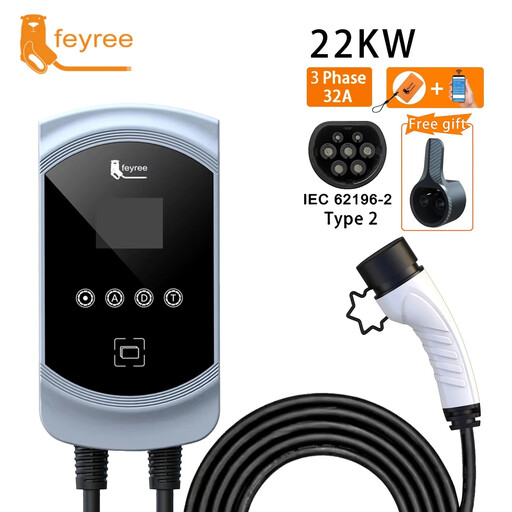
1. Feyree 22?kW Three-Phase Wallbox Charger
View Product: Feyree 22?kW Three-Phase Wallbox Charger
- What sets it apart: This model from Feyree is for those who want the fastest possible charging speeds at home. Its 22?kW power drastically reduces waiting times for compatible vehicles. Its integration with the Tuya Smart app makes it a particularly comprehensive smart charger.
- Advantages:
- Maximum Power: Fast charging at 32A on a three-phase network.
- Smart Control: Remote management via the app (Wi-Fi) to schedule sessions, monitor charging status, and adjust the current from 8A to 32A.
- Comprehensive Safety: The unit includes built-in protection against lightning, overvoltage, overcurrent, and overheating. IP65 certified, it is resistant to both rain and dust, making it suitable for outdoor installation.
- Secure Access: Features an RFID card function to control usage.
- Who is it for?: Owners of electric vehicles that accept a 22?kW charge, have a suitable three-phase installation, and want to optimise their daily charging time.
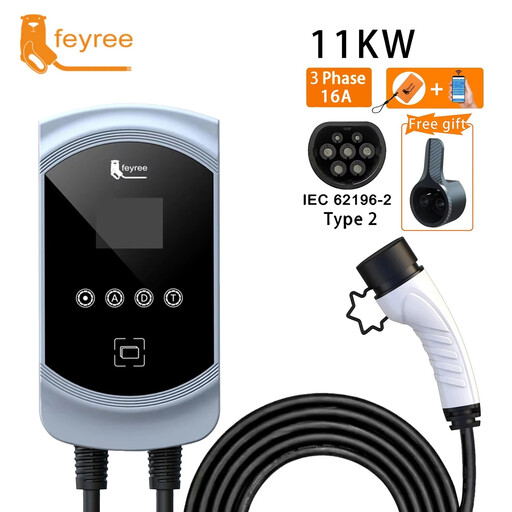
2. Feyree 11?kW Three-Phase Wallbox Charger
View Product: Feyree 11?kW Three-Phase Wallbox Charger
- What sets it apart: This 11?kW version is the sensible choice for the majority of users. It offers all the benefits of a smart, secure charger, with a power output that is perfectly calibrated for most three-phase home installations and vehicles on the market.
- Advantages:
- Balanced Performance: The 11?kW power output ensures a full overnight charge for most EVs.
- App-Based Management: Like its 22?kW sibling, it is controlled remotely via the Tuya Smart app for scheduling and monitoring.
- Adjustable Current: The amperage can be set (8A/10A/13A/16A) to adapt to your electrical system and other running appliances.
- Complete Protection: It includes the same array of safety features (overvoltage, current leakage, overheating, etc.) for total peace of mind.
- Who is it for?: The typical electric or plug-in hybrid vehicle user looking for a reliable, smart, and high-performance home charging solution without the installation requirements of a 22?kW station.
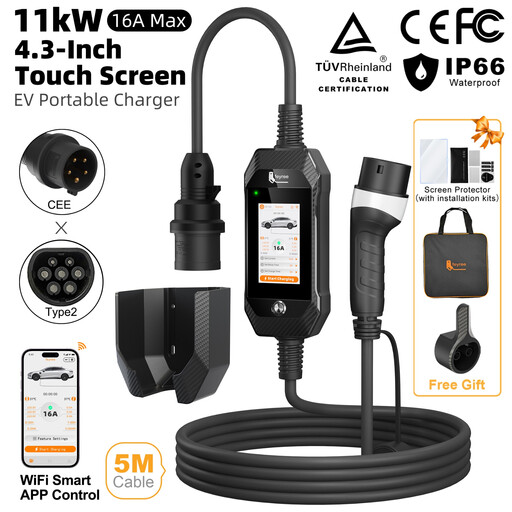
3. Feyree 11?kW Portable Charger with Touchscreen
View Product: Feyree 11?kW Portable Charger with Touchscreen
- What sets it apart: This portable charger combines the power of an 11?kW station with the flexibility of a mobile device. Its 4.3-inch HD touchscreen provides a modern and intuitive interface, a real bonus in this market segment.
- Advantages:
- Maximum Flexibility: Compact design with a carrying case, ideal for use at home, at a friend's house, or on holiday.
- Intuitive Touchscreen Interface: The screen allows you to view real-time charging data and configure all settings directly on the unit.
- Dual Temperature Monitoring: A sensor in the plug and another in the control box ensure enhanced safety by automatically reducing power in case of overheating.
- Smart Connectivity: Also compatible with the Tuya Smart app to schedule charges, adjust the current (8-16A), and track consumption in detail.
- Who is it for?: Drivers who need a powerful but non-permanent charging solution (such as renters) or those who want a single charger for both home and travel.
Need Other Solutions for Your Garage?
While charging an electric vehicle requires specific equipment, outfitting your garage might call for more conventional solutions. To optimise your outlets and power your other devices, take a look at our selection of adapters.
Discover our range of three-way socket adapters
Frequently Asked Questions (FAQ)
1. In simple terms, what's the difference between an 11?kW and a 22?kW charger?
An 11?kW charger adds about 50 to 60 km of range per hour of charging. A 22?kW charger can double that performance, adding 100 to 120 km per hour. The choice depends on your car's ability to accept that power level and the robustness of your electrical system. For daily use with overnight charging, 11?kW is more than sufficient.
2. Is it mandatory to hire an electrician to install a charger?
For a wall-mounted charger (wallbox), hiring a qualified electrician is not only essential for safety but also often legally required to comply with regulations and qualify for potential government subsidies. A portable charger plugs into a reinforced or industrial-grade socket, the installation of which should also be validated by a professional.
3. Is a smart charger really useful?
Absolutely, and for two main reasons. Firstly, it allows for real savings by scheduling charging during off-peak hours when the price per kWh is lowest. Secondly, it offers unparalleled convenience: you can manage everything from your smartphone, whether it's starting a charge remotely, checking its progress, or precisely tracking your energy consumption.


