
Same-day & Next-day Delivery

Quality Guaranteed

Unlock Your Welcome Offers: FREE Delivery | Up to 80% OFF | Free 30-day JoyPlus trial
Download the APP
Navigating the vast world of espresso machines can be overwhelming. Between automatic machines with built-in grinders for those short on time, manual models for the purists, and capsule systems for their simplicity, the range of choices is enough to make your head spin. Our guide is here to cut through the noise and help you find the machine that perfectly suits your habits, your budget, and your love for coffee—all without the confusing marketing jargon.
Before diving into an espresso machine comparison, it's essential to pinpoint the criteria that truly make a difference. Here are the key points to guide you.
This is the starting point—the choice that will shape not only the taste of your coffee but also your entire preparation ritual.
There's no great espresso without controlled pressure: it's the key to extracting a rich and creamy coffee. The golden rule is a pressure of 9 bars at the group head to perfectly extract the oils and aromas from the coffee. Consumer machines often advertise a pump pressure of 15 to 19 bars, a power level that ensures the crucial 9 bars are consistently reached and maintained during infusion.
The stability of the water temperature is just as critical. Advanced systems, like PID (Proportional Integral Derivative) control, ensure the temperature is maintained with degree-perfect precision. The result? A consistently even extraction and constant flavour, cup after cup.
Beyond the coffee itself, certain details can transform your daily experience. A proper steam wand is essential for cappuccino or latte macchiato lovers to achieve a rich, velvety milk foam. The ability to adjust the cup length, intensity, or grind fineness are real advantages for tailoring the coffee to your exact preference. Finally, don't overlook maintenance: removable, dishwasher-safe components will make your life much easier.
We have selected three models with distinct profiles, each excelling in its category.
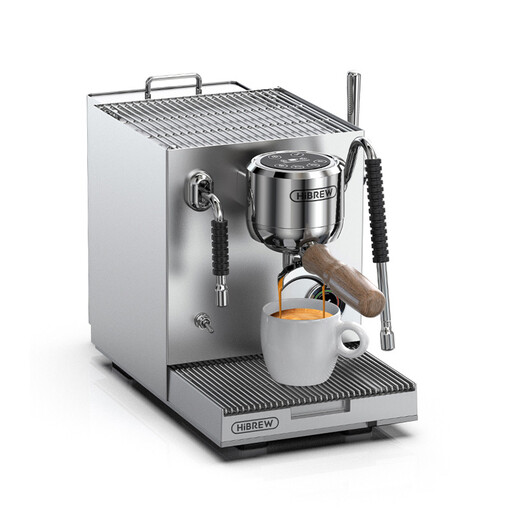
Why we love it: The HiBREW H21 is a manual espresso machine that draws direct inspiration from professional equipment. Its dual boiler and dual pump system allows you to prepare an espresso and froth milk simultaneously, with no waiting time. Precise temperature control (via PID) and programmable pre-infusion offer surgical precision over your extraction.
Key Features:
Who is it for? For the enthusiast who views coffee preparation as an art form and wants to replicate the barista experience at home, with absolute control over every parameter.
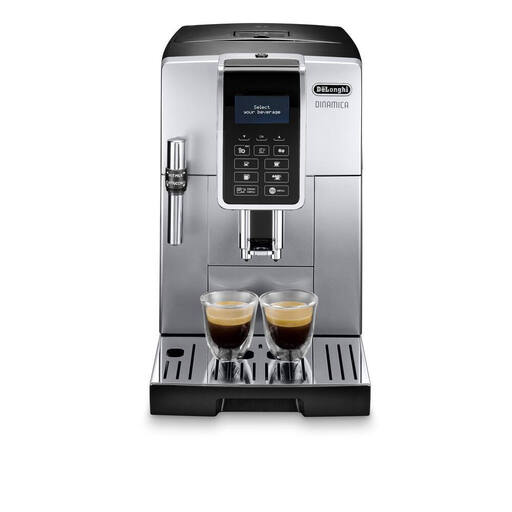
Why we love it: The De'Longhi Dinamica is a bean-to-cup machine that represents the perfect balance between performance and effortless simplicity. It transforms coffee beans into espresso at the touch of a button. Its intuitive interface and "My Menu" function allow you to customise and save your favourite drinks.
Key Features:
Who is it for? For anyone who wants the quality of freshly ground coffee without the complexity. Perfect for daily family use, where consistent and quick results are a priority.
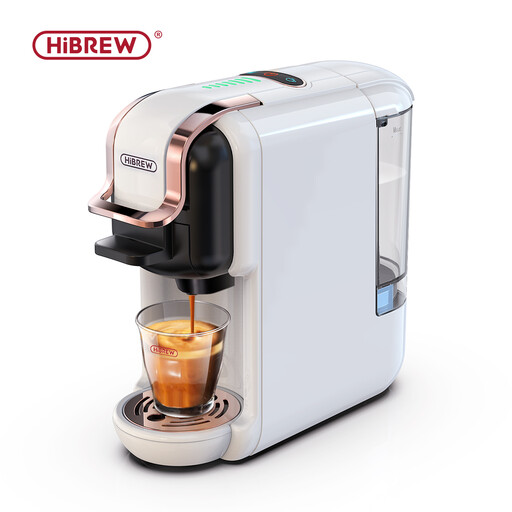
Why we love it: The HiBREW H2B is a multi-capsule coffee machine that shines with its impressive versatility. Thanks to its interchangeable adapters, it is compatible with Nespresso*, Dolce Gusto*, and ESE pods, as well as ground coffee and even K-Cup* capsules. Its dual hot/cold mode allows you to mix things up, from a steaming espresso to a refreshing iced coffee.
Key Features:
Who is it for? For the undecided who don't want to pick a side (capsules, ground coffee...) or for households where tastes vary. A smart solution for small spaces, offices, or holiday homes.
This selection is just a glimpse of the possibilities available to you. Because every coffee lover is unique, there is a model out there made just for you. To discover a wider range, including our deluxe silver coffee machine models, feel free to browse our complete collection.
Discover all our coffee machines
Although the term percolator is often incorrectly used to describe a manual espresso machine, it historically refers to a device where hot water passes through coffee via gravity or simple percolation, without high pressure. In contrast, a modern espresso machine uses a pump to force hot water through the coffee at high pressure (at least 9 bars). It is this pressure that creates the signature crema and gives espresso its unique concentration and body.
The ideal pressure, the one that makes all the difference, is 9 bars at the moment of extraction (at the group head). This is the standard for a perfect espresso. Manufacturers often advertise the pump's pressure (typically 15 to 19 bars). This upstream power acts as a "reserve" to ensure that the critical 9 bars are not only reached but, more importantly, maintained stably throughout the entire extraction.
The initial investment for a bean-to-cup machine is certainly higher than for a capsule model. However, the cost per cup is much more favourable, as coffee beans are significantly cheaper than capsules. In the long run, for a daily coffee drinker, the investment quickly pays for itself, and the machine with a grinder becomes far more economical.