
Livraison le jour même ou le lendemain

Qualité garantie

Débloquez vos offres de bienvenue: Livraison GRATUITE | Jusqu'à -80 % | 30 jours d'essai gratuits à JoyPlus
Téléchargez l'application
Back pain, a stiff neck, flagging concentration... Long days glued to a chair, whether working from home or in the office, eventually take their toll. To combat this, one solution is becoming increasingly popular: the electric standing desk. The concept is simple: it allows you to effortlessly alternate between sitting and standing, helping you rediscover a healthier and more comfortable work dynamic.
But with an overwhelming number of options on the market, how do you choose the right model? This guide is here to help you decode the key features and find the desk that will transform your workspace.
Before making a decision, it's essential to review the features that define a quality ergonomic desk. Let's go over the key points to check to ensure you're making a sound investment.
A good motorised desk must be perfectly stable, even when raised to its maximum height. The sturdiness of the frame, often made of steel, is a key indicator of its durability. The type of motor system is also a crucial point: a dual-motor system will generally be faster, more stable, and quieter than a single-motor model. The height adjustment should be smooth and discreet, so as not to break your concentration. Finally, check the maximum load capacity: the desk must be able to effortlessly support all your equipment (monitors, computer, accessories).
The size of the desktop is a critical factor, especially if you're looking for a desk for remote work. Think about the space you need. Do you use one or multiple monitors? Do you need room for documents, a laptop, and other peripherals? Widths typically range from 120 cm to 180 cm. Measure your available space to ensure the desk will fit, and don't forget to leave a 2 to 3 cm gap from the wall to allow the mechanism to move up and down freely.
Practical details often make all the difference in daily use. The memory function is arguably the most useful: it allows you to save several preset heights (for example, one for sitting, one for standing) and access them with a single button press. Other options can be very convenient: the inclusion of USB or USB-C ports in the control panel for charging your devices, or cable management systems (grommets, trays) to keep your workspace clean and tidy.
To help you make your choice, we have selected several models that stand out for their features, value for money, and design.
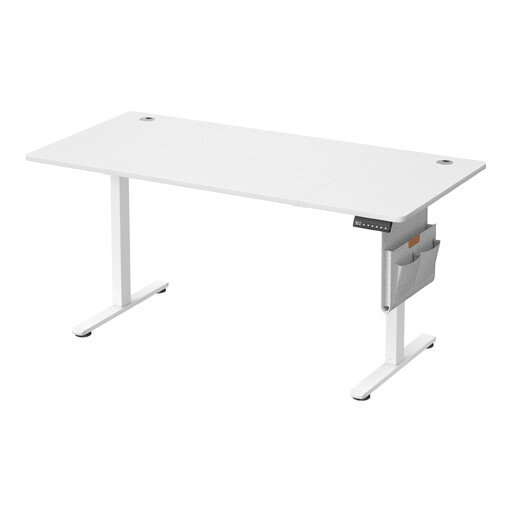
What sets it apart
This model stands out with its very large 180 x 80 cm desktop, offering a generous work surface. It is equipped with a motor designed for smooth and quiet height adjustment, and its control panel includes a 4-position memory function, a fast-charging USB-C port, and a power-saving mode.
Highlights
Who is it for? This desk is particularly well-suited for professionals, creatives, or gamers who require a large work surface to comfortably arrange multiple monitors, a graphics tablet, and other equipment.
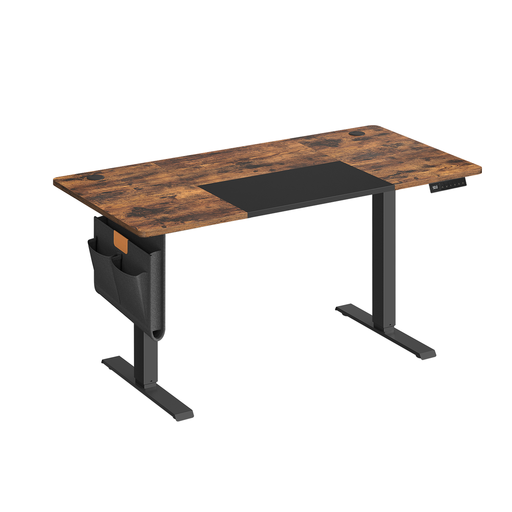
What sets it apart
With its 140 x 60 cm dimensions, this desk offers an excellent compromise between work surface and footprint. It includes the essential features of a desk with memory, including 4 presets, a USB-C port, and reminders to alternate positions. Its two-tone vintage brown and ink black design gives it a polished look.
Highlights
Who is it for? This model is perfect for students and remote professionals looking for a functional and stylish adjustable work table without needing a massive surface area.
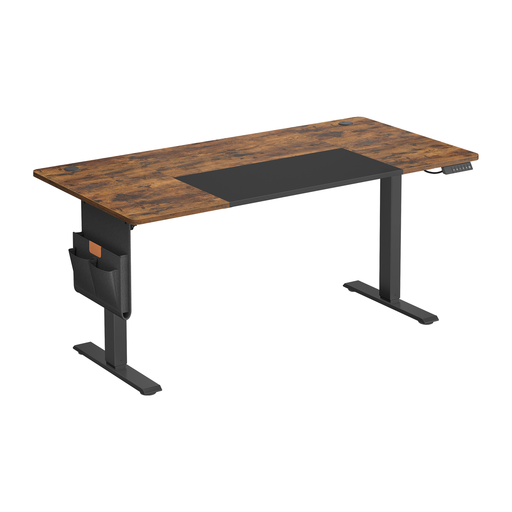
What sets it apart
This 160 x 70 cm desk strikes a happy medium, offering more space than the standard 140 cm model while remaining more compact than the 180 cm version. It includes the same practical features as the other models in our selection, notably the memory function, USB-C port, and organisational accessories.
Highlights
Who is it for? This is a highly versatile option for anyone looking for a spacious and well-equipped ergonomic desk that can adapt to a wide variety of professional or academic tasks.
Weren't convinced by the models in our selection? Whether you're looking for different dimensions, colours, or price points, feel free to explore our full category of workstations.
Discover all our desks and workstations
There is no single ideal height, as it all depends on your body. In a seated position, your feet should be flat on the floor and your elbows bent at approximately a 90-degree angle. When standing, your elbows should maintain that same 90-degree angle as your forearms rest on the desk. This is where the memory function becomes indispensable: it allows you to save these two heights and switch between them with a single press.
Stability is a legitimate concern. Quality models are designed with thick steel frames and wide feet to minimise wobble, even at maximum height. The load capacity, typically around 70 kg for the models featured, is also a testament to their sturdiness. However, it is always recommended to distribute the weight evenly across the desktop.
Most manufacturers have made efforts to simplify assembly. The desks usually come with detailed instructions, numbered parts, and the necessary tools. Assembly can often be done by one person, although having a second person is helpful for handling the desktop, which can be heavy. On average, you should plan for 30 to 60 minutes.