
Livraison le jour même ou le lendemain

Qualité garantie

Débloquez vos offres de bienvenue: Livraison GRATUITE | Jusqu'à -80 % | 30 jours d'essai gratuits à JoyPlus
Téléchargez l'application
Who hasn't stripped a tiny screw while trying to repair their smartphone? Assembling a PC or getting into model making requires meticulous care, but above all, the right equipment. A single stubborn screw or a component damaged by a low-quality tool can quickly turn the job into a nightmare. This is precisely where the electric precision screwdriver kit comes in: the essential ally for combining control, efficiency, and comfort.
This guide is here to help you make sense of it all. We'll break down the essential criteria and introduce you to our top picks—the models that stand out for their design and performance. Our goal: to help you find the perfect tool for your projects.
Before you jump on the first model you see, let's review the key points that separate a gadget from a true professional tool.
Torque, measured in Newton-metres (N·m), is the rotational force of your screwdriver. For micro-electronics, low torque is essential to avoid damaging a delicate screw thread or a fragile printed circuit board. For more robust assemblies, you'll need more muscle. A model with adjustable torque is therefore the holy grail: it allows you to adjust the power on the fly, making it the number one criterion for a versatile electronics repair kit.
A kit, no matter how good, is worthless without the right bits. Take a close look at the quantity and, more importantly, the variety of heads included. A precision toolkit worthy of the name should offer the classics (Phillips, flathead) as well as more exotic types like Torx, Pentalobe (dear to Apple), or Tri-wing. The quality of the metal is just as crucial: S2 steel is a gold standard, renowned for its durability. And never underestimate the power of magnetic bits: they are an absolute lifesaver for handling tiny screws without a meltdown.
When you hear rechargeable cordless screwdriver, think battery life. Expressed in milliampere-hours (mAh), it determines how long you can work before running out of juice. Today, a USB-C port is practically mandatory for simple, universal charging. Ergonomics shouldn't be overlooked either: a compact form factor and a feather-light weight are your best allies against fatigue during marathon sessions on a smartphone or laptop. Finally, the little extra that makes all the difference: an integrated LED light to see clearly, even in the darkest corners.
Enough theory, let's get practical! We've selected three models that shine in their respective categories, each catering to a specific user profile: from the all-around DIYer to the micro-repair specialist.
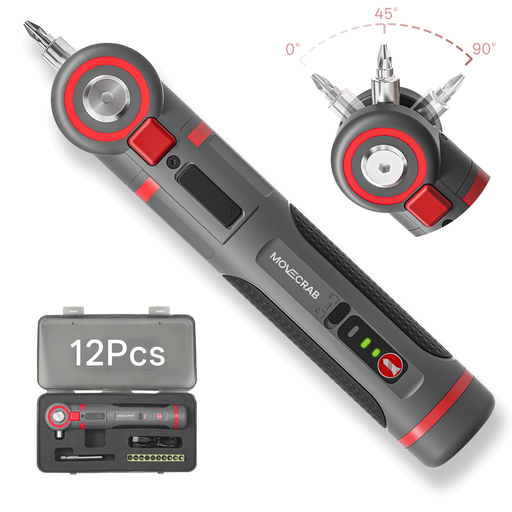
Its standout feature: This model's secret weapon is its pivoting head, adjustable to 0°, 45°, and 90°. This incredible flexibility lets you reach screws in awkward angles where a standard screwdriver would give up. With its hefty, adjustable torque (from 3 to 5 N·m), it's not afraid to leave the electronics workshop to tackle more demanding tasks.
Advantages:
Who is it for? For the all-around DIYer who wants a do-it-all tool, equally comfortable assembling flat-pack furniture and disassembling a laptop.
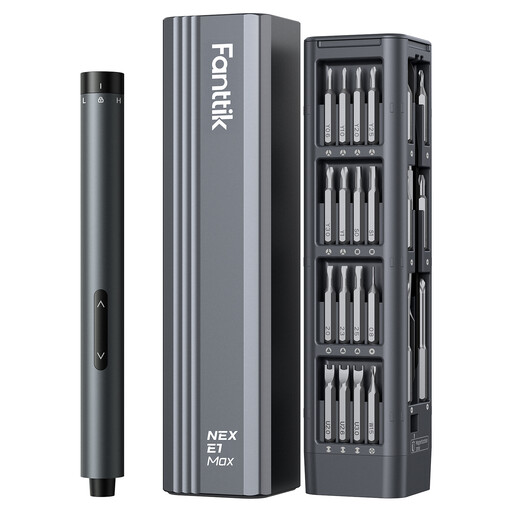
Its standout feature: The Fanttik E1 Max is the choice for style and user experience. An aluminium alloy case, a "pop-up" opening like a spy movie gadget, magnetic storage for all 50 bits... it's a beautiful object, designed down to the last detail. Its two torque levels (0.05 N·m and 0.2 N·m) are tailor-made for electronic surgery. It's no coincidence that it has won the prestigious iF Design and Red Dot Design Awards.
Advantages:
Who is it for? For the aesthete, the high-tech enthusiast, and the meticulous repairer who appreciate beautiful, well-organised tools with surgical precision.

Its standout feature: This model's ace in the hole is its digital torque display. No more guesswork; you can set the tightening force (from 0.1 to 0.3 N·m) with pinpoint accuracy and in real time. Its design is just as clever: a rotary storage compartment is integrated directly into the handle, making it a champion of compactness. With 62 bits under its belt, it's one of the most generous kits on the market.
Advantages:
Who is it for? For the technician on the go or the demanding DIYer looking for an ultra-complete kit that's easy to carry everywhere and offers total control over tightening force.
Our selection covers three distinct use cases. Does your project not fit into any of them? Don't worry, the market is full of other models, with power levels, accessories, and budgets to suit every need.
? Discover our full range of electric tool kits on Joybuy.fr
What's the difference between manual and electric torque? Electric torque is the force from the motor that screws and unscrews for you. Manual torque is the force you apply yourself, just like with a traditional screwdriver. It's often higher and proves perfect for two things: breaking loose a stuck screw at the start, or for the final "by-feel" tightening to avoid damaging the thread.
Is a precision electric screwdriver kit suitable for eyeglasses or watches? Absolutely, but on two conditions: choose a model with a very low minimum torque (like the 0.05 N·m of the Fanttik E1 Max) and verify that the kit includes the necessary micro-bits. For these watchmaker-level tasks, the golden rule is to always start with the lowest torque setting to avoid breaking anything.
How do I maintain the battery of a rechargeable cordless screwdriver? As with all lithium-ion battery devices, a few best practices can help extend its life. Avoid letting it drain completely too often, and don't leave the tool plugged in indefinitely after it's fully charged. Simply store it in a dry place, away from extreme temperatures and humidity.