
Livraison le jour même ou le lendemain

Qualité garantie

Débloquez vos offres de bienvenue: Livraison GRATUITE | Jusqu'à -80 % | 30 jours d'essai gratuits à JoyPlus
Téléchargez l'application
Whether you're a field professional, a seasoned hiker, or simply a prepared citizen looking for a backup light source for your keychain, finding the right flashlight can be a real headache. Faced with an overwhelming number of options and often indecipherable spec sheets, this guide is designed to help you choose the EDC (Everyday Carry) flashlight that will truly meet your needs, with a focus on practicality, reliability, and performance.
Our team of experts has scrutinised dozens of models to provide you with clear, objective advice and guide you toward the best choice.
Before diving into our selection, let's review the essential criteria for making an informed choice.
A modern EDC flashlight is no longer limited to a simple white beam. Depending on your activities, certain options can make all the difference:
The core principle of EDC is to have your gear on you without a second thought. The form factor is therefore a non-negotiable criterion.
The era of disposable batteries is well and truly over for high-performance models. The rechargeable flashlight has become the standard, and for good reason. Opt for models equipped with a USB-C port: you'll be able to charge your flashlight with the same cable as your smartphone or computer. The battery life, expressed in hours, will obviously depend on the chosen lighting mode. Be sure to check the runtime of the lowest mode (often called "moonlight" or "firefly") to know its maximum endurance on a single charge.
After dozens of hours of testing, here are three models that stand out from the crowd for their design and features, each meeting a specific need.

Why it stands out: The Olight ArkPro is a true Swiss Army knife of lighting. Its unique flat flashlight design conceals an arsenal of four light sources: a wide floodlight, a long-range spotlight, a flashlight with UV light, and even a green laser pointer. All in a body that's as slim as it is sturdy.
Key features:
Who is it for? For professionals (technicians, security guards) who need versatile inspection tools, as well as for high-tech enthusiasts who appreciate well-designed multifunctional gadgets.

Why it stands out: The iUltra is simplicity taken to the extreme. Its genius lies in its magnetic activation: detach the light from its base, and it turns on instantly. No buttons, no complicated steps. For charging, its integrated USB-C connector plugs directly into a charger, no cable required.
Key features:
Who is it for? For minimalists, for anyone who wants a backup light always at hand on their keychain, and for those looking for a mini flashlight that is as simple as it is effective.
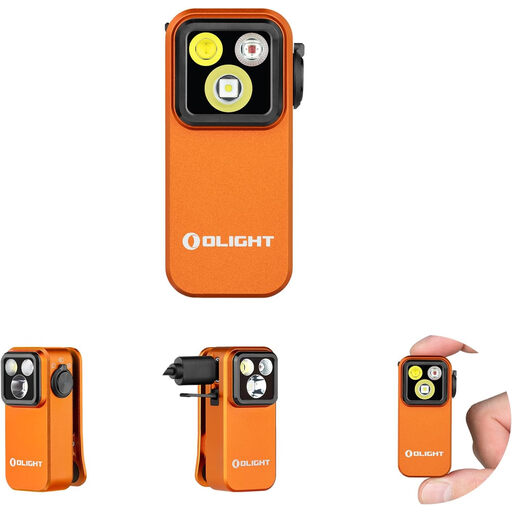
Why it stands out: The Oclip Pro is the queen of hands-free. This magnetic clip light was designed for maximum versatility in the field. Its ultra-sturdy clip attaches to a pocket, a bag strap, or a cap visor, while its magnetic base secures it to any metal surface. It features three essential lighting modes: flood beam, spot beam, and red light.
Key features:
Who is it for? For DIYers, campers, hikers, and anyone looking for a reliable hands-free light that can adapt to any situation.
Our selection focuses on models perfect for everyday use. If you have more specific needs (serious camping, caving, night trail running, etc.), feel free to explore our full range.
? Discover our entire Outdoor Sports Light category
It all depends on your use case. For everyday hassles (finding keys at the bottom of a bag, lighting up a keyhole), 50 to 150 lumens are more than enough. To navigate in complete darkness or for precision work, a brightness of 300 to 500 lumens is more comfortable. A powerful flashlight (over 1,000 lumens) is mainly justified for specific uses like long-distance searching or security.
The Ingress Protection (IP) rating measures a device's resistance to solids (dust, first digit) and liquids (water, second digit). The "X" means that dust resistance has not been tested, which is common. For a flashlight, it's the water resistance that we're most interested in.
The answer depends on your activities. Red light is a real bonus for astronomers, night photographers, hikers, or military personnel, as it doesn't ruin your eyes' adaptation to the dark. UV light is more of a niche tool, but it can be very practical for certain professionals (detecting air conditioning leaks, authenticating documents) or for hobbies like mineral hunting or geocaching.