
Livraison le jour même ou le lendemain

Qualité garantie

Débloquez vos offres de bienvenue: Livraison GRATUITE | Jusqu'à -80 % | 30 jours d'essai gratuits à JoyPlus
Téléchargez l'application
Faced with the vast world of art supplies, choosing the right tool can quickly become overwhelming. Whether you're an established artist, an art student, or simply a passionate crafter, the right instrument is key to bringing your ideas to life. In this universe, the dual-tip marker has established itself as the ultimate Swiss Army knife: two tips, two uses, maximum flexibility. Illustration, lettering, bullet journaling... whatever your craft, this guide is here to provide clarity and help you find the dual-tip marker that will elevate your creations.
Before diving into our selection, let's review a few essential criteria for making the right choice.
The type of ink is crucial: it defines not only the colour rendering and opacity but also which surfaces are compatible with your markers.
This is where the genius of the dual-tip marker lies. The most common and versatile combination is undoubtedly the fine tip and brush tip duo.
Your project dictates the choice. For an illustration on paper, a water-based or India ink will do the job perfectly. Want to customise an object or draw on a non-porous surface? An acrylic marker is then essential. Finally, don't neglect the paper: a high weight (over 120 g/m?) is strongly recommended to prevent the ink from smudging or bleeding through the page.
We've scoured the market to bring you models that stand out from the crowd, each meeting specific creative needs.
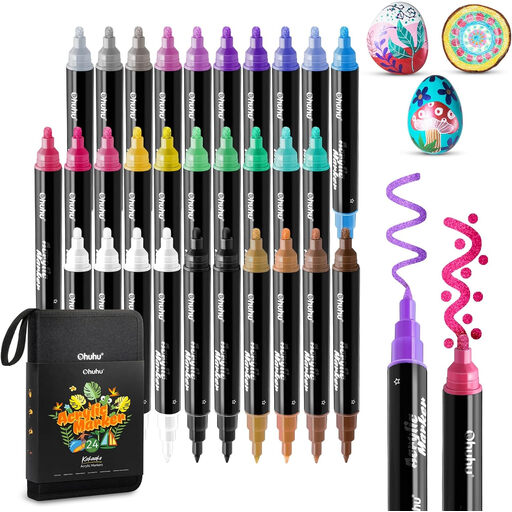
This marker set stands out for its water-based acrylic ink, which opens the door to almost unlimited versatility.
Its key strength: an ink that can adhere to almost anything! Stone, wood, fabric, ceramic, glass, plastic... nothing stands in its way. Its acrylic ink offers remarkable opacity, even for the 24 metallic shades in the pack, which are perfect for adding a shimmering touch to your work.
For versatile creatives who love to experiment on different surfaces. It's the ideal set for getting into object customisation, rock painting, or working on canvas and wood.
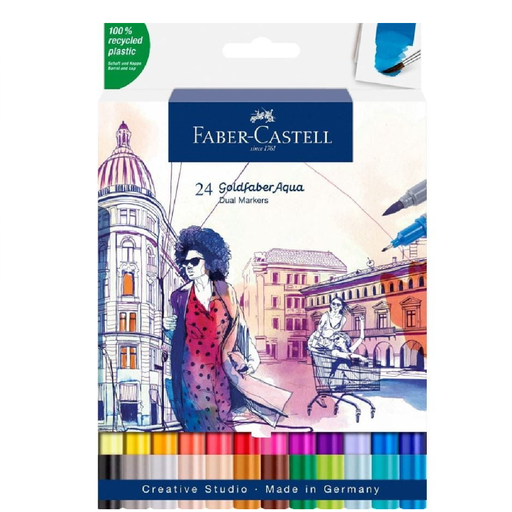
Here, Faber-Castell perfectly blends the convenience of a marker with the delicacy of watercolour, all with an eco-conscious design.
The ink in this watercolour marker is fully soluble, allowing you to create gradients and washes worthy of traditional watercolour, simply with a little water. The other major selling point: the barrel and caps are made from 100% recycled plastic. A real plus for environmentally conscious creators.
Perfect for illustrators, bullet journal fans, travel journalers, and art students. It's the dream fine tip and brush pen for getting started with watercolour without the hassle of pans and complex equipment.
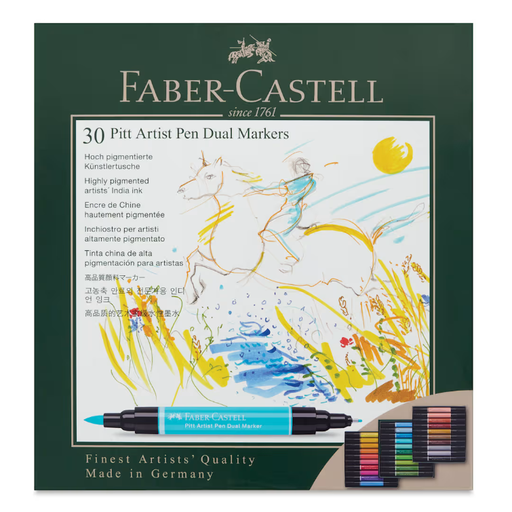
With this marker set, we're clearly moving into a higher tier. It's aimed at creators who demand archival quality for their work.
The secret to its performance: a very high-quality pigmented India ink. Permanent, water-resistant, and lightfast, it ensures exceptional colour longevity. Professional quality, finally accessible.
A must-have for illustrators, designers, comic book artists, and all artists creating works intended for preservation or exhibition. It's the benchmark choice for an archival-quality illustration marker.
Of course, our selection is just a glimpse of the infinite possibilities that dual-tip markers offer. Because every artist is unique, there is a myriad of other models, colours, and tip combinations to discover.
To explore a wider range, discover other brands, or find sets with specific colour palettes, take a look at our complete category.
? Discover our entire collection of dual-tip pens on Joybuy
1. What's the difference between an alcohol-based marker and a water-based marker? An alcohol-based marker uses a solvent that dries very quickly, allowing you to layer colours and create very smooth gradients without causing the paper to buckle. It's a favourite among manga artists and illustrators. A water-based marker, on the other hand, contains an ink that can be reworked even after drying with a wet brush, much like a traditional watercolour.
2. How can I prevent markers from bleeding through the paper? The secret is the paper! Opt for a fairly high weight (120 g/m? minimum, and aim for 180 g/m? or more for wet techniques like watercolour). To be safe, you can also place a scrap sheet under your drawing. Note that some inks, like that of the Goldfaber Aqua, are specially designed to limit this phenomenon.
3. Can I use an illustration marker on any surface? Absolutely not; it all depends on the ink! Water-based or India inks are best friends with paper and cardboard. To tackle smooth or non-porous surfaces (plastic, glass, metal, wood...), you will absolutely need an acrylic marker like those in the Ohuhu set, whose ink is specially formulated to adhere to them.