
Livraison le jour même ou le lendemain

Qualité garantie

Débloquez vos offres de bienvenue: Livraison GRATUITE | Jusqu'à -80 % | 30 jours d'essai gratuits à JoyPlus
Téléchargez l'application
Whether you're customising objects, decorating pebbles from your holiday, or bringing an illustration on canvas to life, dual-tip acrylic paint pens have become an indispensable tool for all creatives. The problem is, the market is flooded with products that promise the world but often deliver disappointing results. As editorial experts, our mission is simple: to help you avoid the pitfalls and identify the criteria that truly make a difference.
To prevent your creative project from turning into a nightmare, let's review the three most common disappointments.
To avoid falling into these traps, focus on a few key technical specifications. These are the true guarantors of the quality and longevity of your future markers.
The strength of a dual-tip acrylic paint pen is its versatility. As the name suggests, it all comes down to its two ends. Here’s what to inspect:
The ink is the heart of the marker. A good water-based acrylic formula must guarantee high opacity from the very first stroke. This is the secret to achieving vibrant colours, even on black or pre-coloured backgrounds.
Also, look for mentions of water and light resistance once the ink is dry. This will ensure the longevity of your creations, whether it's a pen for rocks intended to decorate the garden or a wood paint pen applied to a piece of furniture. True multi-surface acrylic markers form a solid film of paint that adheres without fail and may not even require a varnish for simple decorative objects.
A good acrylic marker set is not measured by the number of colours, but by their relevance. A well-thought-out palette with primary colours, skin tones, shades of grey, and a few bright hues will always be more useful than an avalanche of nearly identical shades.
For projects that stand out, metallic markers or pastel sets are an excellent addition. Check that the metallic pigments are fine and perfectly incorporated into the ink for a smooth, shimmering finish, not just a cheap "glitter" effect that flakes off with the first touch.
Rather than an endless list, we have selected products that meet specific needs while adhering to our strict criteria for quality and durability.
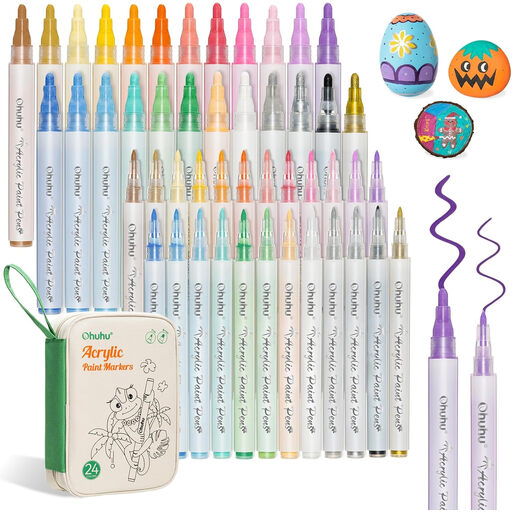
Why we recommend it: This pack is the ultimate solution for those who want it all, without compromise. It contains not one, but two complete sets of 24 colours: the first with fine tips for details, the second with reversible tips (bullet/chisel) for large fills. This guarantees perfect colour consistency, whatever the line.
The reversible tips are the ultimate defence against premature wear. If a tip gets damaged, just flip it over. Its pigment-rich ink ensures flawless opacity, even on the most demanding surfaces.
Reversible tips (bullet/chisel) and a full set of pens dedicated to fine tips for absolute versatility. The ink is water and light-resistant.
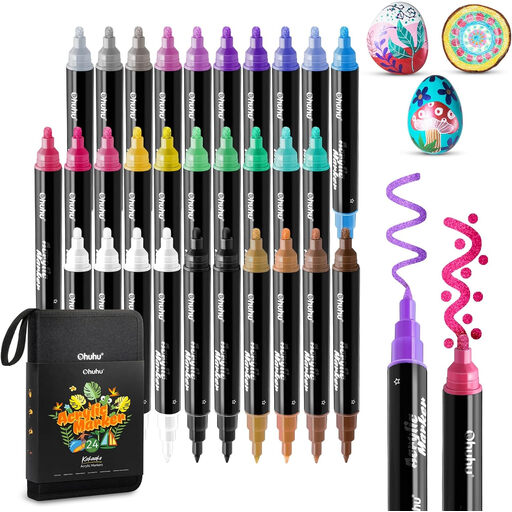
Why we recommend it: Perfect for those who want to add a touch of sparkle to their creations. This kit stands out with its wide selection of 24 metallic colours, cleverly complemented by black and white pens for bases and highlights. Its dual tip (fine and medium) makes it ultra-versatile for decorating on glass, wood, or ceramic.
It solves the problem of disappointing opacity, a common issue with metallic shades. The rich ink ensures a shimmering and perfectly opaque finish, even on dark backgrounds, and eliminates the "diluted glitter" effect.
An impressive palette of 24 metallic colours. The tips are replaceable (8 replacement nibs included), which dramatically increases the kit's lifespan.
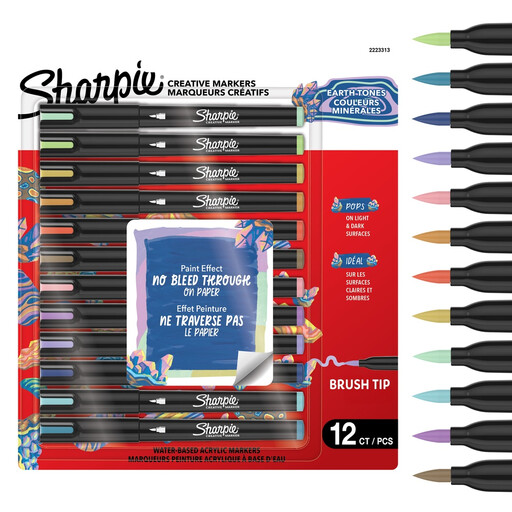
Why we recommend it: This kit is tailor-made for artists seeking control and expressive strokes. Its unique brush tip allows you to switch from a fine, delicate line to a generous fill in a single movement. Ideal for illustration, calligraphy, or adult colouring books.
Its brush tip is designed to be both flexible and durable, preventing it from fraying like classic felt tips. The ink is formulated not to bleed through paper, a decisive advantage for working in a sketchbook or colouring book.
The brush tip for exceptional line variation. The ink is ready to use without shaking the marker, providing a constant and immediate flow.
Explore our full selection of products that meet our demanding selection criteria and current safety standards.
If a marker hasn't been used for a long time, its tip can dry out. Don't panic, and don't throw it away just yet! Shake it vigorously for a full minute. Then, on a piece of scrap paper, gently pump the tip several times to restart the ink flow. If the tip is simply clogged with dried paint, carefully remove it (if the model is detachable) and let it soak for a few minutes in warm water. Dry it thoroughly before putting it back.
On porous surfaces (paper, raw wood, cardboard, fabric…), acrylic ink is indeed very durable once dry. On smooth, non-porous surfaces like glass, ceramic, or plastic, the adhesion is good for decorative use, but the paint remains susceptible to scratches and abrasion. For maximum durability on these materials, there are two solutions: "bake" your creation in the oven (if the object is suitable, like ceramic) or apply a layer of clear protective varnish.
It's trickier than with liquid paint, but definitely possible! The easiest method is to work quickly while the ink is still wet. Apply one colour, then the second right next to it, and use a clean, slightly damp brush to blend the two shades. Another technique: apply your colours to a non-porous palette (an old ceramic plate will do), mix them with a brush, and then apply the result. This method offers more control, but you have to act fast, as acrylic dries in record time.