
Livraison le jour même ou le lendemain

Qualité garantie

Débloquez vos offres de bienvenue: Livraison GRATUITE | Jusqu'à -80 % | 30 jours d'essai gratuits à JoyPlus
Téléchargez l'application
Whether you're an artist preparing your next illustration, a casual coloring enthusiast, or a parent looking for creative supplies for your kids, choosing the right set of drawing markers can quickly become a headache. Faced with a jungle of available options, it's hard to know where to start. Our mission? To help you see clearly and identify the criteria that truly matter for making a smart and lasting purchase.
Marketing is notoriously good at highlighting tempting features that can sometimes hide major flaws. Here are three classic pitfalls that are a recipe for disappointment.
To ensure you make the right choice, here are the technical specifications you should focus on. They define a marker's intended use and true quality.
The ink is the soul of the marker. It determines the finish, coverage, and the surfaces you can use it on.
The shape of the tip directly influences the drawing style you can adopt.
If the markers are for young children, safety is paramount. Check that the products comply with the European standard EN 71, which guarantees they are free of harmful substances. Opt for water-based, non-toxic inks that are, if possible, easily washable from both skin and textiles.
To put theory into practice, here are a few models we recommend, each tailored to specific needs.
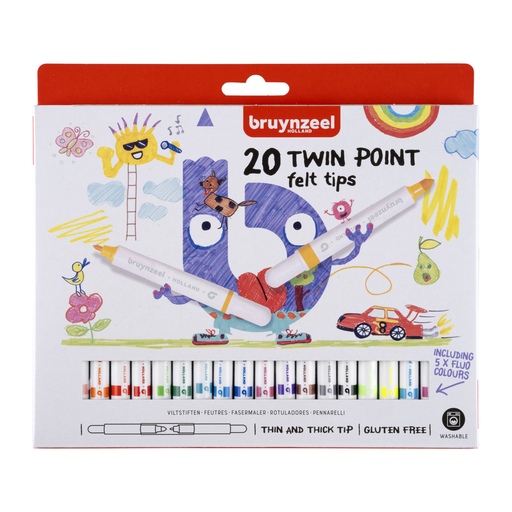
Why we love it: Perfect for parents looking for kids' markers that are safe, durable, and versatile. Their dual tips adapt to every creative whim, from coloring large areas to drawing fine details.
It tackles the problem of markers that dry out too quickly. Its ink is designed to resist drying, and if a tip does dry out, you can simply dip it briefly in water to reactivate it.
The dual tip (one thick, one fine) offers incredible versatility. The water-based ink is a guarantee of safety for children.
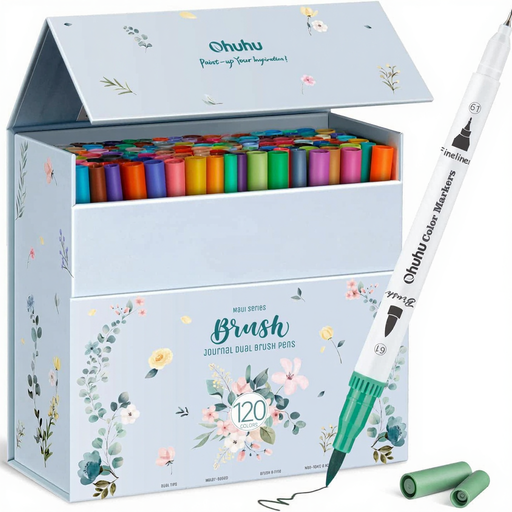
Why we love it: For fans of coloring, bullet journaling, or calligraphy who want a set of art markers with an XXL color palette. This set offers an excellent quantity-to-versatility ratio, all in a well-designed package.
It avoids the "too many colors spoil the quality" trap. Each marker is numbered, and the set includes a blank color swatch card for you to fill in, helping you visualize and make the most of every single shade.
The combination of a brush tip and a fine tip across 120 colors offers nearly infinite creative flexibility. The included replacement nibs are the icing on the cake, extending the life of the set.
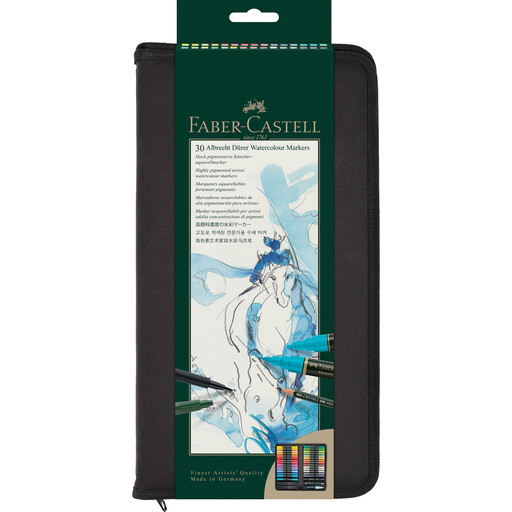
Why we love it: The gold standard for artists seeking a professional marker set. The quality of the pigments and the ink's responsiveness to water make it a top-tier tool for high-level illustration and watercolor work.
It solves the problem of colors fading over time. Faber-Castell guarantees excellent lightfastness, a critical feature for artworks intended to be preserved or displayed without losing their brilliance.
The pigmentation and ink formula allow for true watercolor effects. The dual tip (brush and fine) ensures surgical precision for mixed media techniques.
Explore our full selection of products that meet our strict selection criteria and current safety standards.
The golden rule: store your markers horizontally. This allows the ink to distribute evenly between both ends (especially for dual-tip markers) and prevents one of the tips from drying out. Also, always remember to close the caps tightly until you hear that satisfying "click."
The choice of paper is just as crucial as the choice of markers. For water-based or watercolor markers, a fine-grain or mixed-media paper of at least 180 g/m? is ideal. For paint markers, opt for thick paper or surfaces like canvas board. Avoid standard printer paper (80 g/m?) at all costs, as it's far too thin and absorbent.
Yes, it's possible, provided they share the same ink type (for example, two brands of watercolor markers). However, the chemical formulas can vary slightly. Our advice: always do a test on a piece of scrap paper to check compatibility and color results before working on your final piece.