
Livraison le jour même ou le lendemain

Qualité garantie

Débloquez vos offres de bienvenue: Livraison GRATUITE | Jusqu'à -80 % | 30 jours d'essai gratuits à JoyPlus
Téléchargez l'application
Heavy menstrual flow, postpartum recovery, urinary leaks... In many situations, finding protection that is both secure and invisible is the key to a worry-free day. This is where disposable absorbent underwear for women comes in: it offers the security of high-performance protection with the look and feel of regular underwear.
This guide is designed to help you navigate the many options on the market. We have analysed and selected products that stand out for their effectiveness, giving you everything you need to choose the solution that's right for you—all without the marketing jargon.
Before diving into our selection, let's review the essential criteria that will guide your choice.
This is the most important factor. Needs vary greatly depending on the situation:
Good absorbent underwear should be unnoticeable. To ensure this, check the following points:
Your daily routine is also a determining factor. Underwear for urinary leaks intended for daily use will prioritise absolute comfort, while a model for sports must ensure unbeatable support. For travel, hospital stays, or simply as a backup solution, disposable briefs for women or disposable sanitary underwear, often individually wrapped, prove to be an incredibly convenient solution.
We have selected a few products that excel in their category, chosen for their smart design and effectiveness.

Why it stands out: This model targets the heaviest flows and the postpartum period. Its dual-layer absorbent core, made from FSC-certified pulp, promises very high absorption, equivalent to 4 regular sanitary pads. Its low-rise cut and 360° form-fitting design ensure a perfect, discreet fit.
Advantages:
Who is it for? For anyone who wants absolute security during heavy periods or postpartum, without sacrificing discretion.
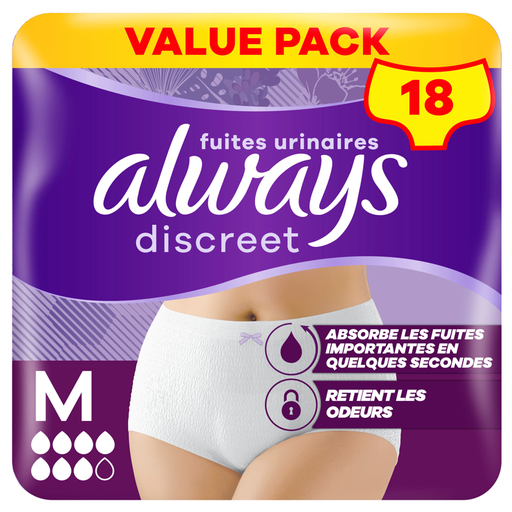
Why it stands out: Specifically designed for urinary leaks, this underwear features RapidAbsorb technology which, according to the brand, absorbs liquid and neutralises odours in seconds. The double LeakGuard barriers reinforce protection where it's needed most. Its 360° FormFit design hugs your body's curves for a comfortable and secure fit.
Advantages:
Who is it for? For active women dealing with moderate to heavy leaks who are looking for effective protection to live their daily lives with complete freedom.
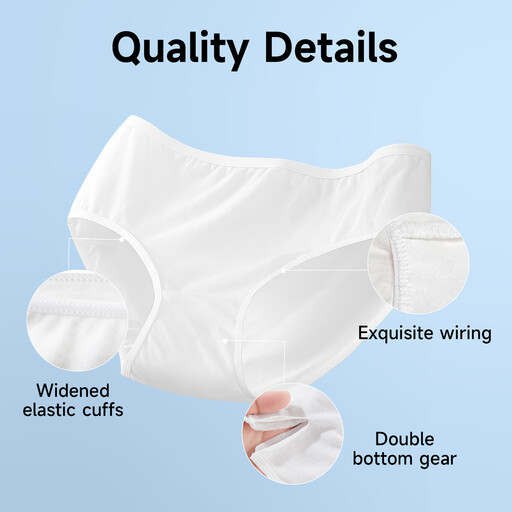
Why it stands out: Please note, this product is different in nature: it is a pair of disposable briefs for women, but it is not absorbent. Made from 100% cotton, it focuses entirely on hygiene and convenience. Each brief is individually wrapped, making it perfect for travel. This is not a form of protection, but rather single-use underwear.
Advantages:
Who is it for? For anyone who needs a hygienic and practical backup solution while travelling or on the go. It can be worn alone for comfort or combined with conventional sanitary protection (pad, panty liner).
Our selection highlights specific needs, but choosing underwear is ultimately a personal matter. To explore a wider range, with other brands, various absorbency levels, or even reusable alternatives, feel free to browse our catalogue.
To discover other models and find the one that is 100% right for you, check out our complete category of women's underwear.
Although they look similar, their internal design differs. Disposable period underwear is optimised to gradually absorb a thick liquid like blood. In contrast, underwear for urinary leaks incorporates an absorbent core that almost instantly gels a very fluid liquid (urine) to keep the skin dry and neutralise ammonia-related odours.
Absolutely. The majority of models are designed to offer excellent support and discreet protection, even during exercise. Their snug fit and leak guards move with your body to prevent any risk of accidents, allowing you to stay active with total confidence.
Wear time depends on your flow or the severity of leaks, as well as the manufacturer's recommendations. Some products, like the SUNKISS model, mention protection for up to 12 hours. However, for hygiene and comfort, it is recommended to change it as soon as you feel the need, or on average every 6 to 8 hours.