Single person or couple with very little space
A compact model can help reduce hand-washing when a 45 cm appliance will not fit. However, check that the basket can accommodate your everyday dishes, including larger items.


Start by choosing the format based on the measured space, the amount of crockery between washes, and whether you have a water inlet and drainage point. A compact model is suitable for very small daily loads, while a 45 cm model is better suited to more crockery. In an open-plan kitchen, also compare the decibel level, noise class and Eco programme data shown on the label.
A compact model can help reduce hand-washing when a 45 cm appliance will not fit. However, check that the basket can accommodate your everyday dishes, including larger items.
If you have standard connections and floor space available, a freestanding or slimline 45 cm integrated model offers more capacity than a mini model. UFC-Que Choisir states that this format usually accommodates 9 to 10 place settings.
When the appliance operates close to your living area, compare the noise level in dB, the noise class and the Eco cycle duration before considering secondary features. ADEME explains that this information appears on the energy label.
Consider this: if a 45 cm appliance will not fit and your everyday dishes genuinely amount to 2 or 3 place settings.
Accept this: limited capacity may mean washing large dishes by hand or running more cycles.
Consider this: if you have floor space, standard connections and less than 60 cm of width available.
Check this: the exact width, height and depth, as this format requires more space than a compact model.
Consider this: if a compatible housing unit is already available and a seamless look matters in your open-plan kitchen.
Plan for: checking the compatibility of the housing unit, door panel and connections before buying.
| Priority | What to check | Your needs |
|---|---|---|
| Size and installation | Measure the width, height and depth of the space. For an integrated model, also check the housing unit, door panel and installation diagram. Under a worktop, check whether the top is removable when this is предусмотрed for the model. | I want to keep the walkway clear and avoid an appliance blocking the worktop or not fitting into the housing unit. |
| Noise in the living area | Compare the noise level in dB, the noise class and the Eco cycle duration on the label. According to ADEME, an extra 3 dB corresponds to an almost doubling of the noise. | I want to run a cycle without disturbing conversation, rest or off-peak hours near the sitting room. |
| Usable capacity | Compare the number of place settings with the meals, mugs, utensils, saucepans and dishes used between cycles. Also check the maximum plate diameter for a mini model. | My everyday dishes should fit in the basket without requiring multiple cycles or leaving large dishes out. |
| Water, energy and Eco duration | Compare the kWh per 100 cycles, litres per cycle and Eco programme duration. These figures from the label provide a common basis for comparing models. | I prefer to compare equivalent information rather than a quick programme or an isolated low-consumption claim. |
A 2- or 3-place-setting model takes up less space, but it will not necessarily eliminate hand-washing if your dishes or daily load exceed the basket capacity. The documented Bob is limited to 3 place settings and plates measuring no more than 29 cm.
List the dishes produced between washes, including frying pans, salad bowls, mugs and containers, then choose a compact model only if they fit within the stated capacity.
A commercial description is no substitute for a comparable measurement. UFC-Que Choisir highlights that noise is particularly important in an open-plan kitchen, while ADEME points to the perceptible effect of a 3 dB difference.
Check the noise level in dB, the noise class and the Eco cycle duration on the label for the exact model.
The external dimensions, housing unit, height adjustments and door panel can make an appliance incompatible, even if its nominal width is 45 cm.
Use the model’s installation diagram and check the housing unit, required door panel and connections before buying.
A matching door panel may be required for an integrated model, so the installation requirements are not the same as those for a freestanding appliance.
Comparisons of water, energy, noise and duration are based on the Eco programme at nominal capacity. An Express cycle may be much shorter without providing an equivalent basis for comparison.
To compare two appliances, start with the kWh per 100 cycles, litres per cycle and Eco duration shown on their labels.
French brand offering Bob, a mini countertop dishwasher designed for spaces where a 45 cm appliance will not fit.
The brand offers freestanding, integrated and built-in 45 cm dishwashers for compact fitted kitchens.
Miele offers freestanding and integrated 45 cm dishwashers, some of which are suitable for compact kitchens.
This selection brings together countertop dishwashers designed for small kitchens and smaller loads of crockery.
 Image unavailable
Worth considering for a small home that needs more capacity than a 3-place-setting mini model.
The product name states 6 place settings, 7 programmes, 47 dB and energy class D.
Check the external dimensions, water connection and drainage before installation.
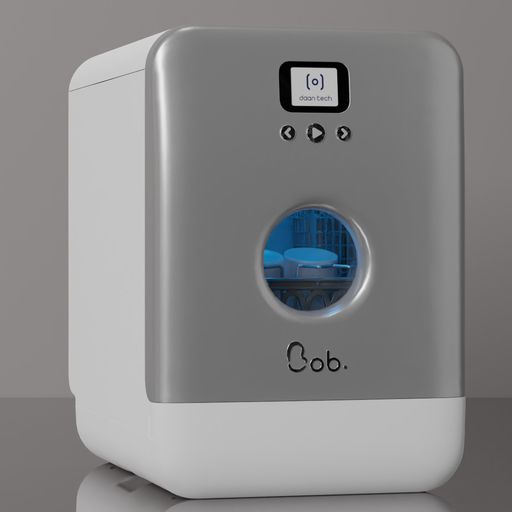 Image unavailable
This countertop format is designed for a very small daily load when a 45 cm appliance is not an option.
The product name indicates 3 place settings and a width of 34 cm; the stated noise level is 43 dB.
Check the noise class, Eco programme data, included accessories and water supply method before buying.
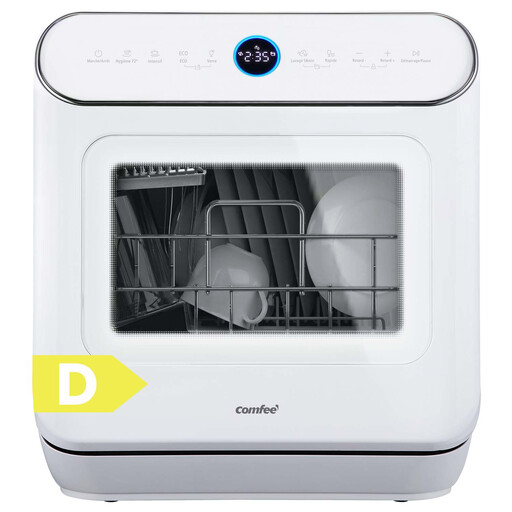 Image unavailable
An option for a single person or couple looking for a very compact countertop appliance.
The product name states 3 place settings, 7 programmes, touch controls, a 24-hour delay-start function and energy class D.
For an open-plan kitchen, check the noise level, noise class and Eco programme data; large dishes may need to be washed separately.
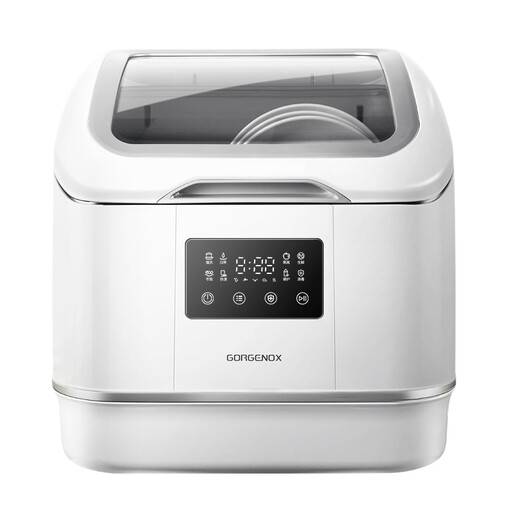 Image unavailable
This countertop model may suit a very small household looking to reduce hand-washing.
The product name indicates a capacity of 3 place settings and countertop use.
Check the dimensions, noise, consumption, Eco duration, tap connection and drainage arrangements.
Measure the width, height and depth of the space. For a freestanding model under a worktop, also check whether the top is removable. For an integrated model, use the installation diagram and check the exact dimensions of the housing unit. Bosch states that common freestanding formats are 45 or 60 cm wide and approximately 84.5 cm high.
Compare the energy class, kWh per 100 cycles, litres per cycle, Eco cycle duration, noise level in dB and noise class. ADEME states that this information is displayed on the energy label for dishwashers; the Eco programme is used as the basis for regulated measurements.
It depends on the model. For Bob, Daan Tech states that a built-in 3.9 L tank can replace a conventional water inlet, but drainage must still be arranged using a hose to a sink or another drainage point. Check the instructions and accessories supplied with your chosen model.
Yes, it can make a difference in an open-plan kitchen. ADEME states that an extra 3 dB corresponds to an almost doubling of the noise, so compare the dB level and noise class before relying on a commercial description.
No. A quick programme alone does not provide a comparable basis between appliances. To compare water and energy use, use the label values associated with the Eco cycle, together with its duration. An Express cycle can still be useful occasionally when saving time matters more.