
Livraison le jour même ou le lendemain

Qualité garantie

Débloquez vos offres de bienvenue: Livraison GRATUITE | Jusqu'à -80 % | 30 jours d'essai gratuits à JoyPlus
Téléchargez l'application
With the rise of remote work and distance learning, setting up a dedicated workspace at home has become a necessity. Choosing a desk is no longer about a simple plank on trestles: the goal is to find a piece of furniture that is functional, durable, and suited to both your body and your decor.
Faced with an overwhelming number of options, it can be hard to know where to start. To help you make sense of it all, this guide provides key insights and practical advice for choosing THE desk that will meet your needs, without getting lost in marketing jargon.
Before you begin, there are three main criteria to consider to make the right long-term choice.
The first step, of course, is to measure the space you have available. A large desk is certainly comfortable, but it can quickly overwhelm a small room.
Spending long hours sitting can quickly take a toll on your well-being. Ergonomics is therefore not an option, especially for a desk for remote work.
The height-adjustable desk, also known as a sit-stand desk, is an increasingly popular solution. It allows you to alternate postures throughout the day, switching from sitting to standing in seconds. This flexibility is a real bonus for overall comfort during long work sessions.
A well-organised workspace is key to concentration. A desk with storage built-in (drawers, shelves, cabinets) is an incredibly practical solution for keeping your documents, supplies, and cables within reach but out of sight. If you prefer a minimalist design, keep in mind that you can always add modular storage solutions later.
To move from theory to practice, here are three models that meet distinct needs, selected for their balance of functionality and design.
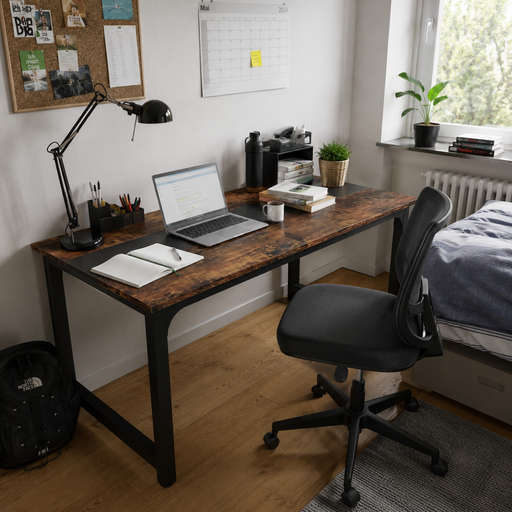
What sets it apart
This model stands out for its very generous 160?x?80?cm work surface. Its minimalist design and robust frame make it a reliable choice for those who need space. The reinforced steel frame ensures excellent stability, a crucial feature for a desk intended to support heavy equipment.
Key features
Who is it for?
This large desk is particularly suitable for professionals who work with large formats (architects, graphic designers), developers juggling multiple monitors, or anyone looking for a spacious and sleek computer desk.
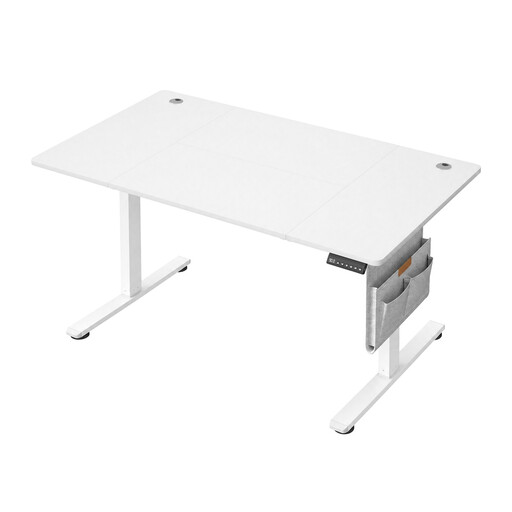
What sets it apart
This motorised height-adjustable desk places ergonomics at the heart of your workspace. Its quiet motor allows you to switch from a sitting (72 cm) to a standing (120 cm) position effortlessly. The four-height memory function is a real convenience for daily use.
Key features
Who is it for?
This sit-stand desk is the ideal companion for professionals in remote work who spend long hours at their station. It is perfect for those looking to improve their comfort by varying their posture throughout the day.
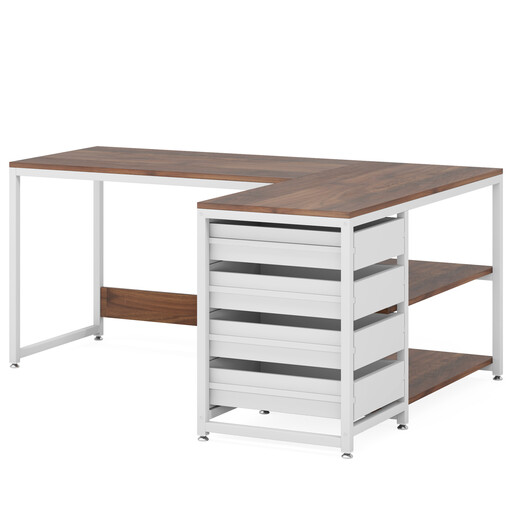
What sets it apart
This corner desk combines a large work surface with a comprehensive storage solution. Its L-shaped design is reversible, so you can assemble the storage module on the left or right, depending on your room's layout.
Key features
Who is it for?
This model is perfect for those looking to make the most of a corner in a room. It is also ideal for users who need a large amount of storage within easy reach, such as students, administrative professionals, or creatives.
Our selection focuses on versatile models, but perhaps you have more specific needs. If you are looking for a particular aesthetic or configuration, many other options are available.
Explore our full collection to find the perfect piece of furniture that will seamlessly integrate into your home. For example, discover our range of Black Corner Writing Desks.
Measure the available space in your room, remembering to leave enough clearance for your chair. For the desktop, a depth of 60 cm is the minimum to be comfortable with a laptop. If you use an external monitor, aim for a depth of 70 to 80 cm for better visual comfort.
A height-adjustable desk is a true ally for your comfort. Its main advantage is allowing you to easily change your posture during the day. Alternating between sitting and standing helps break up sedentary periods and relieve tension, a much-appreciated benefit during long days of remote work.
The load capacity varies greatly from one model to another. A simple desk with thin legs will obviously support less weight than a model with a reinforced steel frame. The key is to check the product's technical specifications, where this information is usually listed (look for the "maximum static load capacity"). For standard use with a computer, a monitor, and a few books, most desks will suffice. For heavier equipment, opt for models with a robust metal frame.