
Livraison le jour même ou le lendemain

Qualité garantie

Débloquez vos offres de bienvenue: Livraison GRATUITE | Jusqu'à -80 % | 30 jours d'essai gratuits à JoyPlus
Téléchargez l'application
A fender bender in a car park? A dispute following a road accident? In these situations, video evidence can make all the difference. The dash cam, or in-car camera, is no longer a gadget for tech enthusiasts but a true guardian angel for many drivers. Whether you're a daily commuter, a road professional, or simply a cautious driver, this driving recorder provides invaluable peace of mind.
The market is flooded with models offering a wide range of features. To help you navigate the options, we've broken down the key functionalities to help you choose the perfect in-car camera without breaking the bank.
Before diving into our selection, let's review the essential technical criteria that will guide your choice.
A dash cam's mission is simple: to capture clear, usable footage, day or night. While Full HD (1080p) is the bare minimum today, a 4K dash cam (Ultra HD) is a game-changer. It offers a far superior level of detail, making it possible to read a licence plate or identify crucial details from a distance.
Night-time image quality is just as important. For this, look for models equipped with high-performance image sensors, like Sony's renowned STARVIS sensor, known for its effectiveness in low light. HDR (High Dynamic Range) technology is also a must-have, as it balances harsh contrasts, typically when entering or exiting a tunnel.
The number of cameras determines the surveillance area around your vehicle:
Modern dash cams include features that go beyond simple recording:
Here are a few options that stand out for their technical specifications and market position.
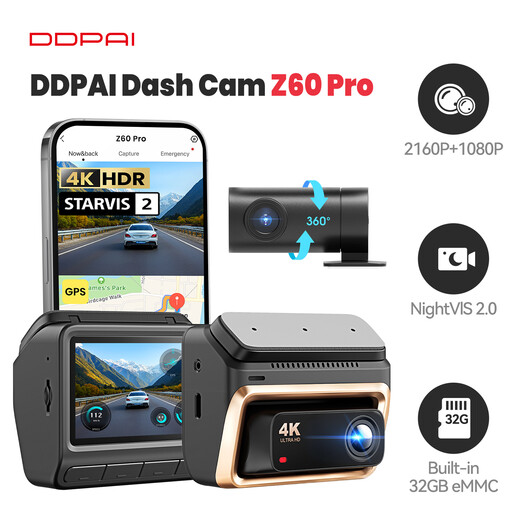
Why it stands out: The Z60 Pro goes all-in on image quality thanks to its dual Sony sensors. The front STARVIS 2 IMX678 sensor enables 4K HDR recording, while the rear camera provides 1080p HDR. Its 60 frames per second mode (available in 3K) ensures stunningly smooth footage, perfect for freezing the fastest-moving scenes with impeccable clarity.
Key features:
Who is it for? For demanding drivers and tech enthusiasts who want to make no compromises on video quality, day or night, and who are looking for maximum image smoothness.
€131.90 (after promotion) See the product on Joybuy.fr
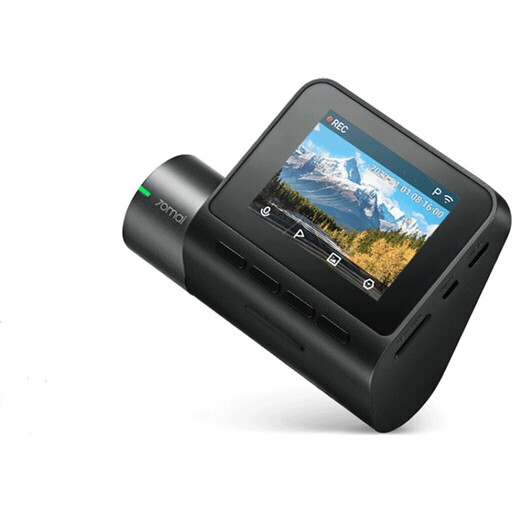
Why it stands out: The 70mai A200 gets straight to the point, but with a secret weapon: 1080p recording at 60 frames per second (fps). This frame rate, rare in this price range, guarantees very smooth videos and reduces motion blur—a major advantage for reading the licence plate of a vehicle overtaking you.
Key features:
Who is it for? For drivers looking for a simple, effective, and affordable solution to record the road, with a real bonus in image smoothness.
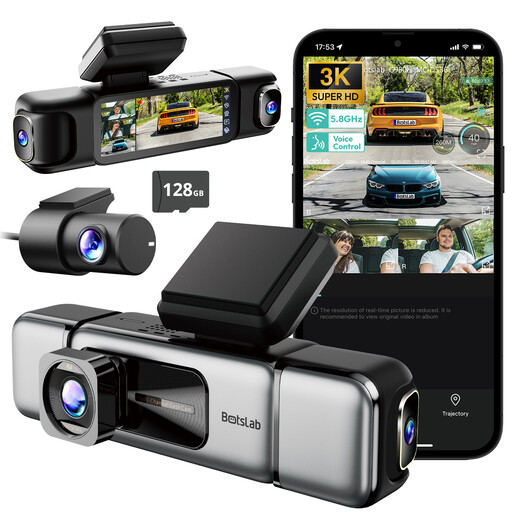
Why it stands out: This model is the ultimate guardian for your car. With its 4-channel system, it monitors everything: the front, the rear, and both sides of the cabin, for an advertised 560° panoramic view. No more blind spots! Its large 3.18-inch touchscreen displays all four feeds simultaneously for total control at a glance.
Key features:
Who is it for? The perfect choice for road professionals (rideshare drivers, taxi drivers, delivery drivers) and motorists who want maximum protection and comprehensive surveillance of their vehicle, both while driving and parked.
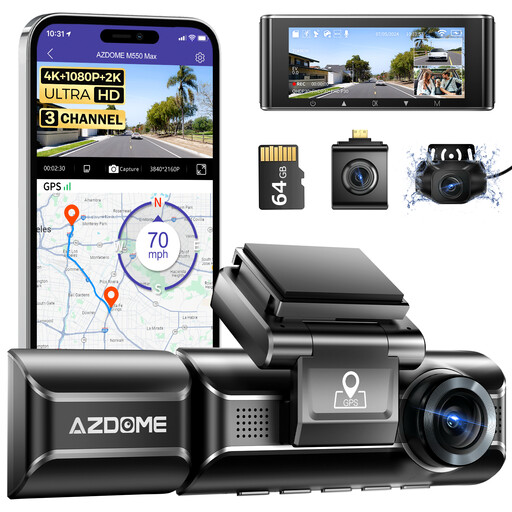
Why it stands out: The AZDOME M550 Max is a 3-channel dash cam that refuses to compromise on resolution. It simultaneously records in 4K at the front, 2.5K on the interior, and 1080P at the rear. The dual STARVIS sensors, supported by 6 infrared LEDs for the interior camera, guarantee formidably clear images, even in complete darkness.
Key features:
Who is it for? For families and professionals who demand complete surveillance (front, rear, cabin) without sacrificing image quality on any angle.
€93.99 (after promotion) See the product on Joybuy.fr
Our selection highlights a few gems, but the in-car camera market is vast. If you can't find what you're looking for here or simply want to explore other options, many alternatives await you.
Explore our full range of car cameras to find the model that's right for you.
Yes, using a dash cam is perfectly legal in France, but its use is strictly regulated. The recordings are considered for private use. In the event of a dispute, they are admissible as a starting point for evidence by law enforcement or a court. Please note: if you publish videos online, blurring faces and licence plates is mandatory to comply with image rights and privacy laws (GDPR). Finally, if you are transporting passengers (for ridesharing, carpooling, etc.), you are required to inform them of the presence of a camera recording the cabin.
Parking mode turns your dash cam into a sentry when your car is parked with the engine off. To work, it needs a continuous power supply. This is achieved by installing a "hardwire kit" (permanent wiring kit) connected directly to the vehicle's fuse box. This kit includes a safety feature that cuts off power before the car's battery is completely drained. Once active, parking mode can operate in several ways: continuous recording at a low frame rate (time-lapse) or, more commonly, triggering recording only upon detecting an impact (via the G-sensor) or motion.
Yes, the vast majority of dash cams rely on a microSD card to save videos. It is crucial to choose a "High Endurance" microSD card. These are specifically designed to withstand the intensive write and rewrite cycles of loop recording, where a standard card would fail quickly. Some premium models, like the DDPAI Z60 Pro, also include internal memory (eMMC). This is an excellent failsafe: if there's a problem with the SD card, your crucial recordings are kept safe.