
Livraison le jour même ou le lendemain

Qualité garantie

Débloquez vos offres de bienvenue: Livraison GRATUITE | Jusqu'à -80 % | 30 jours d'essai gratuits à JoyPlus
Téléchargez l'application
A cluttered entryway, a somewhat dull hallway, that awkward empty space behind the sofa... these are real interior design challenges. The console table emerges as the ideal solution: as decorative as it is practical, it transforms a simple walkway into a welcoming and well-thought-out space.
But with the sheer number of models, styles, and sizes available, making the right choice can sometimes be a puzzle. This guide gives you the keys and practical advice to find the perfect console table—one that truly meets your needs, far from the siren call of marketing.
Before you fall in love with a particular model, let's review the essential criteria to consider.
First step, and a crucial one: take out your tape measure and precisely measure the space you have available. A narrow console table is often preferred as an entryway table or hallway table to avoid obstructing foot traffic. Consider the depth: a console less than 35 cm deep is usually sufficient for placing keys, mail, or a few decorative items. The standard height is between 75 and 90 cm, allowing it to slide behind a sofa or align with the height of a light switch.
For a seamless integration, the console's style should, of course, echo your current decor.
The materials influence not only the aesthetic but also the furniture's durability and maintenance.
Should your console table be purely decorative, or should it also serve as a storage unit for the living room? Some models come with shelves, drawers, or baskets, perfect for hiding clutter. A console with one or two lower shelves offers valuable space for books, storage boxes, or plants, helping to optimise vertical space. It can also serve as a side table or end table if its dimensions allow.
Our editorial team has scoured the market to find models that stand out for their design, practicality, and value for money.

What makes it stand out
Its exceptional length of 160 cm makes it an ideal piece to adorn a large wall or to align perfectly behind a large sofa. Its narrow design (29.5 cm deep) preserves circulation space while offering a generous display surface.
Key Features
Who is it for? For those with a long wall or a large sofa who are looking for maximum display space in a chic farmhouse style.
What makes it stand out
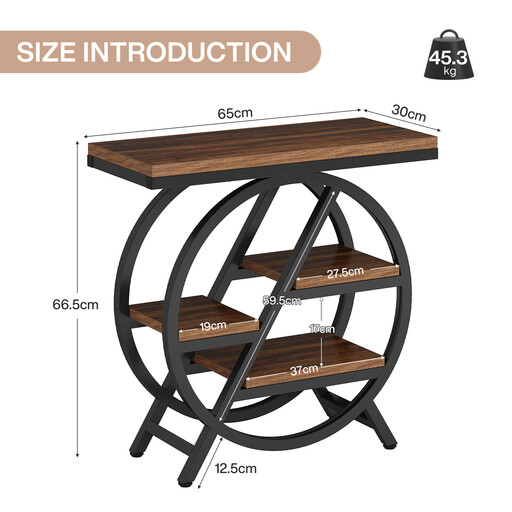
This compact piece is a true champion of versatility. With its three shelves, it optimises vertical storage on a minimal footprint. Its industrial console design makes it an excellent end table or an original nightstand.
Key Features
Who is it for? For those who need a compact and versatile storage solution for a living room, bedroom, or office, and who appreciate the industrial style.
What makes it stand out
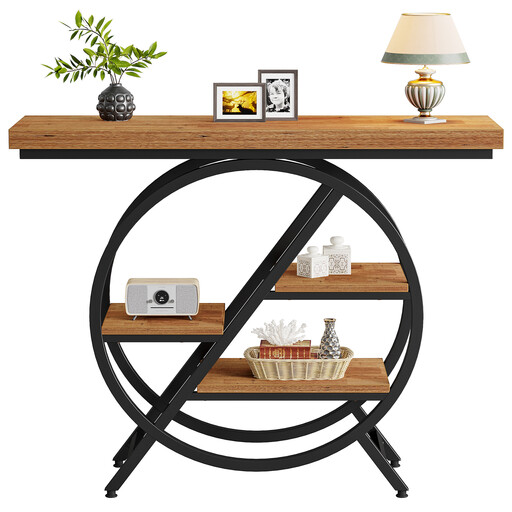
Its bold design, featuring a round metal frame and offset shelves, makes it a true centrepiece. The thick 4 cm top panel reinforces its premium feel and sturdiness.
Key Features
Who is it for? For design enthusiasts who want a functional piece of furniture that is also a strong and original decorative statement.
Did none of these models catch your eye? If you're looking for different dimensions or a different style, other options are available. A side table can sometimes serve a similar function in more compact spaces.
? Explore our complete collection of rectangular side tables to discover other options.
The height of a console table is generally between 75 cm and 90 cm. A 75-80 cm console is ideal for sliding behind a sofa with a backrest at that height. A taller console, around 85-90 cm, is better suited for an entryway or hallway, as it's more comfortable for placing or retrieving items.
For a balanced decoration, follow the "rule of three":
The main difference lies in the depth and storage function. A console table is typically narrow (less than 40 cm deep) and designed for high-traffic areas, often with open storage (shelves). A sideboard is much deeper (40-55 cm) and offers significant closed storage (doors, drawers), making it better suited for a living room or dining room.