
Livraison le jour même ou le lendemain

Qualité garantie

Débloquez vos offres de bienvenue: Livraison GRATUITE | Jusqu'à -80 % | 30 jours d'essai gratuits à JoyPlus
Téléchargez l'application
While smartphones have become stunningly good for photos and videos, they quickly show their limits when it comes to zooming, filming in low light, or achieving a truly professional look. Whether you're a content creator, an avid traveller, or simply looking for superior image quality for your memories, the compact camera is the logical next step.
More powerful than a smartphone and far less bulky than a DSLR, it offers the best of both worlds. This guide is here to help you make an informed decision, breaking down the essential criteria and showcasing the models that matter—all without overwhelming technical jargon.
Before diving into our selection, let's review the key factors to find the camera that's truly right for you.
Image quality primarily depends on sensor size. The larger the sensor, the more light it captures, and the better its performance in low light. It's that simple. On the video front, while Full HD (1080p) is sufficient for occasional use, 4K is a game-changer. The sharpness is unparalleled, and it provides valuable flexibility in post-production (for cropping without losing quality). It's a must-have feature for a vlogging camera intended for YouTube.
For filming yourself or taking selfies, a camera with a flip screen isn't a luxury; it's a necessity. It allows you to check your framing in real-time, making it the perfect selfie camera.
Be careful not to confuse optical zoom with digital zoom. Optical zoom uses the lens elements to physically get closer to the subject with zero loss of quality. It's the indispensable tool for a travel camera, perfect for capturing an architectural detail or a distant landscape. Digital zoom, on the other hand, is merely a software crop that severely degrades the image. It's best to avoid it.
For a digital camera for beginners, ergonomics are king. A lightweight body, clear menus, and well-designed automatic modes will make all the difference in daily use. Connectivity (Wi-Fi, USB-C) is also a major plus for instantly sharing your creations to your smartphone or computer.
Keeping these criteria in mind, we've selected three models that stand out, whether you're a casual vlogger or a demanding travel photographer.
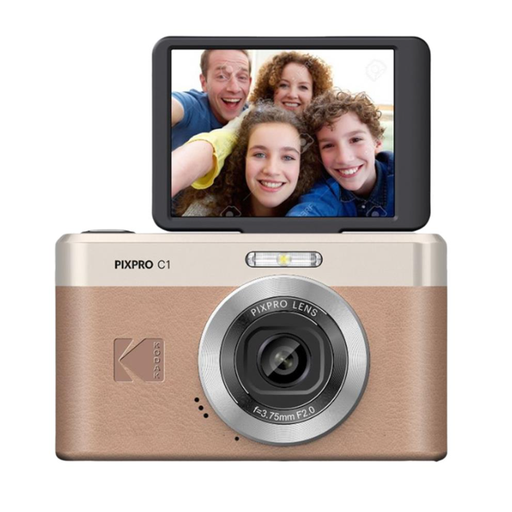
Why it stands out
The Kodak C1 is all about simplicity and efficiency. Lightweight and equipped with a fully articulating screen, it's the ideal companion for upgrading from a smartphone to a real camera, hassle-free. It's designed for immediate, intuitive handling and everyday use.
Highlights
Who is it for?
For aspiring content creators and families who want a simple, effective device to capture everyday moments, selfies, and their first vlogs.
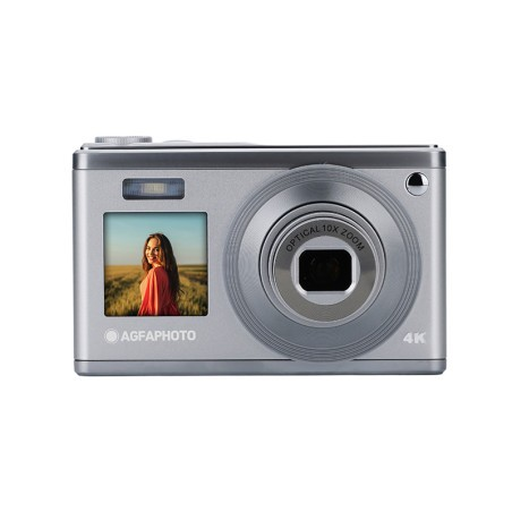
Its standout feature? The zoom.
The AgfaPhoto DC9200 stands out with its powerful 10x optical zoom, a rarity at this price point. Combined with dual screens and 4K video, it offers formidable versatility for travellers who want to capture everything, both near and far.
Highlights
Who is it for?
For adventurers and photographers who want a powerful zoom to ensure they miss nothing, while still enjoying the convenience of a front screen for vlogs and self-portraits.
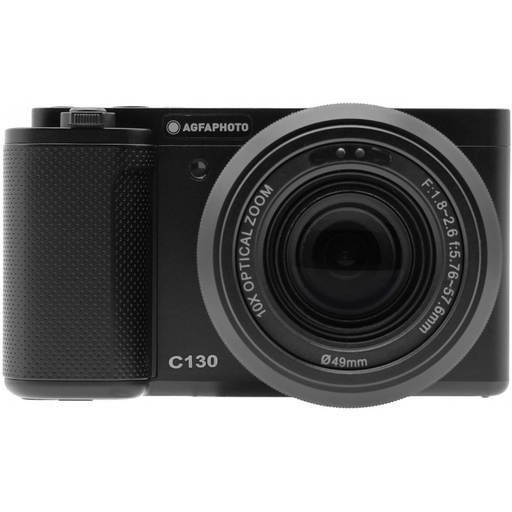
The Most Versatile
The Realishot C130 is a step up, aimed at demanding content creators. It ticks all the right boxes: 10x optical zoom, 4K video, and a fully rotating touchscreen. But it goes further with unique features like infrared night vision and a microphone input, making it a true Swiss Army knife for creation.
Highlights
Who is it for?
For vloggers and creators who want maximum versatility. Ideal if you're looking for advanced features like night vision, a microphone input for flawless audio, and the convenience of a touchscreen.
See the AgfaPhoto Realishot C130
This selection focuses on three distinct user profiles. If you don't see yourself in these descriptions or simply want to explore other options, many other models are available.
Explore our entire collection of compact cameras and find the one that meets your needs.
Optical zoom moves the lens elements to magnify the image with zero loss of quality. It's the "true" zoom. Digital zoom, on the other hand, simply crops into the image and digitally enlarges it, which causes a very noticeable loss of sharpness (a pixelation effect). For travel or wildlife photography, a digital compact with optical zoom is therefore essential.
Absolutely. A dedicated vlogging camera outperforms a smartphone on several key points. Its larger sensor delivers much better image quality, especially when light is scarce. Features like optical zoom, more effective stabilisation, and a camera with a flip screen are game-changers during filming. The icing on the cake is the ability to connect an external microphone on certain models, guaranteeing professional-grade audio quality—often the weak point of smartphones.
Not necessarily, but a 4K camera offers serious advantages. With four times the pixels of Full HD, the image is much sharper and more detailed. For creators, it's also a goldmine in post-production: you can crop, zoom into the image, or apply software stabilisation while still maintaining excellent Full HD quality. It's a great way to make your videos more dynamic and future-proof your content for years to come.