Key selection criteria
First, note the volumes during each time slot, then check the capacity, maintenance requirements and installation constraints before comparing coffee formats.
| Priority |
What to check |
Your needs |
| Availability during breaks |
Compare the stated daily capacity with the number of drinks served on a busy day. Also check the water tank, bean or capsule capacity, and the types of drinks available. |
I want to avoid a group break causing a queue or several refills. In the 2018 Ifop survey, 89% of employees questioned said they took hot-drink breaks at work, with 53% doing so several times a day; this figure describes reported breaks, not a machine’s operating rate. |
| Shared maintenance |
Check the rinsing, cleaning and descaling cycles, as well as access to the coffee-grounds container, drip tray and water tank. A milk system requires specific, regular cleaning. |
The routine should specify who fills, empties, cleans, descales and orders the consumables. Guided programmes can help, but they do not replace clearly assigned responsibility. |
| Coffee format and consumables |
For beans, check how the machine is filled and how the grounds are emptied. For capsules, confirm compatibility and collection arrangements; for filter coffee, plan for batches, filters and washing the carafe. |
I will choose between individual servings, long coffee prepared in several portions and drinks made to order, depending on the team’s habits and the time available. |
| Installation and water |
Check the condition of the socket and cable, as well as the model’s installation instructions. Ensure employees have separate access to fresh drinking water. |
The machine must be installed safely in the break area. Article R4225-2 of the French Labour Code, published by Légifrance, requires employers to provide workers with fresh drinking water; a coffee machine does not replace this obligation. |
Joybuy options for a small office
These Joybuy options include a filter coffee maker for serving batches of long coffee and a bean-to-cup machine for a small team able to organise refilling and maintenance.
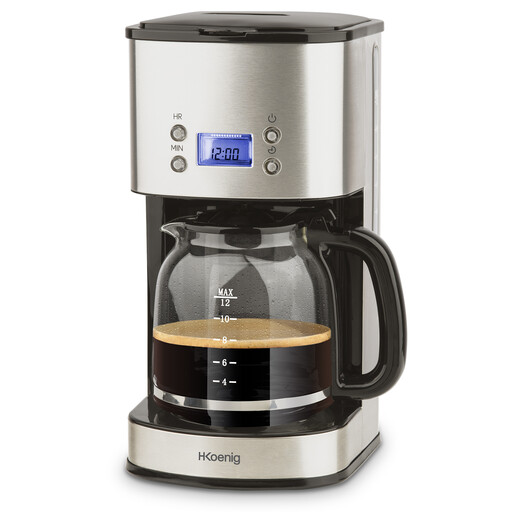 Image unavailable
Hkoenig MG30 programmable coffee maker
For preparing long coffee in batches for several colleagues, with programming for a regular time slot.
1.5 L tank, stated capacity of up to 12 cups, graduated carafe, removable filter holder and keep-warm function.
Best suited to shared long coffee; the glass carafe requires careful handling. Check the keep-warm duration and output rate if breaks are particularly busy.
Joybuy
 Image unavailable
Philips EP2230/10 Series 2200 LatteGo
Worth considering for a small team that can share refilling, emptying and cleaning cycles throughout the day.
1.8 L tank, 275 g bean hopper, two-cup preparation, removable brew group and dishwasher-safe LatteGo parts.
Daily capacity and speed during peak periods should be checked before purchase. The milk system still needs cleaning after milk-based drinks; the AquaClean filter is listed as compatible but is not included.
Joybuy
Frequently asked questions
Does the employer have to install a coffee machine or a machine connected to the water supply?
No. Article R4225-2 of the French Labour Code requires fresh drinking water to be provided for workers, but does not create a general obligation to install a coffee machine or connect one to the mains. Connection therefore depends on the model, premises and manufacturer’s instructions.
What electrical checks should be carried out before installation?
Check the condition of the machine, socket and cable, then follow the model’s instructions. INRS points out that electrical installations and equipment must be made safe, as an electrical accident can also cause a fire or explosion.
Does an automatic programme remove the need for shared maintenance?
No. Rinsing, cleaning and descaling programmes guide these tasks, but responsibility must still be assigned for filling, emptying the containers, cleaning, descaling and ordering consumables. The JURA W4 manual specifically distinguishes between these maintenance operations.
How should capsules be sorted in the office?
Follow the sorting information shown on the packaging or the instructions for your chosen collection scheme. The French Ministry for Ecological Transition states that this information explains where or how everyday products and waste should be sorted.
Can you directly compare the cost per cup of beans, capsules and filter coffee?
Yes, provided you use the same basis for calculation: the price actually paid, the coffee dose or number of capsules, the volume served, filters, cleaning products, water and, where relevant, depreciation of the machine. Compare these elements with your consumption habits rather than assuming the same difference applies to every office.


