
Livraison le jour même ou le lendemain

Qualité garantie

Débloquez vos offres de bienvenue: Livraison GRATUITE | Jusqu'à -80 % | 30 jours d'essai gratuits à JoyPlus
Téléchargez l'application
Your smartphone's battery indicator turns red right in the middle of a GPS-guided trip. In the back, your passengers are fighting over the single charging port. Sound familiar?? Once considered a mere gadget, the cigarette lighter socket is now an indispensable connection hub in our vehicles. But with the growing number of devices we own (smartphones, tablets, dashcams, laptops…), a single outlet is no longer enough.
This guide is designed to help you navigate the available options for multiplying the charging points in your car. We'll review the essential criteria for making the right choice and present a selection of products designed for every type of user: the mobile professional, the family on a road trip, or the frequent traveller.
Before you settle on a model, it's crucial to understand a few key concepts that will make all the difference in daily use.
The first and most important question is: what devices do you need to plug in??
If you're considering a converter, two technical terms will come up often:
Ensure the total power drawn by your devices does not exceed the adapter's capacity and, more importantly, that of your vehicle's cigarette lighter socket (usually limited to between 150 and 180?W). Quality products include protections against overvoltage, short circuits, and overheating—essential safeguards for the safety of your devices and your car.
To guide you, here is our selection of products that tick all the boxes, from the simple need to charge multiple devices to powering more demanding equipment.
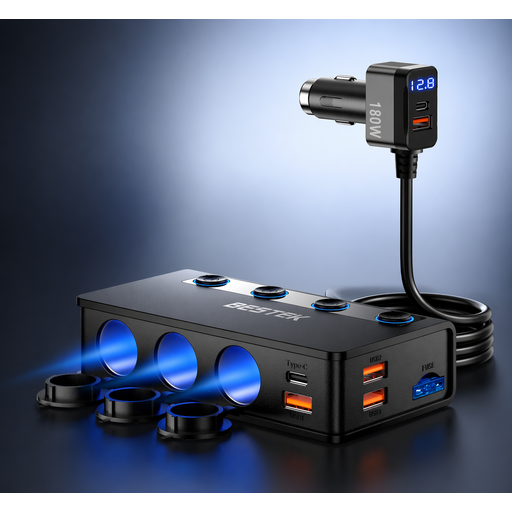
Why we love it: This model transforms your car's interior into a true mobile power station. It converts a single cigarette lighter socket into a solution capable of powering up to nine devices at once—a major asset for shared vehicles.
Highlights:
Who is it for? Ideal for large families, rideshare drivers, taxis, or teams of professionals on the go who need to charge a multitude of devices (smartphones, tablets, GPS units, dashcams) simultaneously.
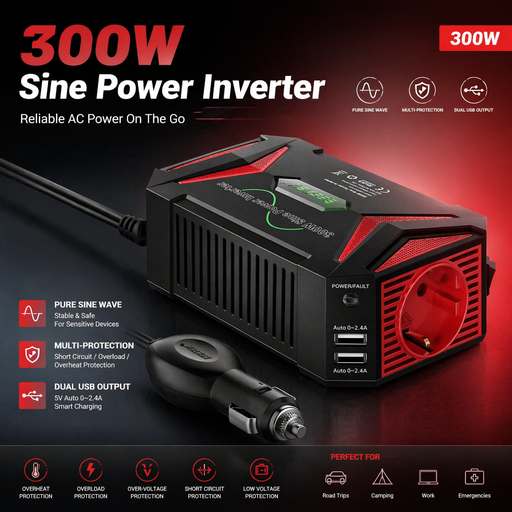
Why we love it: This inverter's main advantage is its pure sine wave output. It delivers a stable, clean current, which is essential for protecting and properly operating the most fragile electronic devices.
Highlights:
Who is it for? Mobile users who need to power valuable or sensitive electronics: photographers, musicians, remote workers, or campers who want to use their laptop or small TV without any risk.
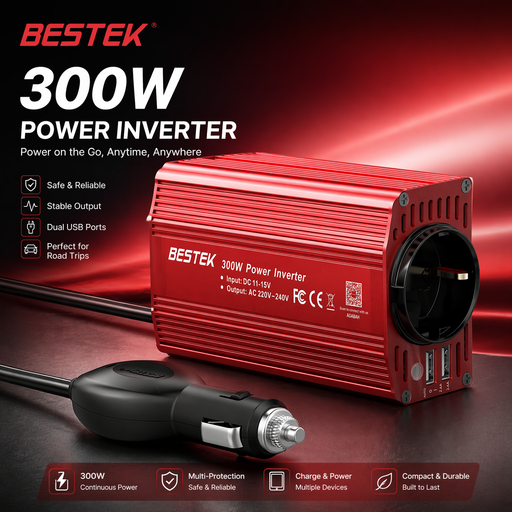
Why we love it: This inverter is the perfect trade-off between performance, versatility, and price. It offers the convenience of an AC outlet in your car for everyday use and for needs less specific than those requiring a pure sine wave.
Highlights:
Who is it for? Drivers and travellers looking for a budget-friendly and reliable solution to power non-sensitive devices: charging a laptop, plugging in an auxiliary light, a fan, or a portable DVD player.
Our selection covers the most common use cases, but your needs may be unique. If you're looking for a model with different features, such as a specific number of ports or higher power output, feel free to explore our catalogue.
To discover a wider range of chargers and accessories, check out our complete category of USB Car Chargers.
1. Can I use a high-power cigarette lighter adapter in any car? Not necessarily. It's crucial to check the maximum power supported by your vehicle. Most cigarette lighter sockets are protected by a 15A or 20A fuse, which limits the power to around 150-200?W. If you plug in a more powerful device, you risk blowing the fuse. For inverters rated at 300?W and above, it is often recommended to connect them directly to the battery with the appropriate clamps to draw their full power.
2. What is the practical difference between a pure and a modified sine wave inverter? To put it simply, imagine the electrical current as a wave. A pure sine wave is smooth and regular, like the one from your outlet at home. A modified wave is more "blocky"; it moves in steps. Simple devices (chargers, light bulbs) can handle this just fine. However, complex devices (computers, audio equipment) are designed for the smooth wave and may malfunction, overheat, or produce buzzing noises with a modified wave.
3. Is it risky to leave an adapter plugged in permanently? It's best to unplug the adapter when you are not using your vehicle. Even if the connected devices are turned off, the adapter itself can have a parasitic draw. Over time, this could drain your car's battery, especially if the battery is already a few years old. Models with switches, like the 9-in-1 splitter featured here, are an excellent way to cut the power without having to unplug everything.