Shoppers who want to reuse a glass jar
If the packaging matters to you, look for clear confirmation of the material. Nutella says its jar is glass; the word ‘jar’ on its own in another product listing isn’t enough to confirm this.


When choosing a chocolate and hazelnut spread, start by comparing the sugar content per 100 g and the ingredients, especially if you need to consider allergens. A glass jar is a choice of packaging, but it tells you nothing about the recipe: Nutella confirms that its jar is glass, while the material of a product described simply as a jar still needs to be checked. If it is shown, Nutri-Score can help you read the label, but it does not replace the nutritional information.
If the packaging matters to you, look for clear confirmation of the material. Nutella says its jar is glass; the word ‘jar’ on its own in another product listing isn’t enough to confirm this.
Organic certification, a recipe made without palm oil and a high proportion of hazelnuts are different things to look for. Ingredient lists published by Auchan and Carrefour can help you distinguish between Nocciolata, Carrefour Bio and Jardin Bio étic recipes.
Compare the sugar content per 100 g, then check the ingredients and allergens for the specific product. The DGCCRF says that relevant prepacked foods carry nutritional information, while Nutri-Score is voluntary.
Whether you’re choosing based on the recipe or the packaging, start with the nutritional information and ingredients. If glass is important to you, check the jar material next, then choose a size that suits how you’ll use it.
| Criterion | What to check | Who it matters to |
|---|---|---|
| Sugar and nutritional values | Compare the ‘of which sugars’ line and the other nutritional values per 100 g, rather than judging by the jar alone. | If I’m comparing several recipes, I want to be able to check their sugar content on the same basis before choosing. Around 39% of shoppers are said to prioritise this comparison. |
| Jar material | Look for an explicit ‘glass’ description for the product you’re considering; check local guidance before recycling the packaging. | If I want to reuse a jar, I need to know what it’s made from rather than relying on the word ‘jar’. Around 23% of shoppers are said to prioritise this. |
| Recipe and allergens | Read the ingredients list and allergen information for the specific product, including when a variant is described as dairy-free. | If certain ingredients don’t suit my diet, the exact composition matters more than claims on the front of the pack. Around 23% of shoppers are said to make this check their priority. |
| Pack size and local availability | Check the pack weight and the range available at your chosen shop or collection point. | If I don’t use much spread, I’d rather choose a suitable quantity and find the product at my local shop. Around 15% of shoppers are said to prioritise pack size and availability. |
In France, the DGCCRF describes Nutri-Score as a voluntary label. However, relevant prepacked foods still carry a nutrition declaration.
To compare two jars, read the values per 100 g and the ingredients list; use Nutri-Score as an additional guide if it appears on the products.
The product description doesn’t always specify the material. Nutella confirms that its jar is glass, but that information doesn’t apply to other products.
If glass is important to your choice, look for an explicit statement on the product or check with the manufacturer.
These claims describe features of the recipe; they don’t tell you how much sugar it contains.
Compare the ‘of which sugars’ line per 100 g for the products you’re considering, even when they carry these claims.
These brands illustrate different points to compare, from confirmed packaging material to ingredients, allergens and hazelnut content. Always check the exact variant before assuming that a feature applies to another jar.
Worth considering if you want a container confirmed as glass: Nutella says its jar is made of glass.
A range to consider for its organic cocoa and hazelnut recipes, including a variant described as dairy-free.
An organic palm oil-free spread to compare by checking its ingredients list.
A hazelnut-based spread that’s distinct from a cocoa and hazelnut spread.
An organic hazelnut and cocoa recipe to compare with other spreads in this category.
These products let you compare several cocoa or hazelnut spreads, as well as recipes that differ from the classic cocoa and hazelnut combination. If a glass jar is your deciding factor, check the material of the product you choose before buying.
 Image unavailable
Worth considering if you’re looking for an organic cocoa and hazelnut recipe. Auchan states that the Nocciolata recipe reviewed contains 18.5% hazelnuts; check the ingredients and allergens for this specific jar.
If the glass container matters to you, confirm its material before buying.
 Image unavailable
Worth considering if you’re comparing organic hazelnut and cocoa spreads in a smaller pack. Its recipe is based on red bean purée, so it differs from a classic cocoa and hazelnut spread.
Check the ingredients, allergens and sugar content per 100 g for the product you choose; check the jar material separately if you want glass.
 Image unavailable
Worth comparing if you’re looking for an organic hazelnut and cocoa spread in a 400 g pack. The Carrefour listing for this product states that it contains 16% hazelnuts and 7% cocoa.
The recipe reviewed contains hazelnuts and milk. Check the product’s allergen information and the container material if glass is important to you.
 Image unavailable
Worth considering if you’d like to compare a praline recipe with a classic cocoa and hazelnut spread. This product is made with a red bean purée base; check the ingredients to make sure it has the flavour you’re after.
To compare the recipes, check the sugar content per 100 g and the allergens in each jar.
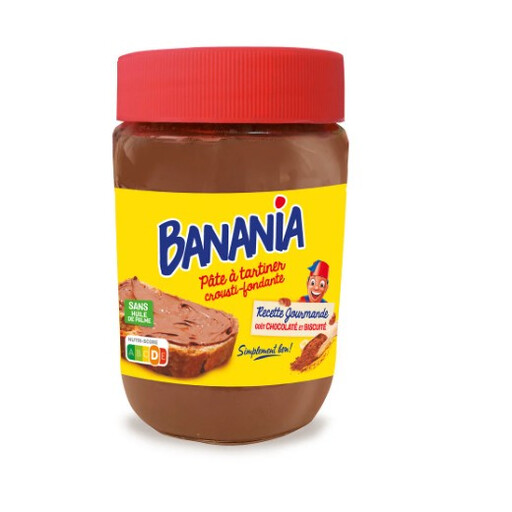 Image unavailable
Worth considering if you’re looking for a larger pack labelled as palm oil-free. The recipe also contains banana, so check the ingredients if you’re expecting a classic cocoa and hazelnut spread.
This product contains milk; check the allergen information and confirm the jar material if you prefer glass.
No. The DGCCRF describes Nutri-Score as a voluntary label. For relevant prepacked foods, the nutrition declaration lets you compare sugar content per 100 g, even when there’s no Nutri-Score.
Look for a clear statement about the specific product. Nutella confirms that its jar is glass, but the term ‘jar’ used to describe another product isn’t enough to identify its material.
Read the ingredients and allergen information for the product you choose. The recipes reviewed include ingredients such as hazelnuts, milk or soya, depending on the product; one Nocciolata variant described as dairy-free still contains hazelnuts and soya.
Follow the instructions on the jar you’ve chosen, particularly after opening. Guidance can vary between recipes, so don’t assume that instructions for another product in the same category will apply.