
Livraison le jour même ou le lendemain

Qualité garantie

Débloquez vos offres de bienvenue: Livraison GRATUITE | Jusqu'à -80 % | 30 jours d'essai gratuits à JoyPlus
Téléchargez l'application
By our product experts, July 18, 2026
Tangled cables, an overflowing power strip, the endless hunt for an available charger... Sound familiar? Between laptops, smartphones, tablets, smartwatches, and earbuds, our devices are more power-hungry than ever. A modern charging station is the perfect solution to bring order to this chaos: it centralises power for your devices, declutters your space, and optimises charging times.
This guide is here to help you make sense of it all. Discover our selection criteria to ensure you make the right choice, and explore our top product picks designed for every need, whether for an immaculate workspace or for travelling light.
Before you dive in, there are a few technical points to check to ensure the product will meet your expectations and be compatible with your devices.
Power, measured in watts (W), is the name of the game. A good charging station must not only have enough total power to supply multiple devices at once but also distribute it intelligently. For modern laptops, a USB-C port with Power Delivery (PD) is almost essential. Be sure to check the power your laptop requires (usually between 45W and 100W). A multi-port USB-C charger with a 65W PD output is an excellent sweet spot, capable of fast-charging most ultrabooks, tablets, and smartphones at full speed.
Do you often see the term GaN charger on tech specs? Let's break it down. Gallium nitride (GaN) is a next-generation semiconductor that is replacing traditional silicon. For the user, the benefits are immediate:
Choosing a GaN model guarantees a more modern and practical product, especially if you are frequently on the go.
It all depends on your gear and your habits.
Here are a few options that stand out for their design and features, tailored to different user profiles.
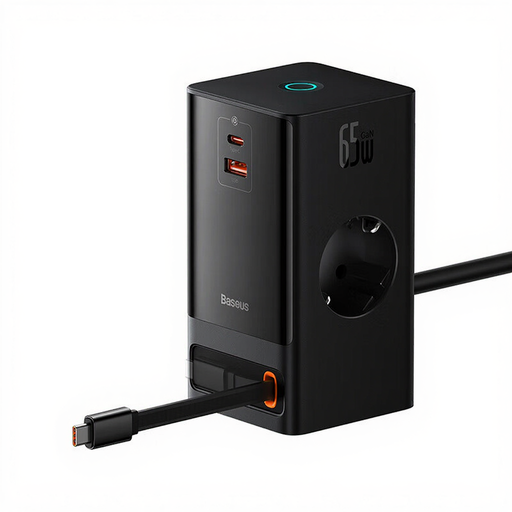
Why It Stands Out
The Baseus PowerCombo is the epitome of the modern desktop charging station. It merges a power strip, multi-port charger, and wireless charger into a design that is as compact as it is elegant. Thanks to GaN technology, it remains discreet while delivering 65W of power through its USB-C port, enough for most laptops. Its 1.5m retractable power cord is a thoughtful touch that makes storage and transport a breeze.
Key Features
Who is it for? This model is ideal for professionals, remote workers, and anyone who wants a perfectly organised desk, powering all their devices from a single point.
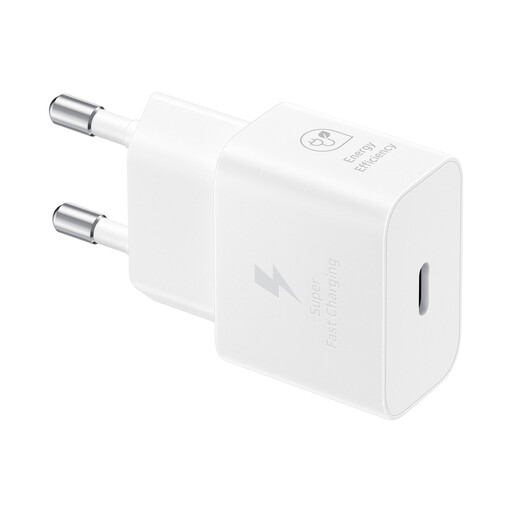
Why It Stands Out
Sometimes, simplicity is the best strategy. This official Samsung power adapter is designed to do one thing: charge your compatible devices quickly and efficiently. With a 25W output and support for PD 3.0 and Super Fast Charging (SFC) protocols, it's optimised for recent Galaxy smartphones but remains perfectly compatible with many other USB-C devices.
Key Features
Who is it for? For Samsung smartphone owners who want to take advantage of the maximum charging speed recommended by the manufacturer. It's also a reliable and affordable option for anyone looking for a compact and powerful USB-C PD charger for one device at a time.
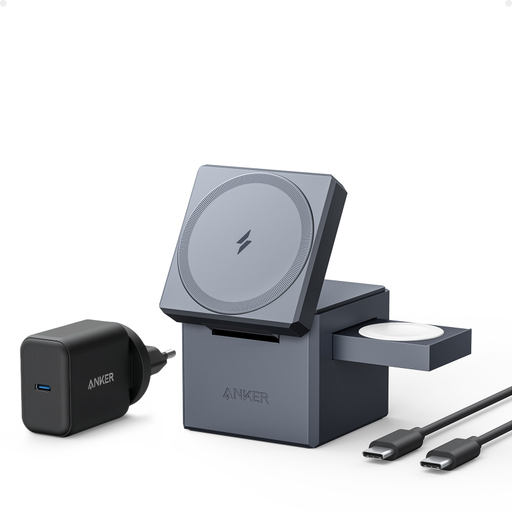
Why It Stands Out
Anker delivers a clever and ultra-compact solution for fans of the Apple ecosystem. This foldable cube is a 3-in-1 charger capable of simultaneously powering an iPhone (via MagSafe), an Apple Watch, and AirPods. Its foldable design makes it incredibly easy to carry, making it the perfect travel companion. The adjustable viewing angle for the smartphone is a real bonus for watching videos or making FaceTime calls while charging.
Key Features
Who is it for? This charger is aimed at iPhone, Apple Watch, and AirPods users looking for a minimalist and portable charging solution, whether for their nightstand or for their travels.
Our selection covers the most common use cases, but the market for charging solutions is vast. If these models don't exactly match your needs, or if you're looking for a simple wall adapter, dozens of other configurations are available.
? Explore our full range of AC adapters to find the perfect model for you.
A GaN charger uses gallium nitride, a material that is more efficient than silicon. It allows for the creation of chargers that are smaller, lighter, and generate less heat, all while being capable of delivering high power. In short, it's the technology that makes our chargers both more portable and more efficient.
The required power depends on the devices you plan to plug in simultaneously. For a single smartphone, 20-25W is sufficient. If you want to charge a laptop, aim for a USB-C PD port of at least 65W. To power multiple devices at once, add up their power requirements and choose a station with a total output higher than that sum to ensure optimal performance.
No, absolutely not. To charge a laptop via USB-C, the charger must be compatible with the Power Delivery (PD) standard and provide sufficient power (usually 45W or more). Trying to use a 20W phone charger, for example, will either not work or will charge the laptop at a snail's pace, if at all, while it's in use. Always check the power required by your laptop and the output power of the charger's USB-C port.