
Livraison le jour même ou le lendemain

Qualité garantie

Débloquez vos offres de bienvenue: Livraison GRATUITE | Jusqu'à -80 % | 30 jours d'essai gratuits à JoyPlus
Téléchargez l'application
Has your sofa become your cat's official scratching post and your chairs their makeshift perches? Giving your companion their own dedicated space is essential for their well-being—and for saving your furniture. A cat tree isn't just an accessory; it's a true vertical territory that fulfils their instinctual needs to climb, scratch, observe, and rest in complete safety.
Faced with a jungle of available models, finding the right one can quickly become a puzzle. This guide is here to shed some light and help you find the cat tree that checks all the boxes: functional, durable, and a seamless addition to your home.
Before you start, there are three criteria to consider to make the right choice and, most importantly, to make your cat happy.
The tree must be suited to your cat's size and energy level. A kitten or a small cat will be happy with a compact model, while a Maine Coon or a household with multiple cats will require a large cat tree, or even an XXL model.
Stability is non-negotiable. A stable cat tree relies on a wide, heavy base to prevent it from wobbling under the assaults of your four-legged acrobat. For the tallest towers, an anti-tip wall mounting kit is an essential safety feature that should not be overlooked.
A good cat tree is a true activity centre. Make sure it includes the following elements:
Measure your space! Determine the floor area you can dedicate to this new addition. In an apartment, a tall cat tree is a clever solution: it utilises vertical space and frees up floor space. If multiple cats live together, a model with numerous platforms and condos is crucial so that each has their own space and to prevent turf wars.
To guide you, here are three models that meet different needs, whether you live in a studio apartment or with a whole tribe of felines.

Why we love it: This model checks all the boxes. It's the perfect balance of a reasonable size, comprehensive features, and excellent stability. At 168 cm tall, it offers a great vertical play area without overwhelming the room. Its numerous activity zones make it a complete play station, ideal for one or two cats.
Pros:
Who is it for? For owners of one or more medium-sized cats looking for an "all-in-one" model: complete, durable, and well-balanced for play, scratching, and napping.
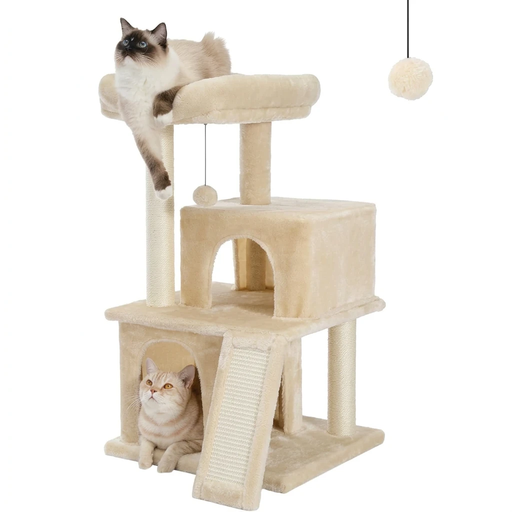
Why we love it: This model is the king of optimisation. At 90 cm high with a compact base, it fits anywhere, even in a studio apartment, without skimping on the essential features for a small feline's happiness.
Pros:
Who is it for? Perfect for owners of kittens or small cats in an apartment. It's an excellent first purchase, or an ideal secondary tree for a bedroom or office.

Why we love it: At 2.06 m, this skyscraper for cats is a true vertical amusement park. Designed for natural-born climbers and large cat families, it makes the most of your ceiling height to offer a multitude of perches where everyone can find their own space.
Pros:
Who is it for? For households with several cats, or for large cat breeds (like Maine Coons) that need space to burn off energy. Be aware, it requires a room with high ceilings.
Did none of these models catch your eye? Are you dreaming of a unique play area for your companion? The alternative is modular solutions. They allow you to combine platforms, wall-mounted scratching posts, suspension bridges, and other hammocks to create a fully customised wall-mounted adventure course.
Let your creativity run wild by exploring our selection of modules in the DIY Cat Climbing Frame category.
A little patience is key! The adjustment period can take a few days. Place the tree in a living area (the living room is ideal), a high-traffic spot where they will feel at the heart of the action. To motivate them, rub some catnip on the posts and platforms. Placing their favourite toys or a few treats on the different levels is also an excellent technique to encourage them to explore their new kingdom.
It all depends on the quality of the model and your little tiger's enthusiasm. Inspect it regularly. If the fabric is in tatters, the sisal is completely destroyed, or, more seriously, if the structure becomes wobbly, it's time to replace it or change the worn-out parts (like the posts).
Not necessarily. It all depends on their temperament, not just the number of cats. A single but very active and climbing-prone cat will be thrilled to have a tall cat tree to burn off energy. Conversely, for a more laid-back or senior cat, a medium-sized model with easy-to-access platforms will be much more suitable.