
Livraison le jour même ou le lendemain

Qualité garantie

Débloquez vos offres de bienvenue: Livraison GRATUITE | Jusqu'à -80 % | 30 jours d'essai gratuits à JoyPlus
Téléchargez l'application
If you share your home with a large cat like a Maine Coon or a Ragdoll, or with a whole tribe of boisterous felines, you know the struggle?: finding a cat tree that won’t threaten to collapse at the first pounce is a real challenge. Standard models, often designed for smaller cats, quickly prove inadequate, or even dangerous. An unstable cat tree isn't just a risk to your companion; it's also a purchase you'll soon regret.
This guide is here to help you track down the perfect cat tree for large cats. We'll go over the essential criteria for stability and comfort before presenting our selection of the best models, designed to withstand the heavyweights and multi-cat households.
Before you start shopping, let's review the details that make all the difference between a genuinely sturdy cat tree and a gimmick that won't last. Here are the key points to watch out for.
Your cat's safety is non-negotiable. A stable cat tree depends on several key factors?:
A large cat needs space—to stretch out fully, perch up high, and nap without feeling cramped.
A cat tree for multiple cats or a large breed is subjected to serious wear and tear daily. The quality of the materials is therefore a decisive factor in its longevity. A designer wooden cat tree made of solid wood will always be more durable and stable than a particleboard model. However, particleboard can be a valid option if it's well-made and properly reinforced. Finally, the sisal rope should be thick and tightly wound to survive months of relentless scratching.
Here is our selection of models that tick all the boxes for sturdiness and comfort for large cats.
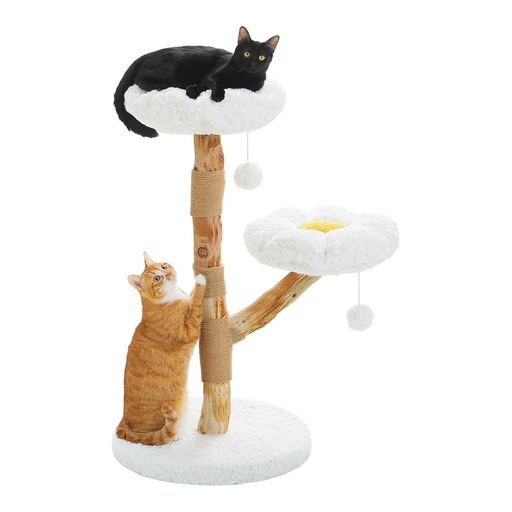
Why it stands out?: This model successfully combines a stylish design with real functionality. With its solid wood structure and two flower-shaped beds, it won't look out of place in your living room while offering cosy resting spots. Its double-reinforced base is a guarantee of stability.
Pros?:
Who is it for?? Ideal for owners of one or two large cats (up to 7?kg) who want a designer wooden cat tree that is as beautiful as it is practical.

Why it stands out?: Standing 168?cm tall with 5 levels, this cat tower for multiple cats is a true vertical playground. It's designed to satisfy climbing enthusiasts and can accommodate up to 6 cats at once, according to the manufacturer.
Pros?:
Who is it for?? Perfect for multi-cat households or for very active felines who need maximum space to climb, play, and rest.
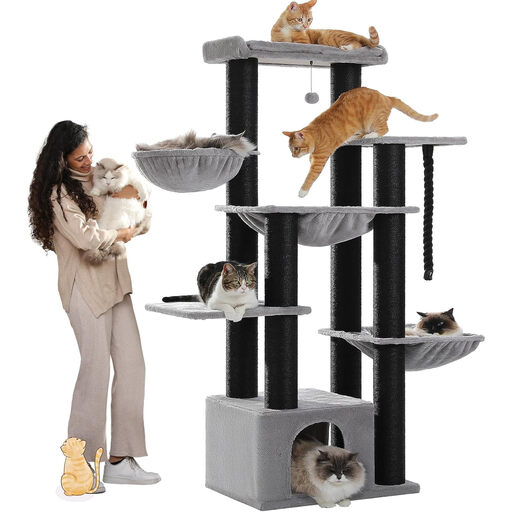
Why it stands out?: Here, the key word is sturdiness. With its 13 scratching posts measuring 11?cm in diameter, this model is built to withstand the power of the largest cats. It's an XXL cat tree that prioritises stability above all else.
Pros?:
Who is it for?? The number one choice for owners of very large cat breeds (Maine Coon, Norwegian Forest Cat, Ragdoll) for whom sturdiness and safety are non-negotiable criteria.
Did none of these models catch your eye?? If you're looking for a different style or want to explore other possibilities, take a look at our full range. You'll discover a wider variety of structures, including models designed for outdoor use.
Discover our selection of Outdoor Cat Posts
There's no single answer. A tall scratching post of at least 90?cm is a good starting point to allow a large cat to get a full-body stretch. For climbing enthusiasts, a tower of 150?cm or more will provide an excellent observation perch. The most important thing is that the structure is perfectly stable, regardless of its height.
Look at the ratio of height to base width?: the wider the base, the more stable the tree will be. Also, check the total weight of the structure (the heavier, the better) and the diameter of the posts. The inclusion of a wall-mounting kit is a real bonus, especially for the tallest models.
A cat tree for a Maine Coon must, above all, be an XXL and ultra-sturdy model. Prioritise structures with a very heavy base, posts with a diameter greater than 10?cm, and resting platforms wider than 45?cm. The hammocks and condos should also be oversized for their comfort. For this powerful breed, the overall sturdiness of the unit is the number one criterion.