
Livraison le jour même ou le lendemain

Qualité garantie

Débloquez vos offres de bienvenue: Livraison GRATUITE | Jusqu'à -80 % | 30 jours d'essai gratuits à JoyPlus
Téléchargez l'application
Does your cat treat your curtains like a Tarzan vine and your brand-new sofa like a giant scratching post? While this behaviour is completely natural, it can test your patience (and your furniture). Far from being a mere gimmick, a cat tree is an essential territory for an indoor cat's well-being. It provides an observation post, a napping spot, a gym, and most importantly, a dedicated surface for maintaining their claws.
But with a jungle of available models, finding the perfect one for your home and your companion can quickly become a headache. This guide is here to help you navigate the options and make the right choice.
Before diving into our selection, let's review the key points to ensure you make the right decision.
The tree's size should suit your home as well as your cat's build and temperament.
Stability is paramount for your pet's safety. A stable cat tree relies on a wide, heavy base. For the tallest models, an anti-tip wall anchor kit is an essential safety feature that should never be overlooked.
The lifespan of the tree and the interest it holds for your cat depend directly on its materials. The natural sisal scratching post is the gold standard. This sturdy fibre withstands repeated clawing and satisfies your cat's natural instincts. As for the plush covering, it should be as soft for comfort as it is durable.
A good cat tree is a multi-level structure that ideally combines several functions:
Gone are the days of unsightly structures that clashed with your living room! Today, there is a multitude of designer cat trees. With their neutral colours (grey, beige, cream) and clean lines, they blend seamlessly into most interiors.
To guide you, we have selected three models that cater to different needs and budgets.
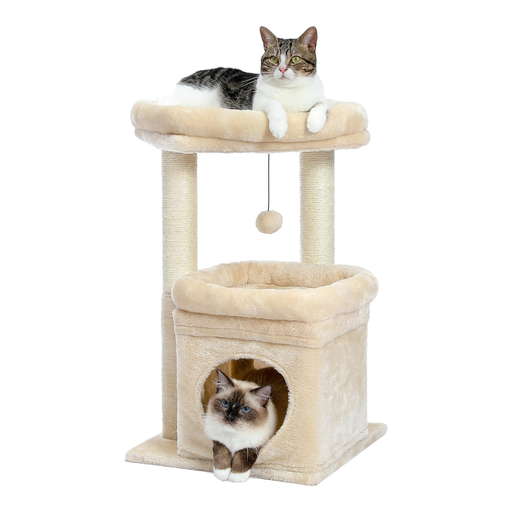
Why it stands out: It's the perfect solution for small spaces. It packs maximum functionality into a minimal floor footprint.
Pros:
Who is it for? Ideal for owners of kittens or a single adult cat living in a studio or apartment. It's an excellent first purchase to teach them proper scratching etiquette.

Why it stands out: This model offers an excellent balance of height, features, and stability. It's a versatile and reliable choice that will suit most households with one or more cats.
Pros:
Who is it for? For households with one or more active cats who love to climb and perch up high. The variety of its rest and play areas makes it a true feline amusement park.

Why it stands out: A true skyscraper for cats, this XXL model is the ultimate structure for felines who need maximum space to explore, climb, and burn off energy.
Pros:
Who is it for? The dream solution for owners of multiple cats, large breeds (like Maine Coons), or simply for those who want to give their four-legged companion a true palace.
Our selection covers the most common needs, but every cat and every home is unique. To explore more options, even more stylish designs, or different configurations, feel free to browse our full catalogue.
Discover our complete collection of cat trees to find the perfect structure.
The ideal height depends on your cat's age and agility, as well as the space you have available. A model around 1 metre high can be sufficient for a kitten or an older cat. For an energetic adult cat, aim for at least 1.50 metres so they can truly climb and survey their territory.
To help your cat adopt their new headquarters, place it in a living area (like the living room), ideally near a window. The foolproof trick? Rub a little catnip on the sisal posts, or place their favourite toys and a few treats on the platforms to encourage them to explore.
Above all, don't isolate it in a corner or a room where nothing ever happens. Cats are social animals who like to keep an eye on the household's activity. The ideal spot is often in the living room, near a large window. This allows them to watch what's happening outside while feeling at the heart of family life.