
Livraison le jour même ou le lendemain

Qualité garantie

Débloquez vos offres de bienvenue: Livraison GRATUITE | Jusqu'à -80 % | 30 jours d'essai gratuits à JoyPlus
Téléchargez l'application
The right brush pen can transform an illustration, bring a creative journal page to life, or elevate your calligraphy. But with a vast world of nibs, inks, and colour palettes, choosing the right set can quickly become a daunting task. Whether you're a beginner artist, a seasoned illustrator, or a crafting enthusiast, finding the tool that truly fits your practice is essential.
This guide is here to provide some clarity. We'll review the essential selection criteria before unveiling our favourite products to help you make the right choice for your creative projects.
Before diving into our selection, here are a few points to keep in mind to find the perfect brush pen for you.
The choice of ink is crucial: it determines the final look of your creations.
The nib is the heart of the brush pen. Its flexibility determines your ability to vary line thickness by modulating pressure.
The nib material (felt, nylon fibre, etc.) also affects its longevity and responsiveness.
Your project dictates the necessary colour palette. A set of 12 vintage colours will be perfect for a journal, while a professional drawing pen will require a much wider range of 24, 36, or more colours for complex illustrations. Consider the harmony of the colours offered and their relevance to your style.
Here are our recommendations, each catering to specific needs, from beginner lettering to professional illustration.
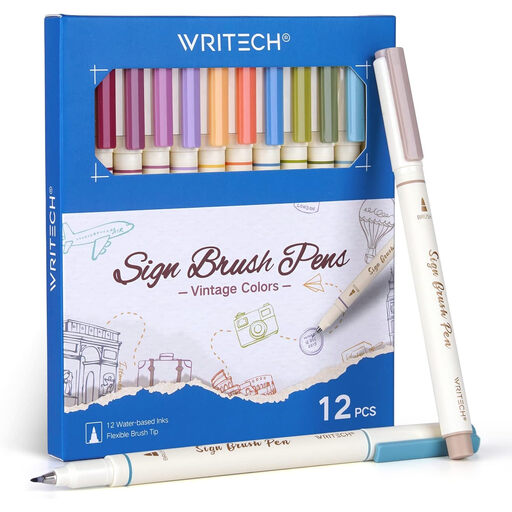
Why it stands out: This set is distinguished by its vintage colour palette, which brings a touch of originality and softness to your creations. Its flexible, pressure-sensitive brush tip is perfect for getting started with line variation.
Key features:
Who is it for? This set is an excellent entry point for beginners in calligraphy pens and lettering, as well as for crafting enthusiasts looking for a colour palette that stands out from the ordinary.
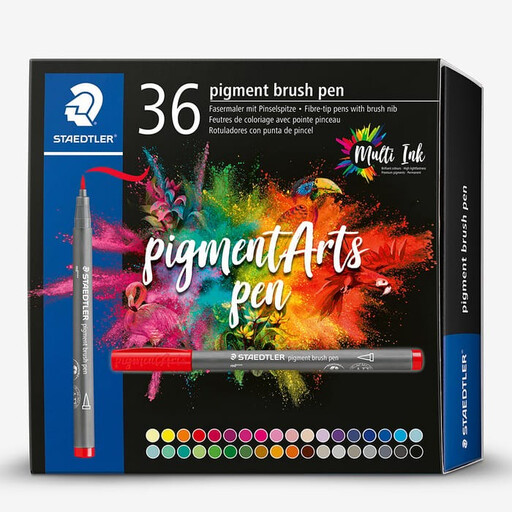
Why it stands out: The STAEDTLER 371 set is designed for artists who value longevity. Its high-quality pigmented ink is water- and light-resistant, ensuring your artwork stands the test of time.
Key features:
Who is it for? This brush marker is primarily aimed at illustrators, comic artists, and artists who need archival-quality ink for their professional projects.
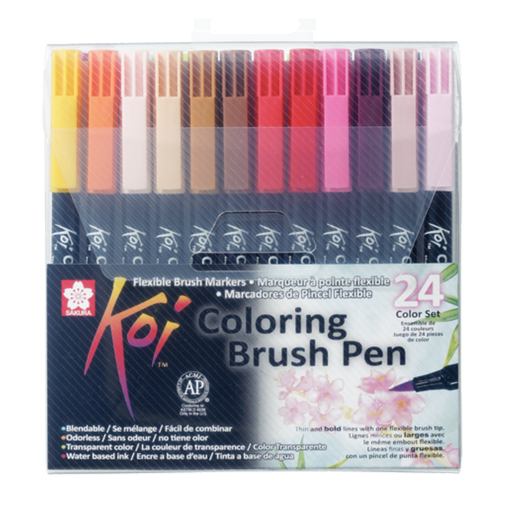
Why it stands out: The SAKURA Koi range is renowned for its ability to produce watercolour effects with the simplicity of a pen. The water-based ink is specially formulated to blend smoothly.
Key features:
Who is it for? For artists who love mixed media, illustrators, and colouring enthusiasts who want to achieve a watercolour look without taking out brushes and paint pans.
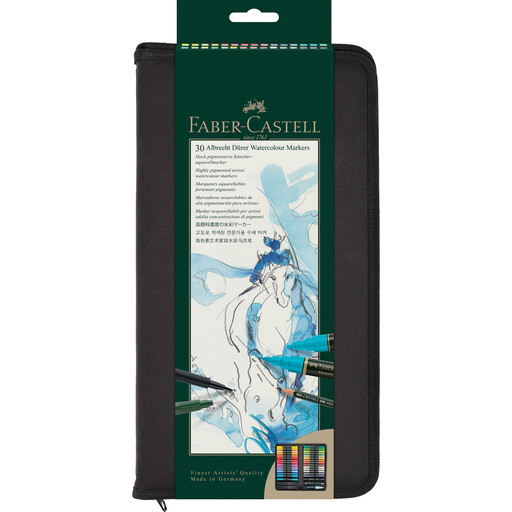
Why it stands out: This set from Faber-Castell combines versatility with professional quality. Each marker features a dual tip: a brush tip for gestural strokes and a fine tip for precise details.
Key features:
Who is it for? The ultimate professional drawing pen, intended for artists, designers, and illustrators who demand a versatile, high-quality tool for both studio and outdoor work.
This selection is just a glimpse of the possibilities that brush pens offer. If your project requires a different tool or if you simply want to explore other options, our range of drawing supplies is here for you.
To discover other models, explore our complete collection of thick sketch pens.
To preserve the nib's flexibility and shape, use smooth paper (like Bristol board or special marker paper). Avoid paper with too much tooth, which can cause it to fray. Also, remember to always cap the pen tightly after use and, if possible, store your pens horizontally to ensure the ink is distributed evenly.
The choice of paper has a direct impact on the result. For water-based pens used for watercolour effects, watercolour paper (cold or hot press) is highly recommended to prevent the sheet from buckling. For lettering or illustration without adding water, a smooth, thick paper (over 100 gsm) will prevent the ink from bleeding through.
The main difference lies in the ink base. The brush pen typically uses a water-based ink, which is layerable and can be blended with water. An alcohol marker, on the other hand, uses an ink that dries very quickly and allows for creating very uniform fields of colour and streak-free gradients, but it tends to bleed through standard paper. The two tools are therefore complementary and meet different artistic needs.