
Livraison le jour même ou le lendemain

Qualité garantie

Débloquez vos offres de bienvenue: Livraison GRATUITE | Jusqu'à -80 % | 30 jours d'essai gratuits à JoyPlus
Téléchargez l'application
The brush pen has become a go-to tool for artists, lettering experts, and crafting enthusiasts. As a perfect blend of a paintbrush's flexibility and a marker's simplicity, it opens up a world of creative possibilities. But there's a catch: the market is flooded with options, and not all of them live up to their promises. Between a tip that frays after just a few strokes and ink that bleeds right through your notebook page, it's all too easy to make the wrong purchase.
As a product expert for our editorial team, my mission is to help you see things more clearly. Let's cut through the marketing jargon and focus on what really matters. Here are the common traps to avoid and the key features to check to find that perfect set of brush pens for your projects.
To avoid these issues, there are a few technical points to inspect. They account for 90% of your user experience.
This is the number one criterion, as it determines the full potential of your markers.
The quality of the tip is non-negotiable. It must be flexible enough to modulate line thickness (for those classic thick and thin strokes) yet resilient enough to snap back to its original shape instantly.
The good news is that many models are available as a dual-tip marker:
This 2-in-1 design is incredibly practical: no more juggling multiple pens, and you're guaranteed a perfect color match.
An artist marker set with 100 colors is tempting, but not always necessary. For lettering or bullet journaling, a well-curated palette of 12 to 24 colors is often more practical and easier to manage. For illustration or coloring, a wider range allows for more subtle shading and transitions. The most important thing is that the colors are vibrant and, of course, blendable if you choose a water-based ink.
Instead of an exhaustive list, here are our recommended options for different user profiles, based on the objective criteria we've just outlined.
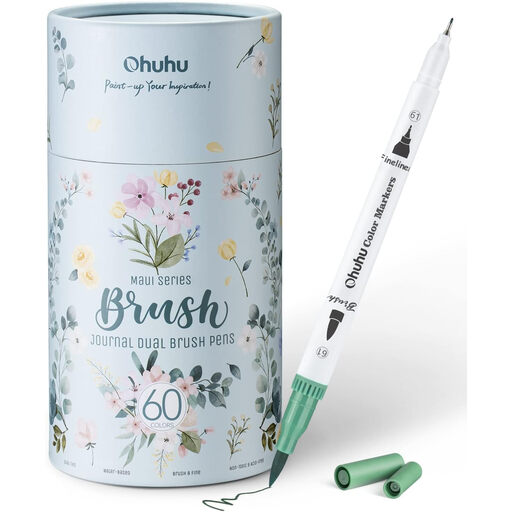
Why we love it: Ideal for exploring a multitude of techniques without breaking the bank. Its wide 60-color palette and dual tip (brush and fine) make it an ultra-versatile tool for drawing, coloring, or getting started with lettering.
Its water-based ink is designed to be blendable, solving the problem of colors that don't mix. The dual tip also saves you from buying two separate sets.
Unbeatable value for money for beginners. The set even includes replacement tips—a clever detail that extends the life of the markers.
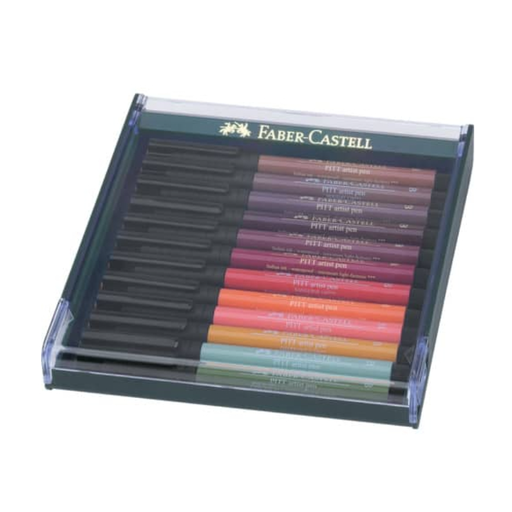
Why we love it: For artists creating work meant to stand the test of time. Its pigmented India ink is water-resistant and lightfast, ensuring perfect color preservation. An absolute benchmark for professional inking and illustration.
Its fiber tip is renowned for its durability and ability to hold its shape. The pigment-based ink won't bleed through drawing paper or smudge when exposed to water once dry.
Archival quality. Its acid-free, pH-neutral ink prevents paper from yellowing and ensures the longevity of your creations.
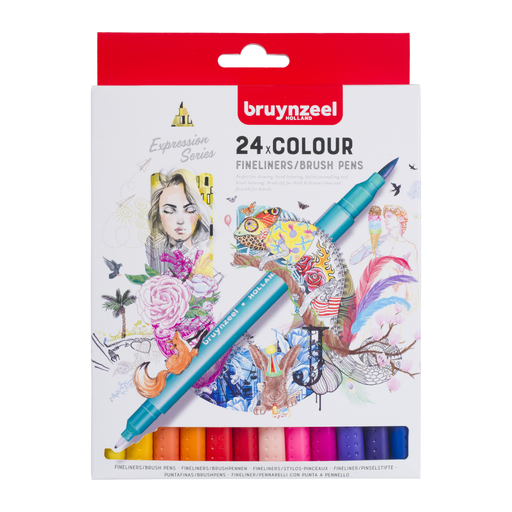
Why we love it: Its dual-tip design (brush + 0.4 mm fine tip) is perfectly tailored for *bullet journaling*: create decorative titles, write fine notes, and fill in trackers and layouts, all with a single pen.
Its water-based ink is formulated to prevent bleeding through notebook pages. The sturdy 0.4 mm fine tip is designed for writing and precise lines without flattening.
The perfect combo for journaling. The 24-color palette is rich enough for organizing and decorating while remaining easy to manage.
We've curated a complete selection of products that meet our quality criteria and industry standards.
The golden rule: always recap your pens tightly right after use, until you hear that satisfying "click." Also, be sure to store them horizontally. This allows the ink to distribute evenly between both tips instead of pooling at one end.
Water-based ink contains dissolved dyes. It's ideal for blending and watercolor effects but remains water-soluble even after drying. Pigment-based ink, on the other hand, contains solid, fine color particles. Once dry, it forms a permanent layer on the paper that is resistant to water and light, making it much more durable.
For a watercolor brush pen, a fine-grain or "mixed media" paper of at least 180 gsm is recommended. It will handle moisture without buckling or tearing. For pigment-based inks or for use in a bullet journal, a smooth, thick paper (over 100 gsm) is preferable. It will minimize ghosting (where the ink is visible through the page) and bleeding (where the ink soaks through the page).