
Livraison le jour même ou le lendemain

Qualité garantie

Débloquez vos offres de bienvenue: Livraison GRATUITE | Jusqu'à -80 % | 30 jours d'essai gratuits à JoyPlus
Téléchargez l'application
Every cyclist's dilemma: where and how to store your ride so it's secure, without sacrificing half of your living room or garage? A good bike floor stand is often the perfect solution. The problem? The market is a jungle where models that look great on paper often prove disappointing in practice.
This guide is here to help you see things clearly, avoid the common pitfalls, and make the right choice the first time.
Before we get into the technical details, let's review the deal-breakers that plague most entry-level models.
For a successful and long-lasting purchase, three technical criteria make all the difference. They are what separate a useless gadget from a true everyday ally.
Stability is the non-negotiable criterion. It rests on two pillars:
The stand should adapt to your bike, not the other way around. The secret? The adjustable wheel slot width. A quality stand must be a true chameleon, able to accommodate everything from the thin tyres of a road bike (from 26?mm) to the chunky rubber of a mountain bike (up to 50?mm and more). This versatility is the guarantee of a long-lasting investment: your stand will adapt with you, even if you change bikes.
For a no-drill bike stand, protection is twofold: for the bike and for your floor.
Rather than just listing products, we've matched specific solutions to real-world needs.

Why we chose it: The perfect solution for storing your bike in an apartment or garage without drilling any holes. Stable, versatile (road, MTB, e-bike), and discreet, it checks all the boxes for smart storage.
Its modular, high-strength ABS design ensures a wide, stable base. The width is adjustable (from 30 to 50 mm) for true versatility, and its four EPS foam pads protect even the most delicate floors.
Ultra-fast assembly and disassembly (3 steps, no tools required), making it easy to store or take with you. Its feather-light weight (approx. 1.1 kg) allows for effortless repositioning.
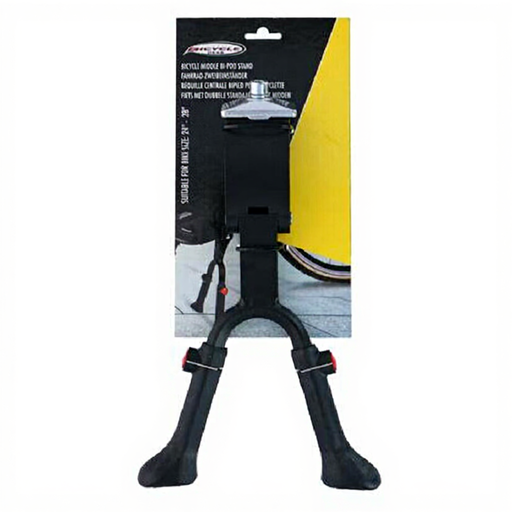
Why we chose it: Note that this isn't a storage stand, but a kickstand that mounts directly to the frame. It's the ideal tool for mechanics (amateur or pro) who need to stabilise their bike for maintenance, as it elevates the rear wheel.
There's no risk of instability here: the kickstand provides central support and rock-solid stability. Once deployed on a flat surface, its double-leg design anchors the bike and eliminates any chance of it tipping over.
Perfect stability for any mechanical work. Its length is adjustable to fit 24" to 28" bikes, and it supports a load of up to 30 kg.
We've curated a full range of products that meet our standards for quality and safety.
Yes, provided you choose the right model. For an e-bike, stability is the number one criterion. Look for stands with a wide base, made from robust materials (steel or reinforced ABS), and with a clearly specified load capacity. Models where the wheel sits deep in the cradle offer superior support for heavy bikes.
This is THE crucial point to check before you buy. To do so, you must opt for a model with an adjustable cradle width. Entry-level stands often have a fixed slot that only fits one type of tyre. A good stand should clearly state its compatibility range, for example, from 26?mm (road) to over 50?mm (MTB).
The rule of thumb is simple: never buy a stand that isn't equipped with protective pads at its points of contact with the floor. Ideally, look for pads made of soft rubber or dense foam (like EPS). It may seem like a minor detail, but it's non-negotiable for keeping your floors pristine, especially with apartment bike storage.